How to Read a Bangkok Street Food Menu: Thai Names, Common Dishes, and Smart Ordering Tips
Decode a Bangkok street food menu fast—Thai dish names, flavors, prices, where to find them, and how to order like a local without melting down.
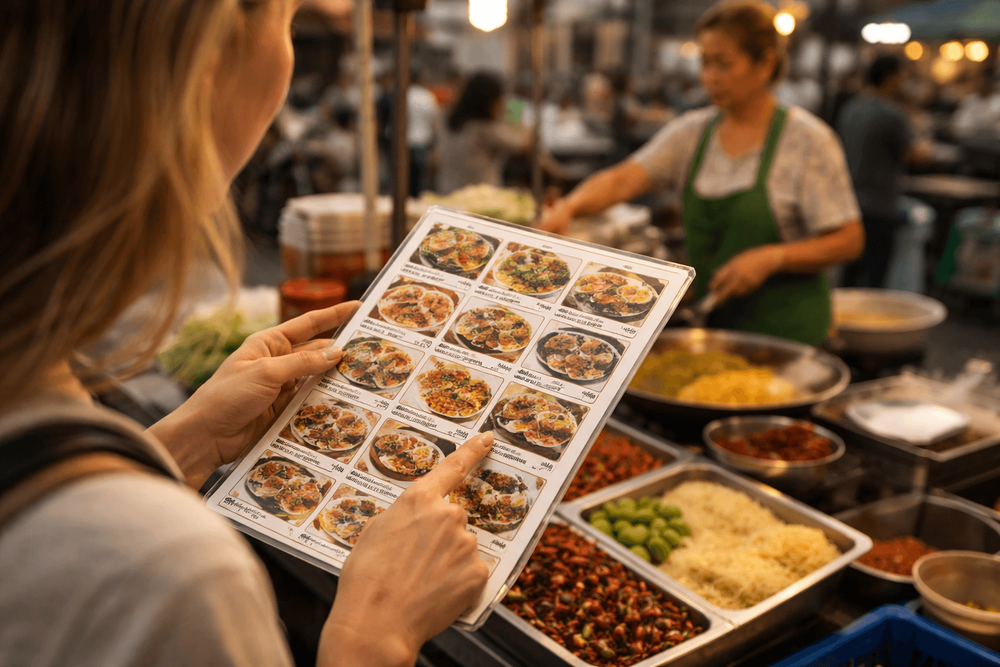
We’re squinting at a steam-fogged plexiglass board on Soi Rambuttri, trying to decode squiggles of Thai while a wok hisses like summer rain. The auntie points a metal ladle at us, we point at noodles, and ten glorious minutes later a perfect bowl lands on a plastic table. A Bangkok street food menu can look chaotic, but once we learn a few cues, we order like locals—and eat better for it.
Data Freshness + Pricing:
- Prices are approximate and in THB.
- Last checked: June 2026.
- Happy hour and promo details change frequently—confirm locally.
How to read a Bangkok street food menu (and not panic)
Let’s get the basics down so a Bangkok street food menu stops feeling like a riddle.
The quick dictionary you actually need
- Proteins: moo (pork), gai (chicken), nua (beef), pla (fish), kung (shrimp), talay (seafood), kai (egg)
- Noodles: sen yai (wide rice), sen lek (thin rice), sen mee (vermicelli), ba mee (egg noodles), mama (instant noodles)
- Rice: khao (rice), khao pad (fried rice), khao man (oily, “Hainanese” rice)
- Broth styles: tom yum (sour-spicy), nam sai (clear), nam tok (dark, beefy, often with blood)
- Cooking verbs: pad (stir-fry), tom (boil), tod (deep-fry), yang (grill), toon (braise)
Customizing your order like a pro
- Spicy levels: mai phet (not spicy), phet nit noi (a little spicy), phet mak (very spicy)
- Add-ons: khai dao (fried egg), piset (extra/large), sai pak yer-yer (load it with veg)
- No/avoid: mai sai (don’t add), mai sai nam pla (no fish sauce), mai sai tua (no peanuts)
Numbers and sizes
- 1 = nueng, 2 = song, 3 = sam. “Song jang, krap/ka” gets us two orders fast.
- Small vs large: tamada (regular) vs piset (special/large). Expect +20–40 THB approx. for piset.
How stalls work
- Noodle shops often give a paper ticket—pay after eating. Grill carts take cash/QR upfront. If there’s no menu, point at ingredients in the glass cabinet and say the style: “pad kra pao moo, khai dao, phet nit noi.”
Popular Bangkok street food dishes and what’s inside
Here’s what we’re actually pointing at—and what arrives on the plate.
Pad Thai (ผัดไทย)
Rice noodles tossed in a tamarind-palm sugar sauce, egg, tofu, garlic chives, beansprouts. Usually with shrimp (kung) or chicken (gai). A wedge of lime, pile of crushed peanuts on the side. Expect approx. 60–100 THB street-side; big seafood versions run 120–180 THB.
Pad Kra Pao (ผัดกะเพรา)
Chopped meat—moo or gai—scorched with holy basil, garlic, and bird’s-eye chilies. Served over rice with a runny fried egg (khai dao) is mandatory as far as we’re concerned. Spicy by default. Approx. 60–90 THB; add egg +10–15 THB.
Kuaitiao Ruea (Boat Noodles, ก๋วยเตี๋ยวเรือ)
Tiny bowls, big flavor. Dark, aromatic broth (often beefy, sometimes with pig’s blood), with your choice of noodles and cuts. Traditionally 15–25 THB per mini-bowl; we stack 3–5. Some shops also do large bowls for 60–90 THB.
Tom Yum Noodles (ก๋วยเตี๋ยวต้มยำ)
All the tom yum flavors—lime, chili, sugar, peanuts—on noodles. Dry (haeng) or with broth (nam). Shrimp or fish balls common. Approx. 60–90 THB.
Som Tam (ส้มตำ)
Pounded green papaya salad. Styles vary: Thai (sour-sweet), Lao/Isan (funkier, fishy), with salted egg (kai kem) or pickled crab (poo). Spice creeps up fast—say “phet nit noi.” Approx. 50–80 THB; with extras 80–120 THB.
Khao Man Gai (ข้าวมันไก่)
Poached chicken on garlicky rice, with gingery-soy dipping sauce and a bowl of clear broth. Comfort in a plate. Approx. 50–80 THB; “piset” extra chicken +20–30 THB.
Khao Kha Moo (ข้าวขาหมู)
Soy-braised pork leg over rice, pickled mustard greens, boiled egg. Unctuous, sweet-salty, perfumed with star anise. Approx. 60–90 THB.
Moo Ping (หมูปิ้ง) & Sticky Rice (ข้าวเหนียว)
Palm-sugary grilled pork skewers, smoky and glossy, plus a warm fist of sticky rice. Skewers are approx. 15–25 THB each; rice 10–20 THB.
Gai Yang (ไก่ย่าง) & Som Tam Combo
Isan-style grilled chicken, charred skin, juicy thighs, served with jaew (tamarind-chili dip) and sticky rice. Portions 80–150 THB; half/whole birds cost more.
Sai Krok Isan (ไส้กรอกอีสาน)
Fermented pork sausage with a tang, grilled and served with ginger, chilies, cabbage. Snack-size links approx. 20–30 THB each; skewers 30–50 THB.
Khao Pad (ข้าวผัด)
Thai fried rice—garlicky, a little smoky. Moo, gai, or talay. We squeeze lime, add prik nam pla (chilies in fish sauce). Approx. 60–90 THB.
Rad Na / Pad See Ew (ราดหน้า / ผัดซีอิ๊ว)
- Rad Na: wide noodles under a glossy gravy with Chinese broccoli and meat. 60–90 THB.
- Pad See Ew: wide noodles, soy-sweet, seared with egg and greens. 60–90 THB.
Guay Jub (ก๋วยจั๊บ)
Peppery rolled rice noodles in a porky broth with crispy pork belly, offal optional. Wakes the sinuses. Approx. 70–100 THB.
Jok / Khao Tom (โจ๊ก / ข้าวต้ม)
Breakfast champions. Jok is silky rice porridge; khao tom is rice-in-broth with ginger and meatballs. 40–70 THB mornings, a bit more late night.
Khanom Krok (ขนมครก)
Coconut-rice pancakes, crisp-edged, custardy centers. Sold by the half-dozen, approx. 30–50 THB.
Mango Sticky Rice (ข้าวเหนียวมะม่วง)
Ripe mango, coconut cream, salted-sweet sticky rice. Seasonal price swings—approx. 80–150 THB.
Roti (โรตี)
Flaky griddled flatbread—egg roti with condensed milk, or banana-chocolate at 1 a.m. 40–80 THB depending on stuffing.
Key flavors, ingredients, and spice levels
Thai street food is all about balance—sour, salty, sweet, spicy—plus texture.
- Sour: lime, tamarind (pad thai, tom yum)
- Salty/umami: fish sauce (nam pla), soy sauce, fermented fish (pla ra in Isan dishes)
- Sweet: palm sugar, condensed milk (hello, cha yen—Thai iced tea)
- Heat: fresh chilies, chili flakes, chili vinegar
- Crunch vs soft: pork crackling in guay jub, crisp beansprouts over soft noodles
Spice reality check: “Not spicy” (mai phet) still might tingle; “a little spicy” (phet nit noi) usually lands nicely. Condiment trays let us tune the bowl—add lime for lift, vinegar-chili for tang, sugar for balance, and chilies for a kick. If there’s prik nam pla on the table, we’re home.
Where to find the most common street food items
Bangkok spreads its sanuk—its fun—across neighborhoods. Here’s where we go when cravings hit.
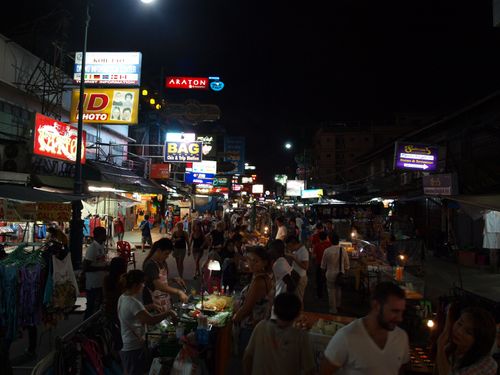
Khao San Road, Soi Rambuttri, Phra Athit
- What to eat: late-night pad thai, roti, moo ping, cheap beers, fruit shakes.
- Why: backpacker chaos, neon, thump of bass—open late. Rambuttri is a shade calmer; Phra Athit has chilled cafes and reliable rice-and-curry shops.
- Getting there: Chao Phraya Express Boat to Phra Arthit Pier (N13), or taxi. BTS/MRT don’t reach Banglamphu directly.
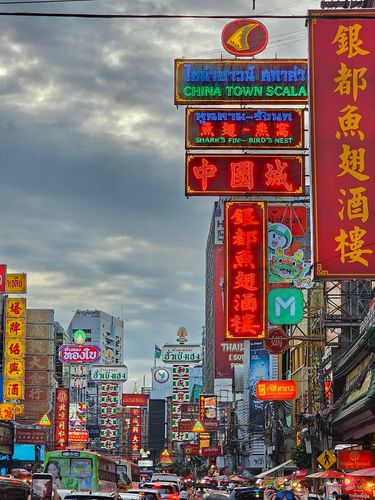
Chinatown (Yaowarat Road)
- What to eat: peppery guay jub, dim sum, oyster omelets (hoy tod), mango sticky rice, endless skewers.
- Why: Nightly street theater—woks roaring, dragons of steam, gold shop neon. Peak 6–10 p.m.
- Getting there: MRT Wat Mangkon; walk to Yaowarat.
Victory Monument
- What to eat: boat noodles—alley clusters serving tiny bowls; also fried chicken and Isan snacks.
- Getting there: BTS Victory Monument; walk the khlong-side alleys under the expressway.
Wang Lang Market (Siriraj)
- What to eat: curry-on-rice (khao gaeng), khanom krok, grilled pork, Thai desserts.
- Why: Lunchtime local crush across the river from the Grand Palace.
- Getting there: Chao Phraya Express Boat to Wang Lang (N10).
Chatuchak & Or Tor Kor
- What to eat: weekend market snacks—coconut ice cream, moo yang, noodle bowls. Or Tor Kor (across the road) has pristine produce and food stalls.
- Getting there: MRT Kamphaeng Phet / Chatuchak Park; BTS Mo Chit.
Charoen Krung & Bang Rak
- What to eat: old-school rice porridge, fish ball noodles, roast duck, Chinese-Thai institutions.
- Getting there: BTS Saphan Taksin; stroll up Charoen Krung toward Silom.
Neighborhood lanes to wander
- Phetchaburi Soi 5 (after work), Ari Soi 1 (evenings), Talat Phlu (grills and sweets). If in doubt, follow the smoke and the queue.
after-dark grazing Bangkok Street Food Night Market Guide: Best Stalls, Hours, and What to Order.
Typical prices, portion sizes, and what’s good value
Street food still stretches a baht beautifully if we know the benchmarks.
- Noodle bowls: approx. 60–100 THB (premium seafood 120–180 THB)
- Rice plates (pad kra pao, khao pad): approx. 60–90 THB; fried egg +10–15 THB
- Grilled skewers: approx. 15–25 THB per moo ping; sausage 20–30 THB
- Som tam + grilled chicken + sticky rice set for two: approx. 180–320 THB
- Desserts/snacks (khanom krok, roti): approx. 30–80 THB
- Drinks: water 15–25 THB, Coke 25–40 THB, Thai iced tea 40–60 THB, fresh pomegranate juice 60–100 THB
Signs of value:
- Crowds of locals at peak meal times
- Posted prices (Thai numerals are easy: ๐-0, ๑-1, ๒-2, ๓-3, ๔-4, ๕-5, ๖-6, ๗-7, ๘-8, ๙-9)
- Hot, made-to-order dishes and high turnover on ingredients
budgeting your feast Bangkok Street Food by Budget: What to Eat for 50, 100, and 200 Baht.
Tips for ordering, dietary considerations, and first-timer must-tries
We’ve learned these the salty-sweaty way—so you don’t have to.
Ordering hacks
- Point + speak: Point at the ingredient, say the style. “Pad kra pao moo, khai dao, phet nit noi.”
- Dry vs soup: “Haeng” (dry, tossed) or “nam” (with broth) for noodles.
- Takeaway magic: “Sai toong” gets it bagged; you’ll get soup in a floating plastic bag like a goldfish prize.
- Payment: Cash rules; bring small bills. Some stalls accept Thai QR (PromptPay), but tourists may not have it.
- Queue etiquette: Put in your order, grab a table, and chill. The wok knows your place in line.
Cleanliness and safety
- Follow the crowds. High turnover beats a lonely pot.
- Eat it hot. Reheated or lukewarm curry? We skip it.
- Allergies: Learn “phom/chan phae …” (I’m allergic to …). Peanuts (tua lisong), shellfish (a-han talay), soy (see ew), egg (kai). When in doubt, avoid sauces.
Dietary considerations
- Vegetarian: Say “mangsawirat” for vegetarian; “jay” is stricter (Buddhist veganish—no meat/fish/egg/strong aromatics). Pad thai jay, pad see ew jay, and som tam Thai without fish sauce are common.
- Vegan: Ask for “jay,” plus “mai sai khai/nam pla” (no egg/fish sauce). Rice-and-veg curry shops (khao gaeng) often have plant-based options.
- Halal: Look for halal signage in Muslim neighborhoods and markets; plenty of chicken/fish options citywide.
- Gluten-free: Rice noodles and jasmine rice are your friends; watch soy sauce, oyster sauce, and fish balls/baked items.
deeper advice Bangkok Street Food for Diets: Vegetarian, Halal, and Gluten-Free Options.
Smart spice management
- Start with phet nit noi and adjust with the condiment tray.
- For som tam, specify “mai sai prik” (no chilies) or “neung met prik” (one chili) if you’re cautious.
First-timer must-try list (strategic edition)
- Breakfast near a wet market: jok with soft-boiled egg, plus a bag of hot soy milk (nam tao hu). Cheap, gentle, filling.
- Lunch near Victory Monument: stack 3–5 boat noodle bowls till the empty towers make you grin.
- Evening in Yaowarat: peppery guay jub and a shared oyster omelet.
- Late-night around Khao San/Rambuttri: pad kra pao moo with a sunset-orange egg yolk and a side of moo ping.
- Sweet finish: Khanom krok eaten off a banana leaf while the city hums.
New to Bangkok’s food scene? This primer pairs nicely with our street-eating 101: Bangkok Street Food for First-Time Visitors: What to Order, How to Eat, and Where to Go Beyond Khao San Road.
Know before you go: tiny things that change everything
- Heat strategy: Eat early/late. Midday woks and Bangkok sun will melt your resolve.
- Hydration: Grab water from 7-Eleven (blessed AC blast) or order nam keng (ice) with your drink.
- Napkins are a myth: Pack tissues or wet wipes.
- Clothes: Light, breathable. Smoke clings; your shirt will tell stories.
- Trash & respect: Use bins, bus your table; a little “khop khun krap/ka” goes a long way.
- Transport: Chao Phraya boats for riverside markets; BTS/MRT for everywhere else. Tuk-tuks are fun but agree the fare first.
- Rain plan: Vendors throw up tarps fast, but puddles get wild. Sandals that don’t fear a flood are your friend.
Putting it all together on the street
We roll up to a cart on Phra Athit Road. The wok sputters, basil hits hot oil and perfumes the soi. We spot chopped pork in the case and say it clean: “Pad kra pao moo, khai dao, phet nit noi.” The auntie nods, we claim a wobbly table, and the fan tick-tick-ticks overhead. Five minutes later, rice, holy basil, runny egg, and a tiny dish of prik nam pla. We splash, we mix, we grin. That’s the whole game—learn a few words, read the signals, and let Bangkok feed us right.
If you want to map a whole eating day by time and crave level, this playbook helps too: Bangkok Street Food by Meal Time: Best Breakfast, Lunch, Dinner & Late-Night Stalls for Travelers.
When the last skewer is gone and the chili buzz fades, we like to crash somewhere near the river or Banglamphu so breakfast is a stroll away—an easy roll from roti on Rambuttri to porridge by the khlong. Tomorrow, we chase boat noodles at Victory Monument and mangoes at Wang Lang; meet us by the wok.
Related Hotels & Places
Khao San Road
Attractions
Bangkok’s backpacker carnival: curbside bars, live bands and DJs from 3pm–2am (midnight Sun). Street eats are cheap — pad thai 70–100 THB, mango sticky rice 60–100 THB. Come for wild people-watching; duck into Rambuttri for a calmer beer.
Rambuttri
Markets
Khao San’s calmer cousin: a tree‑shaded lane of VW van cocktail bars, open‑air foot massages, pad thai grills, and easygoing live bands. Best from sunset to 11pm; beers 80–120 THB, cocktails 150–220 THB. One block from the chaos, all the charm.

Khaosan Station
Hotels
At Khaosan Station, exceptional service and top-notch amenities create a memorable experience for guests.Complimentary internet access is available in the hostel to ensure you stay connected during your visit. Continuously receive the support you require through front desk amenities such as luggage
Chinatown Bangkok (Yaowarat)
Attractions
Neon, woks, and queues: Yaowarat is Bangkok’s street‑food strip. Start at Wat Mangkon MRT, graze T&K Seafood and Nai Ek’s peppery guay jub, snag toasted buns, and finish with mango sago at Sweet Time. Best 6pm–late; ~10‑minute taxi from Khao San.
More Khao San Road Guides
- How to Order Street Food in Bangkok: Thai Menu Words, Queue Etiquette, and Stall-Side Customs
- Bangkok Street Food Order Guide: Thai Names, English Meanings, and Easy Phrases for First-Time Travelers Near Khao San Road
- How to Order Street Food in Bangkok: Menu Signs, Spicy Levels, Pay Methods, and Stall Etiquette
- Bangkok Street Food for Non-Thai Speakers: Essential Phrases, Menu Clues, and Easy Orders