How to Order Street Food in Bangkok: Thai Menu Words, Queue Etiquette, and Stall-Side Customs
Master how to order street food in Bangkok—Thai phrases, menu tips, hygiene checks, prices, and etiquette—so you can eat like a local on Khao San and beyond.
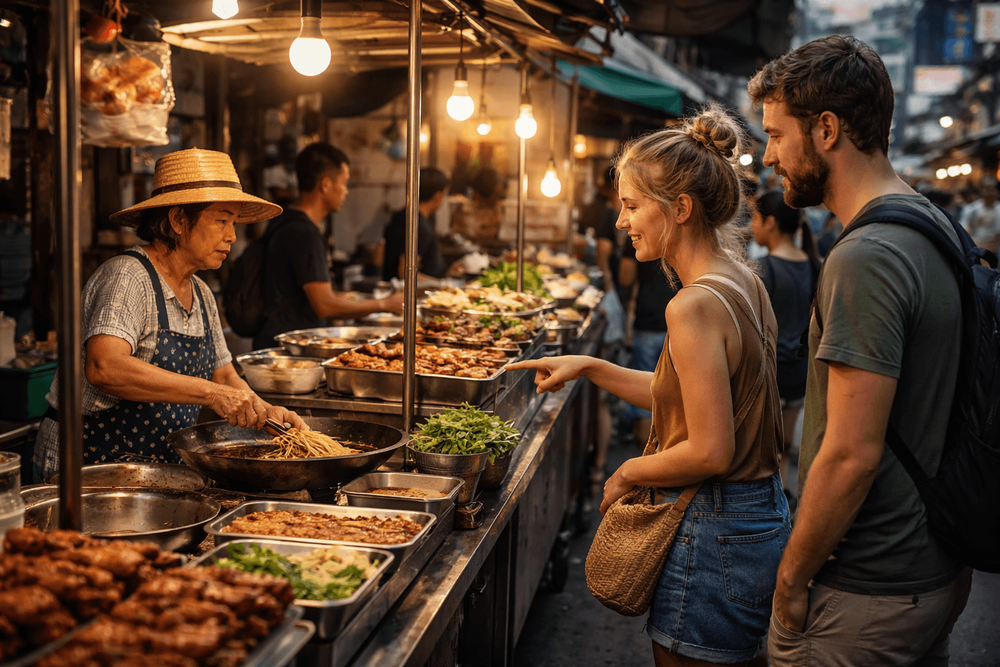
We edge up to the sizzling wok on Soi Rambuttri, neon reflecting off puddles and the smell of garlic hitting like a cymbal crash. The cook barely looks up—wrist flicking noodles through fire—so we do what you do when you’re figuring out how to order street food in Bangkok: we point, we smile, we use a couple of Thai words, and we let the rhythm of the stall carry us along. It’s equal parts chaos and choreography, and once you learn the steps, you’ll eat like a local.
Data Freshness + Pricing:
- Prices are approximate and in THB.
- Last checked: June 2026.
- Happy hour and promo details change frequently—confirm locally.
How to Order Street Food in Bangkok: The Basics
Street stalls in Bangkok are tiny machines that run on muscle memory. Here’s the simple playbook we use.
Step 1: Read the Set-Up
- Menu board: Look for laminated menus clipped to the cart or a signboard with Thai script and occasional English. Key Thai menu words help: “khao” (rice), “kuay tiao” (noodles), “pad” (stir-fry), “tom” (boiled), “yam” (spicy salad), “moo” (pork), “gai” (chicken), “pla” (fish), “goong” (shrimp), “tao hoo” (tofu). If you want a deeper decode, see our companion guide: How to Read a Bangkok Street Food Menu: Thai Names, Common Dishes, and Smart Ordering Tips.
- Order point: It’s usually at the wok or the cutting board. If there’s a queue, hang back and watch for a lull; if there’s a table number system, grab a seat and note your table number first.
Step 2: Use Simple Thai (or Point Like a Pro)
- We keep it short and sweet: “Ao pad krapao moo krap/ka” (I’ll have basil pork). “Ao pad Thai goong” (Pad Thai with shrimp). “Ao kuay tiao tom yum, sen lek” (Tom yum noodle soup with thin rice noodles).
- Spice levels: “Mai ped” (not spicy), “Ped nit noi” (a little spicy), “Ped mak” (very spicy). For no MSG: “Mai sai phong churot.” For eggs: “Sai khai” (with egg), “Mai sai khai” (no egg).
- Allergies and dietary notes: “Phom/Chan phae thua” (I’m allergic to peanuts), “Phom/Chan gin jay” (I eat vegan). If you have allergens, read this before you order: Bangkok Street Food for Travelers with Allergies: What to Order, What to Avoid, and How to Ask for Changes.
- Pointing works. If you see what you want, point and say “ao ni” (this one) with a smile. Bangkok rewards effort over fluency.
Step 3: Noodles Need Details
Noodle carts love specifics. Try the template: dish + noodle type + soup/dry.
- Noodles: “sen yai” (wide rice), “sen lek” (thin rice), “sen mee” (vermicelli), “ba mee” (egg noodles).
- Soup or dry: “nam” (with soup), “haeng” (dry, tossed).
- Extras: “piset” (special/bigger portion, approx. +10–20 THB), “luk chin” (meatballs), “moo daeng” (red pork), “krapao gai” (holy basil chicken) is a dish, not a topping, but you’ll hear it constantly.
Step 4: Confirm the Price
We ask “tao rai krap/ka?” (how much?) before committing, especially around tourist-heavy strips like Khao San Road. Expect approx. 50–80 THB for a standard bowl of noodles, 60–120 THB for Pad Thai, 10–20 THB per grilled pork skewer. If you’re budgeting, this helps: Bangkok Street Food by Budget: What to Eat for 50, 100, and 200 Baht.
Step 5: Grab a Seat and Let the Stall Work
Some stalls hand you a number; others shout your dish. If there’s a plastic basket of chopsticks and spoons, it’s self-service. The condiment caddy—sugar, chili flakes, vinegar with chilies (prik nam som), fish sauce with chilies (prik nam pla)—is your tuning dial. Adjust gently; cooks season intentionally here.
Choosing a Safe, Busy, and Reputable Stall
Bangkok’s street food scene runs on turnover. We follow a few sanity checks so we can feast without fear.
- Follow the line: A stall with a steady queue near Victory Monument’s boat noodle alley or Wang Lang Hostel by Siriraj Hospital moves food fast, which means freshness.
- Watch the hands: We like stalls where money and raw ingredients are handled separately. Tongs for raw, a different hand for cash, and a quick rinse station are green flags.
- Covered ingredients: Look for mesh covers over prepped veg and lids on curry pots. If raw meat is basking in direct sun on Phra Athit Road at 2 PM, we keep walking.
- Hot stays hot: Rice cookers should be plugged in and steaming. Soups should be bubbling, not idling.
- Ice: Tube ice is industry-standard and generally safe. If you’re sensitive, order bottled drinks.
- Smell test: Bangkok has its own perfume—grills, garlic, diesel, durian—but if a stall smells off (sour oil, rancid funk), we skip.
- Pricing in sight: A price list—Thai or English—signals orderliness. If a vendor hesitates when you ask “tao rai?” on a street that swarms with farang, consider a different stall.
If you want a thorough hygiene and confidence primer before you dive in, bookmark this: Bangkok Street Food for First-Time Visitors: A Practical Guide to Ordering, Hygiene, and Must-Try Classics.
Popular Bangkok Street Foods You Can Order Confidently
Bangkok’s a buffet disguised as a city. Here are the greatest hits we order on repeat.
Pad Thai (ผัดไทย)
- What to say: “Ao pad Thai goong” (shrimp) or “ao pad Thai khai” (egg). If you prefer no dried shrimp or peanuts, say “mai sai goong haeng/mai sai thua.”
- Price: approx. 60–120 THB depending on protein and neighborhood. Around Khao San, the late-night wok shows are part of the tax.
- Pro move: Squeeze lime, add a tiny pinch of sugar and chili flakes to taste. Don’t drown it.
Pad Krapao (ผัดกะเพรา) – Basil Stir-Fry
- What to say: “Ao pad krapao moo/gai + khai dao” (add a crispy fried egg). “Ped nit noi” if you want mild.
- Price: approx. 50–80 THB for pork or chicken; beef or seafood can run 70–120 THB.
- Where it shines: Lunch rush at office areas around Sathorn and Silom—speed, smoke, and blistered basil.
Boat Noodles (ก๋วยเตี๋ยวเรือ)
- What to say: “Ao kuay tiao ruea moo, sen lek, nam.” Add “piset” for a bigger bowl.
- Price: traditional tiny bowls approx. 12–25 THB each; modern full bowls 50–80 THB.
- Where: Victory Monument khlong-side alleys or small shophouses along the canal. Sip, slurp, repeat.
Moo Ping (หมูปิ้ง) – Grilled Pork Skewers
- What to say: Hold up fingers and say the number: “song” (2), “sam” (3), “ha” (5). Pair with sticky rice: “khao niao.”
- Price: approx. 10–20 THB per skewer; sticky rice 10–15 THB.
- Sensory joy: Char, caramelized fat, and the smoke that clings to your shirt until the next 7-Eleven AC blast.
Som Tam (ส้มตำ) – Green Papaya Salad
- What to say: “Ao som tam Thai, mai ped/ ped nit noi.” If you want fermented fish funk, “som tam pla ra” (advanced class).
- Price: approx. 40–70 THB.
- Pairing: Eat with grilled chicken (gai yang) and sticky rice. Prepare for a lime-chili-sugar slap.
Mango Sticky Rice (ข้าวเหนียวมะม่วง)
- What to say: “Ao khao niao mamuang.” During off-season, ask “mamuang sod mai?” (is the mango fresh?).
- Price: approx. 60–120 THB depending on portion and season.
- Where: Night markets around Ratchada or Talat Phlu keep it flowing late.
Khao Gaeng (ข้าวแกง) – Curry over Rice
- What to say: Point at trays and count your curries: “song yang” (two kinds), “sam yang” (three kinds) over rice.
- Price: approx. 40–70 THB for two curries over rice; more for seafood.
- Tip: If a tray looks tired or crusted, skip that pan and pick a fresher one.
Namtok/Laab (ลาบ/น้ำตก) – Isaan Salads
- What to say: “Ao laab moo/nam tok moo, mai ped/ ped nit noi.”
- Price: approx. 60–100 THB.
- Crunch and kick: Toasted rice powder and mint make these sing; great with cold beer on Phra Athit Road.
For a wider hit list and where to chase these beyond Khao San, our night-market cheat sheet helps: Bangkok Street Food Night Market Guide: Best Stalls, Hours, and What to Order.
Payment, Pricing, and Tipping at Stalls
Cash is still king on the curb, though some vendors flash a PromptPay QR. If you’re visiting, assume cash and carry small bills.
- Typical prices (approx.):
- Noodles and rice plates: 50–80 THB basic, 70–120 THB with seafood or upgrades.
- Skewers: 10–20 THB each.
- Fruit shakes: 30–60 THB.
- Desserts: 30–80 THB.
- How to pay: Pay when the dish arrives or when you’re done—watch what others do. If the vendor keeps a whiteboard tally at your table, settle at the end.
- Portion sizes: Standard bowls are modest; order “piset” for larger or double meat (approx. +10–30 THB). Some noodle shops offer “sen yai yai” (extra noodles) for a small add-on.
- Bargaining: Not a thing. Street food prices are already local-friendly. If you must ask, confirm politely before ordering.
- Tipping: Not expected. We round totals up by 5–10 THB when service is sweet or someone chases us with forgotten change.
If you’re planning your baht by the bite, this is handy: Bangkok Street Food by Budget: What to Eat for 50, 100, and 200 Baht.
Helpful Etiquette and Local Customs
Queueing Without Chaos
- Invisible lines: At wok stations, bodies form a loose semicircle. Make eye contact, say your order, and hold your ground. If there’s a ticket or table-number system, use it.
- Share tables: If a plastic chair opens up at a communal table, sit. Smile and say “sawadee krap/ka.” Space is shared; that’s the sanuk.
- Don’t hover with a plate: Order first, sit second—unless the stall clearly runs self-service trays.
How to Eat Like a Local
- Spoon over fork: Thai street food is mostly eaten with spoon and fork, fork as a pusher. Chopsticks for noodles and some Chinese-leaning dishes.
- Season at the table: Customize from the condiment caddy, but taste first. Sugar in noodles sounds odd until it makes the chili pop.
- Napkins and bins: Bring tissues or wet wipes; napkins can be flimsy. Finished bones and skewers go in the small table bin.
- Pace yourself: Eat while it’s hot. Street food is about heat and momentum, not a languid three-hour sit.
Peak Hours and Patience
- Breakfast rush: 7:00–9:00, carts near river piers (Chao Phraya Express stops like Phra Arthit or Tha Chang) slam out jok (rice porridge) and grilled pork.
- Lunch crush: 11:30–13:30, markets and office clusters surge.
- Dinner and beyond: 18:00–21:00 for families; after 22:00 the Khao San and Chinatown (Yaowarat) crews take over. Some carts don’t open until the wok calls at midnight.
Respect and Small Gestures
- Politeness pays: End sentences with “krap” (if you present masculine) or “ka” (feminine). It oils the gears.
- Photos: Ask with a smile before you lean over the wok for that action shot. Most vendors will nod you in.
- Alcohol: Not every stall is BYOB-friendly, and some areas have restrictions. If in doubt, don’t plonk a big Chang on the table uninvited.
For a deeper look at manners that make you blend in, we wrote this just for you: Bangkok Street Food Etiquette: How to Order, Pay, Sit, and Eat Like a Local.
Know Before You Go
- Heat management: Bangkok’s humidity will hug you like a damp towel. We stash a small fan, tissues, and hand gel. Duck into a 7-Eleven for that life-saving AC blast between bites.
- Hydration: Order water (“nam plao”) or soda with ice. If you’re wary of ice, ask “mai sai nam khaeng” (no ice) and take a cold bottled drink.
- Getting around: For riverside eating, hop the Chao Phraya Express to Phra Athit or Wang Lang. For night feasts, we glide by tuk-tuk between Soi Rambuttri and Khao San, or grab a taxi to Yaowarat. BTS/MRT puts you within a short moto-taxi of markets like Ratchada.
- Clothing: Street eating is casual, but temples aren’t. If you’re coupling dinner with a Golden Mount sunset, pack a light cover-up.
- Accommodation: We like staying within stumble distance of the action—near Phra Athit Road for riverside breezes or a quiet soi off Rambuttri when we want to be close to Khao San without sleeping on top of the bass. If you crave a pool to rinse off the chili sweat, pick a stay that mentions it explicitly; mid-range spots around the Old City and riverside often deliver at a friendly price.
Troubleshooting: When Things Get Spicy (or Weird)
- Too spicy: Say “mai ped” up front, and if fire still arrives, hit the caddy—add sugar and a splash of vinegar to cool things down.
- Not what you expected: It happens. Smile, chalk it up to adventure, and order another round elsewhere. Bangkok rewards curiosity.
- Stomach wobble: Stick to busy stalls, skip anything that’s been sunbathing, and go easy on raw veg if you’ve just landed. A probiotic before wheels down never hurts.
- Night moves: If you need late eats after the bars thump back to life, look for carts on Tanao Road or the thin alleys behind Khao San. Moo ping and khao niao at 2 AM taste like victory.
A Sample Order Flow at a Noodle Cart
We slide into a stool near Victory Monument, steam fogging our glasses.
- We scan the menu and decide: “Ao kuay tiao tom yum, sen lek, ped nit noi.”
- The cook nods, asks “nam rue haeng?” We answer “nam.”
- We confirm price: “tao rai?” He answers “70.” We grin and pass a 100; change arrives with the bowl.
- We taste before we tweak, then add a whisper of chili and a squeeze of lime.
- We slurp, pay, and clear our bowls to the bus tub with a khop khun krap/ka.
Why We Keep Coming Back
Because a 60-THB bowl of boat noodles eaten under a khlong bridge beats a white-tablecloth dinner nine nights out of ten. Because the smoke of moo ping follows us down Phra Athit Road like a puppy. Because the city hums, and when we eat on the street we hum with it. Tomorrow night, we’ll start at Soi Rambuttri for pad krapao with a fried egg that crackles like summer rain, then walk it off along the river until the mangoes call our name.
If you want to lock in the basics and then wander deeper, keep these in your pocket: How to Read a Bangkok Street Food Menu: Thai Names, Common Dishes, and Smart Ordering Tips and Bangkok Street Food Etiquette: How to Order, Pay, Sit, and Eat Like a Local. We’ll meet you at the next wok.
Related Hotels & Places
Rambuttri
Markets
Khao San’s calmer cousin: a tree‑shaded lane of VW van cocktail bars, open‑air foot massages, pad thai grills, and easygoing live bands. Best from sunset to 11pm; beers 80–120 THB, cocktails 150–220 THB. One block from the chaos, all the charm.
Khao San Road
Attractions
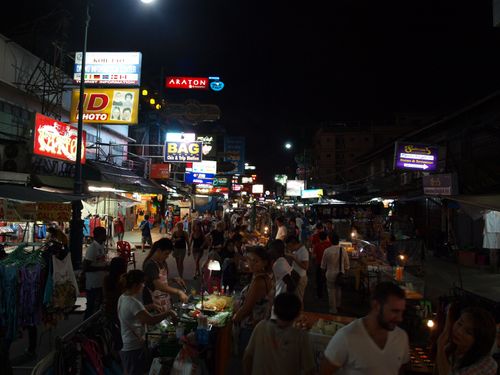
Bangkok’s backpacker carnival: curbside bars, live bands and DJs from 3pm–2am (midnight Sun). Street eats are cheap — pad thai 70–100 THB, mango sticky rice 60–100 THB. Come for wild people-watching; duck into Rambuttri for a calmer beer.
Wang Lang Hostel
Hotels
A 0-star hotel in Bangkok.
More Khao San Road Guides
- How to Order Street Food in Bangkok: Thai Phrases, Stall Etiquette, and Easy Customizations
- How to Order Street Food in Bangkok: Menu Signs, Spicy Levels, Pay Methods, and Stall Etiquette
- How to Order Bangkok Street Food Like a Local: Stall Signals, Queue Etiquette, and Customization Tips
- How to Order Bangkok Street Food Like a Local: Thai Phrases, Toppings, and Stall Etiquette