How to Order Bangkok Street Food Like a Local: Thai Phrases, Toppings, and Stall Etiquette
Skip the awkward pointing. Learn how to order Bangkok street food—Thai phrases, customizations, prices, and etiquette—for flawless bowls from Soi Rambuttri to Yaowarat.
The wok hisses, the garlic hits first, then basil and chilies punch the air. We’re shoulder-to-shoulder on Baan Manee BKK, watching the auntie flip pad krapao like a pro while a tuk-tuk coughs past and a bar on Khao San Road thumps bass in the background. If you were googling “how to order street food bangkok,” we’ve got you—let’s sidestep the awkward pointing and get exactly what we want, extra crispy fried egg and all.
Data Freshness + Pricing:
- Prices are approximate and in THB.
- Last checked: July 2026.
- Happy hour and promo details change frequently—confirm locally.
How to Order Street Food Bangkok: The Basics
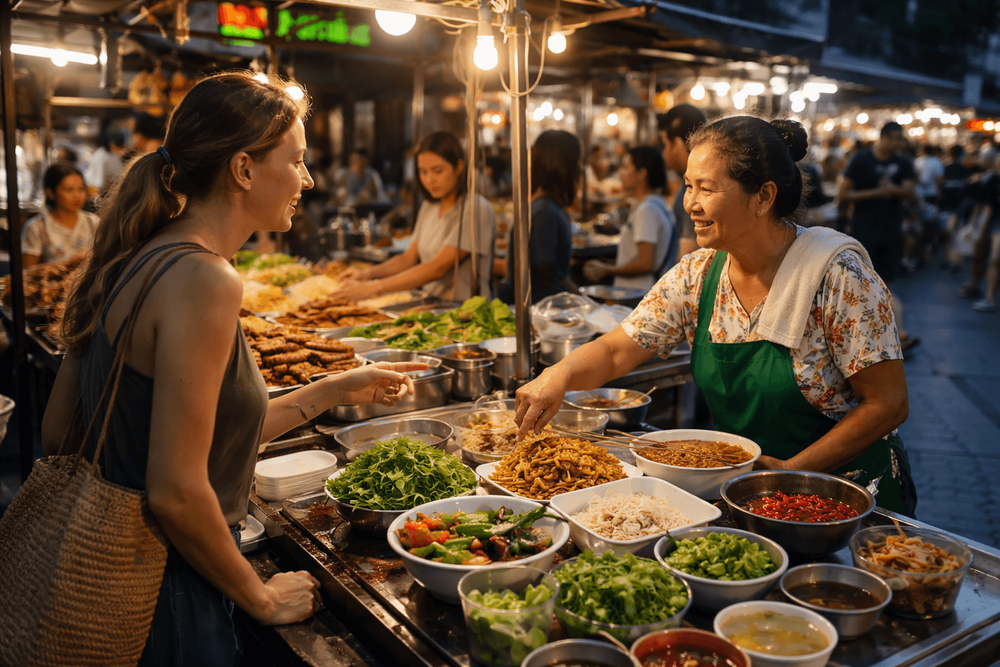
Ordering is a dance: greet, point or speak, customize, confirm, pay. Most vendors are lightning-fast and friendly—if we’re clear and respectful, they’ll meet us halfway.
- Start with a sawadee (hello). Add “krub” if you’re male, “ka” if you’re female. A smile does wonders.
- Pointing works. Gesture at the wok or the menu sign; hold up fingers for quantity. Vendors read body language like fortune tellers.
- Simple English is fine at busy hubs (Khao San, Yaowarat Chinatown Heritage Center). Words like “no spicy,” “one chicken,” “takeaway,” usually land. But Thai phrases go further (we’ve got those below).
- Order structure: dish name → protein/noodle choice → size/spice level → eat here or takeaway. Example: “Pad krapao moo, phet nit noi, kai dao, kin tee-nee.” (Basil pork, a little spicy, with fried egg, eat here.)
- Payment: often after eating if you’re sitting; upfront if takeaway. Keep small bills—20s, 50s, 100s.
Want a deeper primer on the flow? We also break down stall-side customs here: Bangkok Street Food Etiquette: How to Order, Pay, Sit, and Eat Like a Local.
How to Pick a Good Stall (So You Don’t Need Luck)
We read the street like a menu. Here’s what we look for from Phra Athit Road to Yaowarat’s neon strip:
- Turnover is king: a short line that moves fast beats an empty stall. Freshness rides the wave of constant orders.
- Mise en place tells the story: covered herbs, meats on ice, broth at a proper simmer, chopped veg replenished, not limp.
- Clean enough: a splash station, separate boards for raw/cooked, sanitizer bottle nearby. Bangkok is hot—smart vendors adapt.
- Menu clarity: hand-painted Thai signs with prices are normal; English transliterations help but aren’t required. Expect approx 50–120 THB for most single-plate dishes; skewers 15–25 THB each.
- Peak times: 7–9 am for breakfast jok and khao man gai; noon rush for noodles; 6–10 pm for grills and som tam; midnight for pad thai and boat noodles. Show up at the right hour and the good stuff sings.
If you want help reading those Thai signs and common dish names, bookmark this: How to Read a Bangkok Street Food Menu: Thai Names, Common Dishes, and Smart Ordering Tips.
What to Order (And How to Customize Like You Belong Here)
Half the fun is dialing it to your taste. Here are the Bangkok classics we order on repeat, with the Thai you need at the cart.
Pad Kra Pao (Holy Basil Stir-Fry)
- How to say it: “Pad krapao moo/kai/neu” (pork/chicken/beef)
- Custom: “kai dao” (fried egg) is non-negotiable in our book. “Krob” for crispy pork belly.
- Spice: “phet nit noi” (a little spicy), “mai phet” (not spicy), or “phet phet” (very spicy).
- Eat: Over rice, fast. Expect approx 60–100 THB; add 10–20 THB for the egg.
Kuay Tiao (Noodle Soup)
- Noodles: “sen lek” (thin rice), “sen yai” (wide rice), “sen mee” (vermicelli), or “ba mee” (egg noodle).
- Style: “nam” (with broth), “haeng” (dry), or “tom yam” (spicy-sour).
- Proteins: moo (pork), gai (chicken), luuk chin (meatballs), or “ruam mit” (mixed).
- Condiments on table: sugar, chili flakes, vinegar with chilies, fish sauce—tune your bowl.
- Price: approx 50–90 THB.
Boat Noodles (Kuay Tiao Ruea)
- Tiny, punchy bowls once served on khlongs. We stack two or three.
- Order: “ruam mit” if you want the full works; “sen lek nam tok” for the classic rich broth.
- Price: small bowls approx 20–40 THB each near Victory Monument; larger bowls 60–90 THB.
Som Tam (Papaya Salad)
- Base: “som tam thai” (sweet-sour-peanut), “som tam lao” (funkier with fermented fish “pla ra”), or “tam sua” (with rice noodles).
- Your call: “mai sai pla ra” (no fermented fish) if you’re new; “phet nit noi” to ease in.
- Price: approx 50–90 THB; add-ons like salted egg or grilled pork belly bump it to 80–120 THB.
Moo Ping + Sticky Rice
- Order by sticks: hold up fingers or say the number.
- Ask for “khao niew” (sticky rice) and “mai phet” chili dip if you’re heat-shy.
- Price: skewers approx 15–25 THB each; rice 10–20 THB.
Khao Man Gai (Hainanese Chicken Rice)
- Options: boiled (plain), fried (“tod”), mixed (“ruam”). Skinless? “Mai ao nang.” Extra rice? “Khao pbet.” Bigger plate? “piset.”
- Sauce: sweet-salty-gingery; soup on the side.
- Price: standard approx 60–90 THB; special/extra meat 80–120 THB.
Pad Thai
- Variants: “kung” (shrimp), “moo” (pork), “tao hu” (tofu). Vegetarian? Say “jay” (vegan Buddhist-style, no fish sauce/egg/garlic—confirm specifics) or “mang sa wirat” (vegetarian; may include egg and sauces).
- Finish: squeeze of lime, toss on crushed peanuts and chili.
- Price: approx 60–120 THB; tourist-hotspots can hit 150–180 THB.
Jok or Khao Tom (Breakfast Porridge/Soup)
- Jok is creamy rice porridge; khao tom is brothy rice soup.
- Add-ins: pork meatballs (“moo sap”), egg (“kai”), ginger (“khing”), century egg (“kai yeow ma”).
- Price: approx 40–70 THB.
Mango Sticky Rice (Khao Niew Mamuang)
- Ripe mango, coconut cream, sticky rice. Ask for “khao niew noi” (less rice) if you’re pacing.
- Price: approx 80–150 THB depending on mango season.
Thai Phrases You’ll Actually Use
A few well-placed words unlock smiles and better bowls. Don’t sweat tones; context carries you.
- Hello/Thanks: “sawadee krub/ka” (hello), “khob khun krub/ka” (thank you)
- I want…: “ao…” (I’ll take…)
- How much?: “tao rai?”
- Eat here / Takeaway: “kin tee-nee” (eat here), “khao pao” or “sai toong” (takeaway, bag)
- Not spicy / a little / very: “mai phet” / “phet nit noi” / “phet phet”
- No… (ingredient): “mai sai…”
- With rice / noodles: “khao” / “sen…”
- One / two / three: “neung / song / saam”
- Delicious: “aroi!”
- Check please: “gep nguen” (collect money/bill)
Ingredients and allergens:
- Fish sauce: “nam pla”
- Oyster sauce: “sa-ot hoi” (often just say “oyster sauce”)
- Shrimp: “kung”; crab: “pu”; squid: “pla muek”; pork: “moo”; chicken: “gai”; beef: “neu”
- Peanuts: “tua-lisong”; egg: “kai”; milk: “nom”
If you need a more thorough phrase list plus real-world ordering flow, keep this handy: How to Order Street Food in Bangkok: Thai Menu Words, Queue Etiquette, and Stall-Side Customs.
Paying, Queuing, and Not Being “That Farang”
- Cash first: Many stalls now accept Thai QR PromptPay, but carry small bills. Expect to pay approx 50–120 THB per dish; grills and snacks 10–30 THB each.
- When to pay: If we’re handed a seat and a number, pay after eating. If it’s a stand-and-slurp situation, pay upfront or as they pass the bowl.
- Queue etiquette: Stand behind the person being served; don’t hover over the wok. A gentle “ao…” when it’s your turn beats shouting.
- Table share: It’s normal to share a formica table with strangers. Nod, smile, dig in.
- Condiments are communal: a few shakes only—no chili avalanches.
- Water and ice: Some shops put a metal cup and ice jug on the table; water may be charged approx 2–5 THB per glass. Bottled water is usually 10–20 THB.
- Napkins: Tissue boxes sometimes come with a tiny fee printed on them—drop a coin; it’s normal.
- Takeaway: Say “khao pao” or “sai toong.” You’ll get your food bagged with a rubber band and a smile.
First time in Bangkok stalls? This nuts-and-bolts guide pairs well with what you’re reading: Bangkok Street Food for First-Time Visitors: How to Order, Pay, and Eat Safely.
Allergies, Dietary Needs, and Smart Workarounds
Bangkok’s flavors love fish sauce, oyster sauce, and shrimp paste. If you’re avoiding any, be direct.
- No fish sauce: “mai sai nam pla.”
- No oyster sauce: “mai sai oyster sauce.” (Borrow the English; it lands.)
- No shrimp: “mai ao kung.” No peanuts: “mai ao tua-lisong.” No egg: “mai ao kai.”
- Vegetarian/vegan: “jay” is the safest Thai shorthand, but confirm “mai sai nam pla/sa-ot hoi” (no fish/oyster sauce). If you take egg, add “kin kai dai.”
- Gluten: Soy sauce can contain wheat; ask for “mai sai si-iu khao” (no light soy) and “mai sai si-iu dam” (no dark soy), and prefer salt/fish-sauce-free seasonings.
For deeper allergy strategies and Thai lines to keep you safe, we’ve put together this: Bangkok Street Food for Travelers with Allergies: What to Order, What to Avoid, and How to Ask for Changes.
Know Before You Go (Timing, Heat, and Street Smarts)
- Heat is real: We dart into 7-Eleven for that arctic blast between stalls. Hydrate. Coconut water is approx 25–40 THB from pushcarts.
- Rush hour rules: Popular vendors sell out fast. If the fried chicken looks like it’s been waiting, skip it and circle back when the next batch hits the oil.
- Bring change and wipes: A pocketful of coins smooths everything; wet wipes earn MVP in chili situations.
- Trust your eyes and nose: Sweet rot of old seafood? Keep walking. Fresh lemongrass, sizzling wok, lively line? You’ve arrived.
- Negotiate tuk-tuks before you ride: Old Town hops are usually approx 80–150 THB depending on distance and hour. Or walk; Bangkok rewards the curious.
Where to Base Yourself for Street Food Missions
If we’re planning a week of stall-hopping, we sleep light and central. Around Khao San and Phra Athit Road, you’re wedged between the river, late-night pad thai, and the day-boat to Chinatown. We usually crash in a simple guesthouse with decent AC and, when luck smiles, a small pool—perfect for a post-noodle dunk without wrecking the budget. If you like quieter nights and coffee culture, Ari and Phaya Thai put you on the BTS with quick runs to Victory Monument for boat noodles. Night owls? Yaowarat dishes till late, and staying within walking distance of MRT Wat Mangkon means mango sticky rice at midnight is a five-minute decision.
Getting Around to the Good Stuff
- Chao Phraya Express Boat: Hop the Orange Flag to Phra Arthit Pier for Rambuttri/Khao San eats or to Ratchawong Pier for Yaowarat. Fares approx 16–20 THB.
- MRT: Ride to Wat Mangkon for Chinatown, Sanam Chai for Rattanakosin/Tha Tien markets. Fares approx 16–42 THB.
- BTS: Victory Monument for boat noodles; Ari/Phaya Thai for hip cafe streets and solid lunch stalls. Fares approx 16–47 THB.
- Saen Saep Khlong Boat: Fast track to Pratunam’s food courts and side-street stalls. Fares approx 10–20 THB.
- Walk: The best snacks hide on the next soi. Follow your nose and the grill smoke.
Putting It All Together: One Clean Order Flow
Here’s the five-step rhythm we use everywhere from Soi Rambuttri to a sleepy morning cart on Samsen Road:
- Greet and queue politely. A soft “sawadee krub/ka.”
- Order in this order: dish → protein/noodle → spice/egg/extras → eat here/takeaway. Keep it tight and smile.
- Confirm the price. “Tao rai?” Have small bills ready.
- Season at the table. Taste first; then adjust with the four stalwarts: sugar, chili, vinegar, fish sauce.
- Pay and thank them. “Gep nguen” when you’re done; “khob khun krub/ka.”
If your mission is literally how to order street food Bangkok without guesswork, these steps will carry you from breakfast jok to a late-night bowl of boat noodles.
We’ll be the ones loitering near the basil-scented smoke on Phra Athit, eyeing the wok for our moment. Come hungry; we’ll save you a seat and an extra-crispy kai dao.
Related Hotels & Places

Baan Manee BKK
Hotels
A 118‑year‑old riverside house turned boutique stay and café. Sunset terrace, a small bar and a fire pit on the Chao Phraya. Ten minutes across from Khao San—come for proper coffee by day, drinks after dark, and quiet sleep away from the noise.
Khao San Road
Attractions
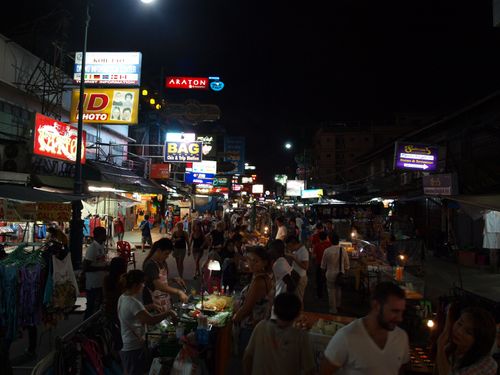
Bangkok’s backpacker carnival: curbside bars, live bands and DJs from 3pm–2am (midnight Sun). Street eats are cheap — pad thai 70–100 THB, mango sticky rice 60–100 THB. Come for wild people-watching; duck into Rambuttri for a calmer beer.
Yaowarat Chinatown Heritage Center
Attractions
Inside Wat Traimit by Chinatown Gate, this tidy museum charts Yaowarat’s Chinese roots with bilingual displays, period photos and short films. Open Tue–Sun 8:30am–4:30pm; closed Mon. Pair it with the Golden Buddha upstairs.
Rambuttri
Markets
Khao San’s calmer cousin: a tree‑shaded lane of VW van cocktail bars, open‑air foot massages, pad thai grills, and easygoing live bands. Best from sunset to 11pm; beers 80–120 THB, cocktails 150–220 THB. One block from the chaos, all the charm.
More Khao San Road Guides
- How to Order Bangkok Street Food: Thai Phrases, Spice Levels, and Stall Etiquette for Khao San Road First-Timers
- How to Order Street Food in Bangkok: Thai Phrases, Stall Etiquette, and Easy Customizations
- Bangkok Street Food for Non-Thai Speakers: Essential Phrases, Menu Clues, and Easy Orders
- How to Order Street Food in Bangkok: Thai Menu Words, Queue Etiquette, and Stall-Side Customs