
Backpacker Packing List for Thailand: Electronics, Power, and Charging Adapters
The no‑nonsense Thailand charging adapter packing list: plugs, voltage, power banks, cables, and where to buy replacements in Bangkok—without frying your gear.
We’re hunched over a plastic stool on Soi Rambuttri, the fan lazily moving humid air while our phone drops to 3%. The wok claps fire, a tuk-tuk coughs by, and the neon spill from Khao San Road is already calling. This is where a solid Thailand charging adapter packing list stops being theoretical and starts saving your night. We duck into 7-Eleven for that blessed AC blast and a quick top-up—only to remember the outlet looks nothing like home.
Data Freshness + Pricing:
- Prices are approximate and in THB.
- Last checked: July 2026
- Happy hour and promo details change frequently—confirm locally.
which adapter actually works in Bangkok We’ll keep it sanuk—fun—but honest about the heat, crowds, and the occasional dud charger.
Thailand Plug Types, Voltage, and Frequency: What Works and What Won’t
Let’s start with the electricity basics so we don’t turn your gadgets into paperweights.
Voltage and frequency in Thailand
- Thailand runs on approx. 220–240V, 50Hz (commonly listed as 220V/50Hz).
- Most modern phone, tablet, and laptop chargers are “dual voltage” (100–240V, 50/60Hz). Check the tiny print on your brick; if it shows 100–240V, you’re good without a bulky converter.
- Single‑voltage devices from 110V countries (older hair dryers, curlers, some shavers) can burn out. If your device only says 110–120V, leave it or bring a step‑down transformer. But transformers are heavy, run hot, and cost approx. 800–1,800 THB. We usually skip them and use the hostel hair dryer.
Plug and socket shapes you’ll meet
- Common sockets accept Type A (flat two‑pin), Type C (Euro two‑pin), and often Type F (Schuko two‑pin with side grounds). Thailand’s official Type O (three round pins with ground) exists but many outlets are the “universal” style that take A/C/F. True three‑prong grounding isn’t guaranteed.
- Translation: a slim Type A/C two‑pin adapter will fit in most places. If your laptop brick needs a ground pin, pack a proper grounded plug solution or a high‑quality universal adapter with a ground.
Grounding realities
- Many wall plates are two‑hole only, even when the faceplate looks “universal.” If you rely on a ground (some gaming laptops, metal‑body devices), carry an adapter that supports ground and a short grounded extension. Be realistic: you may still end up on two-pin in cafes.
Surge and power stability
- City power is generally stable, but storms and older buildings can cause dips and spikes. A tiny travel surge protector or a GaN charger with built‑in protections is cheap insurance (approx. 300–700 THB locally).
Pro tip we learned the sweaty way: don’t fight the system. Build your kit around USB‑C PD and dual‑voltage gear, and you’ll charge anywhere—from a guesthouse off Phra Athit Road to a riverside cafe by the Chao Phraya.
Thailand Charging Adapter Packing List (What to Bring)
Here’s the lean, no-regrets kit we actually carry across Khao San, Silom, and Sathorn.
1) The right wall adapter(s)
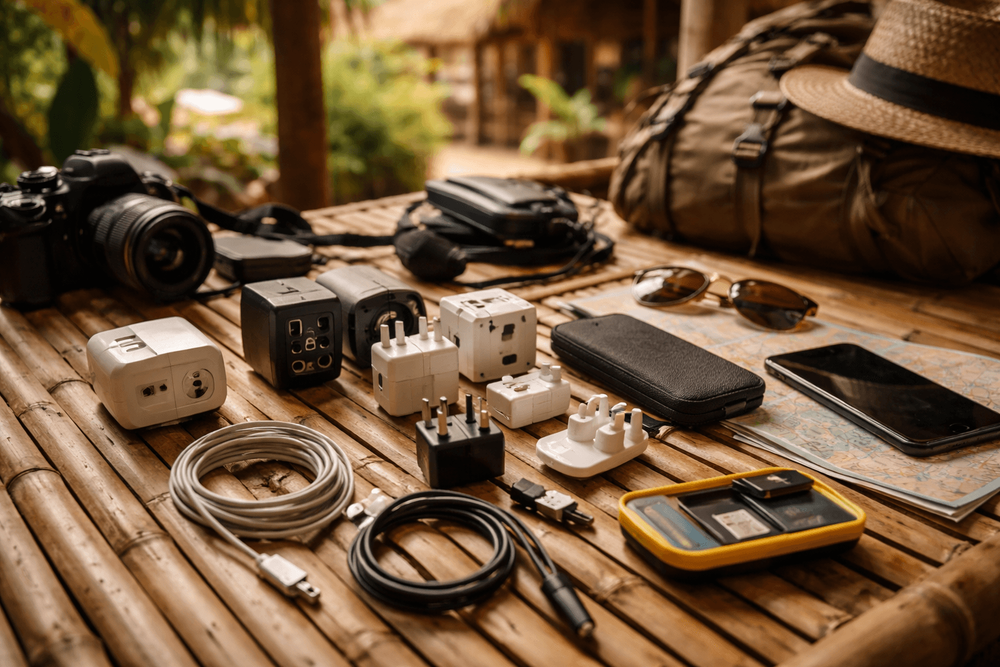
- Slim Type A/C plug adapter: Light, cheap, and fits 90% of Thai sockets. Pack 1–2. Approx. 80–200 THB each in Thailand.
- Quality universal adapter (with ground): For laptops or camera chargers with chunky plugs, and for future trips. Expect 300–1,200 THB depending on features (fuses, USB ports).
- Short grounded extension (optional): A 0.5–1m cable with a grounded outlet at the end. Helps when the wall socket is loose or badly placed. Approx. 200–450 THB.
When a universal brick gets bulky, we prefer a slim Type C adapter plus a multi‑port USB‑C charger to keep it simple.
2) Multi‑port USB‑C PD GaN charger
- Go for 30–65W USB‑C PD with 2–3 ports so we can power phone + earbuds + camera battery together. 65W will also fast‑charge many laptops and the newer iPads. Approx. 600–2,000 THB at malls.
- If your laptop needs 100W+, consider a 100–140W GaN unit. Heavier, but it replaces multiple bricks.
3) Power bank (carry‑on only)
- Aim for 10,000–20,000mAh. Sweet spot for weight vs capacity is 10,000–15,000mAh (approx. 400–1,200 THB in Thailand). 20,000mAh is great for island ferries and long train rides.
- Airline rule: power banks must go in carry‑on. Most airlines allow up to 100Wh without approval (about 26,800mAh at 3.7V). Above that, it gets tricky. Check Wh on the label.
- USB‑C PD output (18–30W) is worth it for fast charges between temple hops.
4) Cables (carry spares)
- USB‑C to USB‑C (2x): One 1m for day use, one 2m for awkward hostel outlets.
- USB‑A to USB‑C (1x): For older ports in buses or planes.
- Lightning cable (if you’re on older iPhone models): Many iPhone 15+ users are on USB‑C, but Lightning is still common.
- Micro‑USB (1x): Headlamps, action cams, or those lifesaving 7‑Eleven desk fans love this dinosaur.
- Velcro wraps or rubber bands so you don’t create a cable nest.
5) Camera, drone, and niche gear
- Dual battery charger that runs on USB‑C is clutch. If yours is AC‑only, bring the right adapter.
- Spare memory cards and a tiny card reader (USB‑C).
- Action cam magnetic or short charging cable—easy to lose in tuk‑tuks.
6) Safety and sanity extras
- Small travel surge protector (1x): Especially if you’re plugging an expensive laptop into a mystery outlet. Approx. 300–700 THB.
- Cable labels or colored tape: Helps when sharing chargers in dorms.
- Zip pouch for “charging kit”: If it doesn’t live together, it gets left behind.
broader gear rundown that includes SIMs and accessories Thailand Electronics Packing List: Adapters, Power Banks, and SIM Gear.
Which Adapters and Converters for Phones, Laptops, and Cameras
Phones and tablets
- Almost all phone/tablet bricks are dual‑voltage. You only need the right plug shape and a decent USB‑C PD charger for speed.
- Expect cafe and hostel outlets to be hit-or-miss. That’s why we carry a multi‑port GaN and a spare cable.
Laptops
- Ultrabooks (MacBook Air, many thin Windows laptops): 30–67W USB‑C PD is usually fine.
- Power-hungry laptops (gaming, 16‑inch pro machines): Consider bringing the OEM charger or a 100–140W GaN with an e‑marked 100W cable.
- If your OEM brick has a figure‑8 or Mickey‑Mouse cord, swap just the cord to a Type A/C Thai-compatible one locally (approx. 120–250 THB) instead of using a clunky adapter on the brick.
Cameras and drones
- USB‑C charging cameras are easiest. For older models, bring their specific AC charger plus a universal adapter.
- Drones: Pack extra prop guards and ensure the charger is dual‑voltage (most are). Carry the batteries in your cabin bag; airlines can be strict.
Hair tools and shavers
- If it’s not dual‑voltage, assume it won’t end well. We’ve seen more fried curlers than we can count at hostels off Khao San.
- Consider a travel‑friendly, dual‑voltage version or use what’s provided at your guesthouse.
charger choices and cable combos What to Pack for Thailand for Phone, Power, and Connectivity: SIMs, Chargers, Adapters, and Backup Battery Basics.
The Practical Power & Cable Checklist
Use this quick list before you zip up on Phra Athit Road and roll out to Don Mueang.
Essential:
- 1–2 slim Type A/C plug adapters (approx. 80–200 THB each)
- 1 universal grounded adapter (approx. 300–1,200 THB)
- 1 USB‑C PD GaN charger, 30–65W with 2–3 ports (approx. 600–2,000 THB)
- 1 power bank 10,000–20,000mAh, USB‑C PD (approx. 400–1,200 THB)
- 2x USB‑C to USB‑C cables (1m + 2m), 60–100W rated
- 1x USB‑A to USB‑C cable
- 1x Lightning cable (if needed)
- 1x Micro‑USB cable (legacy gear)
- 1 small surge protector or at least a charger with built‑in protections (approx. 300–700 THB)
- Zip pouch for the kit
Nice-to-have:
- Short grounded extension (0.5–1m) for awkward outlets (approx. 200–450 THB)
- Spare camera battery and USB‑C dual charger
- Cable labels or colored tape
- Carabiner or cable keychain for quick access
For longer stays or data‑heavy travelers, we also cover eSIMs, tethering, and on‑the‑go charging strategies here: What to Pack for Thailand for SIM Card, Connectivity, and Charging on the Road.
Where to Buy or Replace Adapters in Thailand
We lose things. Bangkok forgives.
7‑Eleven and convenience stores
- Open late, everywhere (the sweet, cold whoosh of AC is half the draw). You’ll find basic plug adapters, Lightning/micro‑USB/USB‑C cables, and smaller power banks.
- Prices are fair: adapters approx. 80–200 THB; cables 120–300 THB; basic power banks 300–800 THB.
- Quality varies, but it’ll get you through a night on Khao San or Soi Rambuttri.
Malls and dedicated electronics centers
- MBK Center (Pathumwan): A warren of phone stalls and accessory shops. Haggle a bit; quality improves as you move to the bigger stores. Multi‑port GaN chargers are common. Expect approx. 500–1,800 THB.
- Fortune Town IT Mall (Rama 9 MRT): Great for legit brands, laptop chargers, and specialty cables. Prices are posted; less haggling, more reliability.
- Pantip Plaza (near Pratunam): Old‑school electronics bazaar vibes. Mixed quality, good for oddball cables.
- Big‑box chains (Power Buy, Banana IT) in malls like CentralWorld or Terminal 21: Wider selection of branded chargers and power banks. Expect approx. 700–2,500 THB for quality GaN units.
Airport shops
- Suvarnabhumi and Don Mueang both stock adapters, cables, and power banks—at a markup (often 1.5–2x city prices). Worth it if you land at midnight with 2% battery and a hostel code stuck in your email.
Markets and street stalls
- Chatuchak Weekend Market and some night markets sell cheap cables and adapters. Inspect carefully, test if possible, and avoid knock‑off power banks with suspiciously high capacities.
Delivery apps
- If you’re posted up for a few days near the khlongs or working out of Ari cafes, apps like Grab or local e‑commerce can deliver same/next day. Handy for niche items (e.g., 100W e‑marked USB‑C cable).
Common Charging Mistakes to Avoid
We’ve made all of these so you don’t have to.
- Assuming your device is dual‑voltage: Check the label. If it only says 110–120V, don’t plug it in without a transformer.
- Confusing plug adapters with voltage converters: A plug adapter only changes the shape. It won’t tame 220V.
- Overloading a single outlet: Multi‑port chargers are fine, but daisy‑chaining cheap power strips in a dorm is asking for a blackout—and maybe a lecture from the manager.
- Buying rock‑bottom knock‑offs: That 79 THB “100W” charger is a hot potato. Spend a little more.
- Leaving power banks in checked luggage: Airlines will make you surrender them. Keep all lithium batteries in carry‑on.
- Not carrying a spare cable: Tuk‑tuks, ferries, and night buses are brutal on cables. One spare saves your morning at the Golden Mount.
- Ignoring grounding: If your laptop hums or you get tingles on a metal case, find a grounded outlet or switch to a two‑prong charger with proper insulation.
- Charging near pools or damp balconies: Tropical nights and condensation don’t mix with exposed outlets. Keep it dry.
- Forgetting outlet placement: Many Thai rooms have only one reachable socket. A 2m cable or short extension turns that far wall into a usable nightstand.
Know Before You Plug In
- Outlets vary from polished hotel rooms on Sukhumvit to timeworn sockets above a noodle cart’s counter. Test gently; don’t force plugs.
- Cafes along Phra Athit Road, coworking in Asoke, and BTS/MRT stations often have charge points. Always mind your bag—dorm thieves love a tethered phone.
- Bring your charging pouch to night trains, the Chao Phraya Express boat, and minivans. We’ve rescued more dying phones between Victory Monument and Ayutthaya than we can count.
Anker Nano II 65W USB C Charger, GaN II Foldable Fast Charger
If we had to strip it to the essentials: a slim Type C adapter, a 2–3 port 65W USB‑C PD GaN charger, a 10–20k power bank, and two sturdy USB‑C cables. That kit handles Bangkok, Chiang Mai, and the islands without drama. Then we can get back to the real work—boat noodles on Victory Monument pier and a rooftop beer with a skyline view, markup not included.
Related Hotels & Places
Khao San Road
Attractions
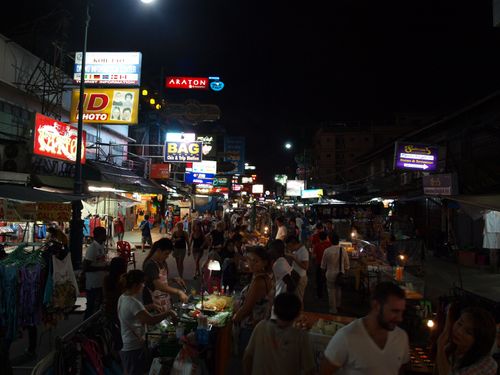
Bangkok’s backpacker carnival: curbside bars, live bands and DJs from 3pm–2am (midnight Sun). Street eats are cheap — pad thai 70–100 THB, mango sticky rice 60–100 THB. Come for wild people-watching; duck into Rambuttri for a calmer beer.
7-Eleven
Shops
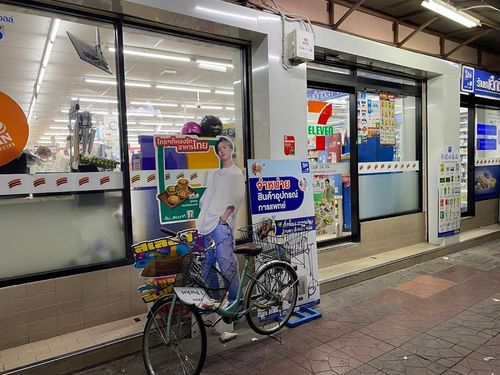
Khao San’s 24/7 reset button: ice‑cold A/C, ham‑cheese toasties, All Café iced lattes, water for 7–14 THB, and late‑night supplies from snacks to sunscreen—right by Rikka Inn.
Recommended Products
More Khao San Road Guides
- Thailand Backpacker Packing List for Electronics, Charging, and Power Adapters
- Backpacker Packing List for Thailand with Electronics: Adapters, Chargers, Power Banks, and Device Protection
- Backpacker Packing List for Thailand’s Tech and Charging Setup: Adapters, Power Banks, and Cable Control
- What to Pack for Thailand for Backpacker Electronics: Charging, Adapters, and Power Backup Essentials