
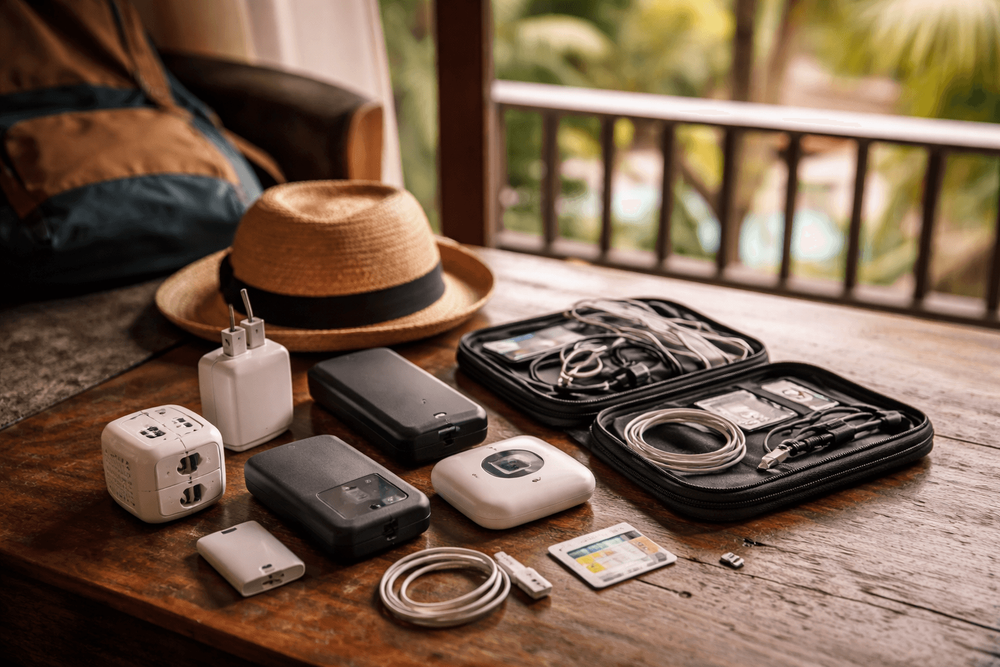
Thailand Electronics Packing List: Adapters, Power Banks, and SIM Gear
Pack smart power: adapters, SIM/eSIM, power banks, and waterproof fixes. Our Bangkok-tested list keeps your gear charged and safe from Khao San to Koh Tao.
We’re halfway down Soi Rambuttri, the wok smoke curling into the night, when our phone coughs at 3% and the bass from Khao San Road thumps a countdown. The neon 7-Eleven sign glows like salvation, but if we’ve done our Thailand electronics packing list right, we don’t have to sprint for a socket. We’ve got juice, backups, a plan—and we can keep chasing boat noodles on Phra Athit Road without babysitting a dying battery.
Our Thailand Electronics Packing List (what we actually carry)
Let’s keep it real: you don’t need a suitcase full of cables to conquer Bangkok, but a smart kit turns chaos into sanuk.
Essentials for everyone
- Smartphone + fast charger: USB‑C if you’re on Android; Lightning or USB‑C for the iPhone crowd. Aim for a 30W GaN charger—small, cool-running, and strong enough to top up phones and tablets fast.
- Power bank (carry-on only): 10,000–20,000 mAh hits the sweet spot. That’s enough to keep Google Maps alive from Chatuchak Haus to Chinatown Bangkok (Yaowarat). Check airline rules, but under 100 Wh (roughly up to 27,000 mAh at 3.7V) is almost universally allowed in carry-on; never in checked bags.
- Cables (2–3 total): One at your hotel, one in your daypack, one spare. Mix USB‑C to USB‑C and USB‑A to whatever you need. Short 0.3–0.5 m leads for power banks, a 1–2 m lead for awkward hotel outlets.
- Lightweight earbuds or headphones: Noise from tuk-tuks and long-tail boats on the khlong is part of the charm—until you need a nap on the train to Ayutthaya Art Now.
- Universal travel adapter: Many Thai sockets accept flat (Type A) and round (Type C) two-pin plugs, but not all are grounded. A compact universal adapter saves swearing.
- SIM or eSIM: Tourist eSIMs from AIS, DTAC, and TrueMove H are easy—think 8–15 days, 15–50 GB, around 299–599 THB. Physical SIMs are everywhere at the airport and in 7‑Eleven/official shops; bring a SIM tool.
Work, creator, and hobby gear (bring only if you’ll use it)
- Camera you’ll actually carry: Mirrorless or an action cam. A prime lens for night markets (f/1.8-ish) and a small zoom for temples.
- 2–3 spare batteries + compact charger: Shooting sunrise from Golden Mount eats juice fast.
- Extra memory cards: Heat and humidity aren’t kind to flaky cards. Better to rotate 2–3 smaller ones than risk a single giant card.
- Travel tripod or clamp: For long exposures on the Chao Phraya at dusk. A mini table-top tripod often beats a full-size one.
- Laptop or tablet: Only if you’re editing or working. A 45–65W GaN charger pulls double duty—laptop at night, phone by day.
- E‑reader: Saves space and keeps you from hauling paperbacks across provinces.
Optional but often clutch
- Waterproof phone pouch: Essential for Songkran or long-tail rides to Railay Beach Cafe. Also good for sweaty pockets.
- Cable organizer pouch: No more spaghetti in your daypack.
- Multi‑port USB hub: Hotels sometimes have one hard-to-reach outlet. A 4‑port 30–65W hub is civilized.
- Bluetooth tracker: Tile/AirTag for bags when moving between islands and night buses.
- Compact surge protector: Voltage is generally stable in cities, but storms can blip power. A palm-sized unit with two outlets + USB gives peace of mind.
Plugs, voltage, and adapter needs in Thailand
- Voltage: 230V, 50 Hz. Most modern phones, laptops, and camera chargers are dual-voltage (100–240V). Check your brick’s print.
- Plug types: You’ll see two-pin flat (Type A) and two-pin round (Type C) everywhere; the Thai standard is Type O (three-pin), and some outlets resemble Type B. Many hotels have “universal” sockets that accept multiple types, but don’t count on grounding.
- What to pack: A compact universal adapter with a spare two-pin plug head. If you’ve got a grounded three-pin laptop plug, bring a travel adapter that supports it.
- Before you fly: Test all chargers at home. If a charger runs hot in your cool living room, it’ll melt in Bangkok. Label your cables so you don’t leave them in a café on Soi Samsen.
We keep the Thailand electronics packing list simple: one GaN charger + one universal adapter + one power bank covers 95% of situations.
Heat, humidity, beaches, and monsoon: protecting your gear
Bangkok’s humidity slaps like opening a steam oven; down south, salt spray sneaks into ports. Treat your electronics like street food—delicious, but better with a little protection.
- Sweat and condensation: Phones live in our front pocket, which is basically a tropical greenhouse. Use a slim waterproof pouch or stash in a ziplock inside your daypack. Let cold cameras warm up in the bag before you step into the soup to prevent lens fog.
- Rain (sometimes sideways): In monsoon season, a cheap rain cover for your daypack is worth its weight in mango sticky rice. Keep a few ziplock bags for emergency bagging on a motorbike taxi.
- Beach and islands: Sand is the silent killer. Use a roll-top dry bag on boats to Koh Tao or Railay, and crack gear open only when hands are dry. Wipe salt spray off with a fresh-water damp cloth at day’s end.
- Humidity over days: Toss a few silica gel packets in your camera pouch and cable organizer. Swap them out if they turn color.
- Charging spots: Outdoor beach bars and night markets can have sketchy power strips. We prefer topping up at our room or a reputable café with proper outlets.
Accessories and backups we actually rely on
Here’s where the Thailand electronics packing list earns its keep—little things that prevent big headaches.
Cables and power
- Two short USB‑C cables for power bank use on the move; one long cable for hotels.
- A USB‑C to Lightning cable if you’re mixed ecosystem.
- One USB‑A to USB‑C dongle or tiny adapter for older power banks and buses.
- 30–65W GaN wall charger with at least two ports (one USB‑C PD, one USB‑A).
Storage and media
- 2–3 SD or microSD cards, 64–128 GB each, from a known brand. Rotate daily when shooting heavy.
- A tiny SSD (500 GB–1 TB) if you’re editing on the road; back up in cafés while we hide from the afternoon sun.
Protection and organization
- Waterproof pouch for phone; roll-top 5–10L dry bag for boat days.
- Cable organizer the size of a paperback—fits charger, power bank, SIM tool, and cords.
- A slim outlet splitter or short extension if you travel as a pair.
Connectivity: SIM, eSIM, and Wi‑Fi
- eSIM: Easiest. Activate before landing or at the hotel on Wi‑Fi. AIS, DTAC, and TrueMove H all offer tourist eSIMs with generous data.
- Physical SIM: Buy at the airport arrivals hall or in official shops/7‑Eleven across town; bring passport. Plans often include 15–50 GB over 8–15 days for 299–599 THB, with top-ups starting around 50–100 THB.
- Portable Wi‑Fi hotspot: Only worth it if you’re a group sharing data across multiple devices. Most solo travelers do fine with an eSIM.
- Tethering etiquette: Thai cafés are chill; buy a drink if you’re sucking Wi‑Fi for an hour while editing photos from the Chao Phraya Express boat ride.
Practical tips to keep devices charged, safe, and sane
Charging without drama
- Hotel habits: As soon as we drop the bags, one outlet becomes “charging station.” All cords live there. No charging scattered across the room where cables get forgotten at checkout.
- Always be topping up: On long BTS rides or café stops, give your phone a 10–15 minute sip. The power bank is your roaming lifeline on temple days.
- Night buses and trains: Expect a random mix of working and non-working sockets. Power bank first, then wall if available.
- Air travel rules: Keep power banks in carry-on only. If security asks, state the capacity in mAh and Wh (printed on the pack). Over 100 Wh may require airline approval; more than two large banks can be a problem.
Safety and theft reality check
- Bangkok is safer than most big cities, but crowds around Khao San and Chatuchak are prime for pickpockets. Keep phone lanyarded or deep in a zipped pocket when weaving through the night market.
- Don’t flash the full rig: If you’re not actively shooting, cap the lens, tuck the camera away, and enjoy the pad thai smoke and guitar buskers.
- Hotel room: Use the safe for passports and SSDs. We keep less-than-precious chargers and cables out; the expensive bits get tucked away.
Heat management and longevity
- Shade breaks: Your phone will overheat shooting in full sun on temple terraces. Step into the nearest 7‑Eleven for that blast of AC and a 12 THB water while the phone cools.
- Battery care: High heat kills battery health. Don’t leave gear in a tuk‑tuk trunk or in direct sun on a long-tail boat roof.
- Cleaning ritual: At day’s end, wipe ports and screens with a microfiber cloth; salt and street grit are tiny assassins.
Where to buy or replace gear in Bangkok
- MBK Center (near National Stadium BTS): A warren of phone shops, cases, cables, and legit carrier counters. Haggle for accessories; skip the too‑good‑to‑be‑true memory cards.
- Fortune Town IT Mall (Rama 9 MRT): Great for computers, cameras, and repair stalls; calmer vibe than MBK.
- Pantip Plaza (Pratunam): Classic electronics mall—go for parts, be picky about warranties.
- 7‑Eleven and Big C: Perfect for emergency cables, plug adapters, and SIM top-ups.
If you’re new to backpacking and want the non-tech side dialed, our general kits pair nicely with this list—see Thailand-specific packing advice here: Thailand Packing List for First-Time Backpackers: What to Bring and What to Leave Behind. For even more gear balance (clothes vs. cables), browse a recently updated round-up: Backpacker Packing List for Thailand and another take with ultralight tweaks: Backpacker Packing List for Thailand.
Know before you go: quick checks and preflight setup
- Back up at home: Cloud plus an offline copy on an SSD. Losing a phone at Yaowarat hurts less if the memories live elsewhere.
- Update and download offline maps: Grab Bangkok, Chiang Mai, and Southern Thailand regions in Google Maps for dead-zone navigation.
- Enable eSIM or confirm your phone is unlocked: Most carriers will unlock if you ask in advance; farang problems disappear with a local number.
- Pack a tiny “tech first-aid” kit: SIM tool, a few port dust plugs, alcohol wipes, silica gel, short cable, and a spare wall plug.
- Label everything: A strip of colored tape on your black cable makes it yours when four identical cords pile up on a hostel desk.
Sample day-pack loadout (field-tested)
- Phone in waterproof pouch, on a short lanyard
- 10,000–20,000 mAh power bank + 0.3 m USB‑C cable
- Earbuds in a hard mini-case
- Cable organizer with universal adapter, 30W GaN charger, spare cable, SIM tool
- Microfiber cloth + two ziplocks
- Camera with one extra battery and one spare card (if you’re shooting)
With this, we can jump from the Golden Mount’s breezy terrace down to a long-tail boat, weave through Pak Khlong Talat’s flower maze, then end up devouring tom yum on Soi Rambuttri—without babysitting a socket or panicking at a thunderclap.
Final word: build your kit, then forget it and go play
EPICKA Universal Travel Adapter, International Power Adapter with USB Ports
A tight Thailand electronics packing list is like a good pad kra pao—balanced, satisfying, and not overdone. Set it up once, test everything before wheels up, and then let Bangkok carry you. We’ll be by the river, cold Leo in hand, watching the ferries blink across the Chao Phraya—phones charged, backups humming, nothing left to do but enjoy the ride.
Related Hotels & Places
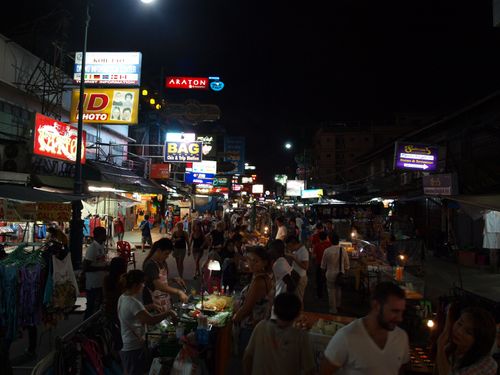
Khao San Road
Attractions
Bangkok’s backpacker carnival: curbside bars, live bands and DJs from 3pm–2am (midnight Sun). Street eats are cheap — pad thai 70–100 THB, mango sticky rice 60–100 THB. Come for wild people-watching; duck into Rambuttri for a calmer beer.
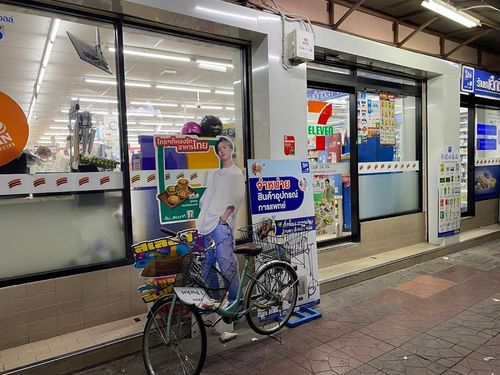
7-Eleven
Shops
Khao San’s 24/7 reset button: ice‑cold A/C, ham‑cheese toasties, All Café iced lattes, water for 7–14 THB, and late‑night supplies from snacks to sunscreen—right by Rikka Inn.
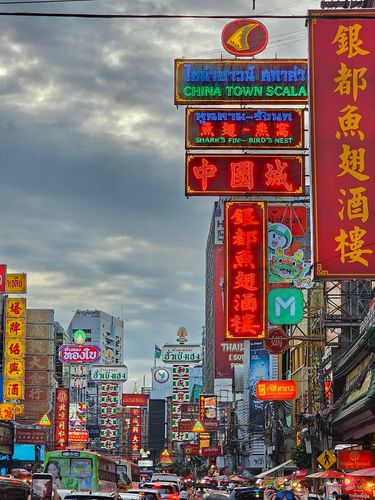
Chinatown Bangkok (Yaowarat)
Attractions
Neon, woks, and queues: Yaowarat is Bangkok’s street‑food strip. Start at Wat Mangkon MRT, graze T&K Seafood and Nai Ek’s peppery guay jub, snag toasted buns, and finish with mango sago at Sweet Time. Best 6pm–late; ~10‑minute taxi from Khao San.

Chatuchak Haus
Hotels
A 5-star hotel in Bangkok.
Railay Beach Cafe
Restaurants
Beachfront tacos and sundowners on Railay West. Nab a front table for golden‑hour views; order the tacos, som tam with crispy seafood, icy fruit shakes, and happy‑hour margaritas. Casual crowd straight off the long‑tails; stay for sunset.
Ayutthaya Art Now
Attractions
Recommended Products
More Khao San Road Guides
- Backpacker Packing List for Thailand with Electronics: Adapters, Chargers, Power Banks, and Device Protection
- Backpacker Packing List for Thailand: Electronics, Power, and Charging Adapters
- Thailand Backpacker Packing List for Electronics and Power: Adapters, Chargers, Backup Battery, and Tech Safety
- Backpacker Packing List for Thailand’s Gadget-Safe Travel: Power Banks, Adapters, and Tech Protection