Bangkok Temple Run for Photographers: Best Light, Angles, and Viewpoints at Wat Pho, the Grand Palace, and Golden Mount
How to nail bangkok temple photos like a local—best light, respectful tips, and can’t-miss angles at Wat Pho, the Grand Palace, and Golden Mount.
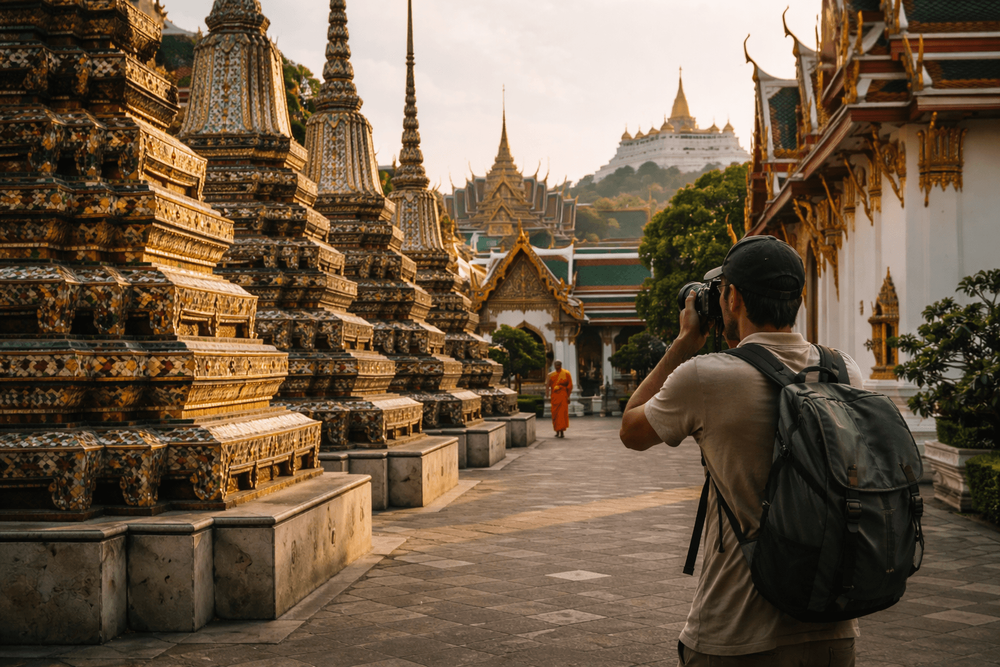
We step out from Soi Rambuttri just as the sky pinks up, tuk-tuks yawning awake and the street carts firing their woks. The air is sticky-sweet with pandan crepes and the faint rot of durian from a cart that stayed too late. This is the hour for bangkok temple photos—before the tour buses, before the AC blast of 7‑Eleven becomes a lifeline, when gold actually glows and the marble still remembers the night.
If you want the city’s sacred shimmer without the crowds, we’ll show you where to stand, when to shoot, and how to keep it respectful so we get the shot and leave good karma behind.
The Big Three (and Their Photogenic Friends)
We’re building our temple run around Wat Phra Chetuphon Wimon Mangkhalaram Rajwaramahawihan, the Grand Palace (Wat Phra Kaew), and Golden Mount (Wat Saket). Each gives you a different canvas—skin-close mosaics, palace-scale drama, and skyline panoramas. We’ll also slide in a few neighbors along the Chao Phraya that punch way above their entrance fee.
Wat Pho: Texture, scale, and sleepy morning light
- Best time: 7:30–9:00 AM for soft side light on the chedis and empty cloisters. Late afternoon also plays nicely on the tilework.
- Why we love it: The place is a mosaic jungle—turquoise, mustard, and rose tiles marching up the chedis; mother-of-pearl inlay on doorways; lines of serene Buddhas under dim eaves.
- Where to point your lens:
- The row-of-Buddhas shot along the cloister—shoot low, let the repeating hands lead your eye. A 35–50mm keeps faces natural; ultrawide exaggerates the rhythm.
- Chedi corners for tile geometry. Polarizer on; watch reflections pop after a sprinkle or morning wash.
- Reclining Buddha: go early, expose for the highlights on the face, then grab a detail—the feet’s mother-of-pearl panels are the money shot. It’s tight; an ultrawide or your phone’s 0.5x helps.
Expect a small entry fee (often in the 100–200 THB range); hours are typically around 8:00 AM–5:00 PM, but they can shift with holidays.
Grand Palace & Wat Phra Kaew: Drama and detail
- Best time: Gates not long after opening for side light on the gold chedi and minimal crowds; late afternoon if you want silhouette drama on the yaksha (guardian) statues.
- Why we love it: This is the big one—razor-edged rooflines, mirror mosaics that catch every photon, and colonnades that frame like a studio set.
- Where to point your lens:
- The golden chedi (Phra Si Rattana Chedi) with a yaksha in foreground for scale—kneel a little so the spire clears the roofline.
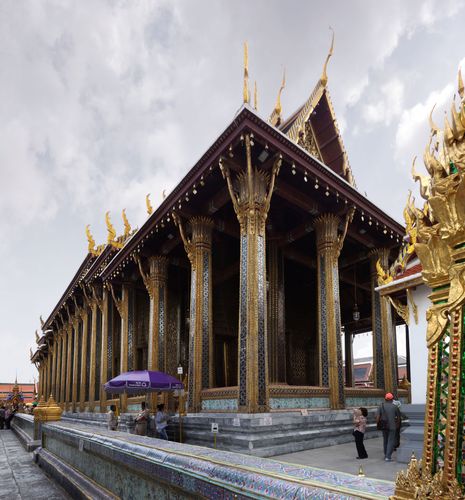
- The Emerald Buddha temple exterior—no photos inside—so work the doors, murals, and gables. Faces off: many spaces are sacred; we photograph respectfully from a distance.
- Long colonnades for vanishing-point compositions; wait for a saffron-robed monk to pass (always ask if you’re close).
Budget more here—entry can run high compared to other temples (often 500–600 THB for foreigners). Beware the classic “Grand Palace is closed” scam outside; it’s almost never closed during posted hours.
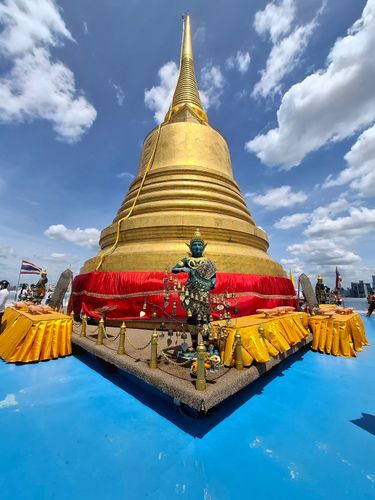
Golden Mount (Wat Saket): 360° of skyline and bells
- Best time: Golden hour to blue hour. The glow on the chedi is real, and the city twinkles without the punch-in-the-face heat.
- Why we love it: The spiral climb past rows of bells delivers a drumbeat soundtrack. Up top, we get the old city’s low-slung roofs, Chinatown haze, and a hint of skyscraper teeth to the east.
- Where to point your lens:
- Hand-on-bell details mid-staircase—motion blur at 1/20s with steady hands or phone stabilization.
- Panorama from the top—shoot at 28–35mm to dodge ultrawide distortion; or stitch a pano. The chedi base makes a luminous foreground at night.
Entry here is typically a small fee (often around 50–100 THB). Bring water—there’s shade, but Bangkok doesn’t play nice after 10:00 AM.
Bonus neighbors worth a detour
- Wat Arun (across the river from Tha Tien): Best shot from the east bank (Tha Tien or a riverside pier) at sunset. The prang becomes a silhouette torch; a 70–100mm compresses the ferries and spire.
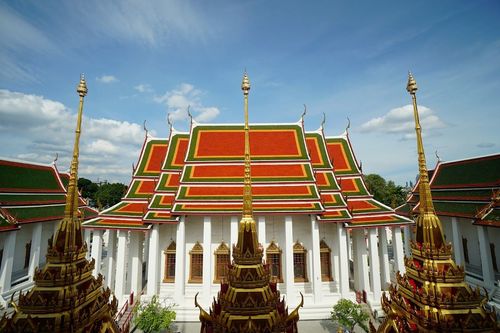
- Wat Ratchanatdaram Worawihan: Symmetry fiends, rejoice—tiers of black-metal spires stack like a mandala. Early or late for shadows that carve the geometry.
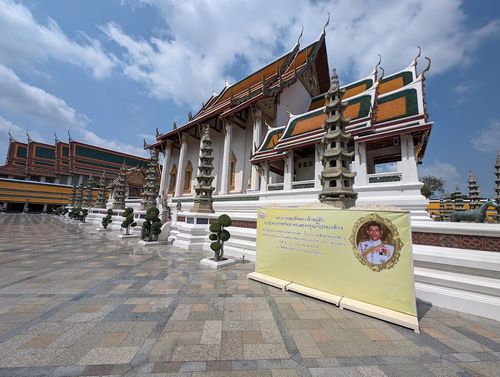
- Wat Suthat Thepwararam Ratchaworamahawihan and the Giant Swing (Sao Ching Cha): Red frame against blue sky—clean lines, strong graphic punch.
- Bowonniwet Vihara (near Khao San): Monastic calm and stately interiors—quiet corners for detail-rich close-ups.
If you want deeper framing tips per stop, we’ve packed more angles and quiet corners into our temple photo run here: Bangkok Temple Day Photo Guide: Best Angles, Viewpoints, and Shot Ideas at Wat Pho, Grand Palace, and Golden Mount.
How to Get bangkok temple photos Like a Local
Good photos come from good planning—and not passing out from heat stroke. Here’s how we play it.
Timing and light
- Dawn patrol: We roll out at first light—cooler temps, empty frames, pastel skies. Think Wat Pho first, then jump to the Grand Palace as gates open.
- Late afternoon: Swing back for Golden Mount at golden hour, then stay through blue hour for Bangkok’s glow-up.
- Midday: If you must, hunt shade—cloisters, doorways, and under eaves. A polarizer slices glare on lacquer and tile.
Dress and respect
- Shoulders and knees covered—men and women. Light pants or a long skirt beat jeans in Bangkok’s steam bath.
- Hats off indoors; shoes off at temple thresholds. Keep socks handy if hot marble isn’t your love language.
- Women shouldn’t touch monks; if offering something, place it on a cloth or let a male volunteer pass it.
- Keep it calm: temples are living spaces, not just backdrops. We shoot fast and step aside; we don’t block worshippers for “just one more.”
Behavior with cameras
- Tripods: Often restricted in main courtyards and indoors; a mini tabletop tripod or bean bag is less intrusive.
- Flash: Generally a no—especially near murals and Buddha images. Crank ISO or use window light instead.
- People shots: Ask before getting close, especially with monks. A simple “photo okay?” and a smile—sawadee—with a small wai goes far.
We keep more etiquette and gear hacks in our Khao San–centric primer: Temple Photo Tips for Wat Pho, the Grand Palace, and Golden Mount from Khao San Road.
Shot Ideas That Always Deliver
You don’t need a 10kg kit. A phone with an ultrawide, a small mirrorless, and a polarizer will cover 95% of this run. Here’s what we hunt.
Compositions and details
- Repetition: Cloister Buddhas at Wat Pho; roof tiles; prayer bells on Golden Mount. Shoot along the line for rhythm.
- Foreground frames: Doorways and gates make perfect frames—focus on the subject beyond, let the frame blur or silhouette.
- Reflections: After a rinse or quick rain, hunt puddles in Wat Pho’s marble courtyards; keep the lens close to the water for mirror-symmetry.
- Scale plays: Place a yaksha or a visitor at the corner of a giant chedi to show size; back up with a 50mm to flatten and magnify.
Light moves
- Rim light on gold: Position so the sun edges the chedi; expose for highlights to keep the gold from blowing out.
- Blue hour balance: At Golden Mount, start shooting five minutes before the lights kick in; balance city neon with a deepening sky.
- Shade portraits: If a monk or attendant agrees to a portrait, move them just inside a doorway—soft, directional light, no sweat.
Phone-specific tips
- Tap to expose for highlights around gold—let shadows fall; phones love to over-brighten.
- Use the 2x/3x tele for faces on the Reclining Buddha or guardian details. Digital zoom is better than it used to be, but real tele looks cleaner.
- Hold steady with your breath—elbows in, exhale slowly at the click. You’re a human tripod now.
For a morning-by-morning route that milks the best light at each stop, try this playbook: Bangkok Temple Run for Photographers: Best Morning Light, Viewpoints, and Photo Stops.
Rules and Restrictions You’ll Actually Encounter
Temples differ, but these guidelines will keep you out of trouble and in good standing.
- No photos in certain halls: The Emerald Buddha chamber is strictly no-photo. Some ubosot (ordination halls) at other temples are also off-limits for photography. Signs are posted—heed them.
- No flash near murals or Buddha images: Flash harms pigments and kills mood. If you see “no flash” (or no camera icon), comply.
- Tripod and drone bans: Tripods often require permission; drones are a hard no around most temples and the Grand Palace area.
- Restricted areas: Ropes, low fences, or a discreet line on the floor mean “don’t cross.” Don’t hop anything for a shot.
- Donations: Dropping 20–100 THB in a box after an indoor shoot (where allowed) is good form.
- Don’t point feet at Buddha images: Sit with legs to the side or cross-legged. It’s respectful and gets you lower angles anyway.
Getting There and Around the Old City
We start from the Khao San/Soi Rambuttri pocket because it’s minutes from everything we want.
- By river: The Chao Phraya Express Boat is our favorite move. From Phra Arthit Pier (N13), boats head south to Tha Chang (N9) for the Grand Palace and to Tha Tien (N8) for Wat Pho and the ferry to Wat Arun. Fares are usually 16–30 THB depending on distance.
- By MRT: The blue line to Sanam Chai drops you a short walk from Wat Pho/Tha Tien. Fares typically run 16–40 THB.
- By tuk-tuk: Fun, fast, and occasionally a farang tax. For short hops around Rattanakosin, 60–120 THB is normal; agree on price before you hop in and skip “special tour” offers.
- Cross-river ferry: To Wat Arun from Tha Tien it’s a few minutes and usually about 5 THB. Photo gold for the price of a bottle of water (10 THB at 7‑Eleven—blissful AC included).
Temple entry fees vary. Many run 50–200 THB; the Grand Palace is higher. Cash is king, though more places accept cards than before. Hours are typically daylight (roughly 8:00 AM–5:00 PM), with Golden Mount often open a bit later; holidays can shift timings.
Watch for the usual Bangkok curveballs: heat that suffocates by noon, sudden showers that steam-cook your shirt, and the odd tout near Sanam Luang whispering “palace closed.” We smile, keep walking, and stick to signed entrances.
Nearby Photo Spots to Stack with Your Temple Day
You’ve got momentum—let’s make it a full day with easy add-ons around the Old City and river.
Along the river
- Tha Tien market lanes: Crates of limes, hanging squid, grandmas bargaining like prizefighters—great street shots in soft morning light.
- Wang Lang market (across by ferry): A maze of snacks and uniforms; candid life and color.
- Phra Athit Road: Late light slants across shophouse facades; riverside park gives you boats against a peachy sky.
Old City wanderings
- Giant Swing square: Clean lines, shadow play, scooters threading the frame.
- Sanam Luang: Kite flyers at sunset with the Grand Palace outline in the distance.
- Khlong boat rides: Long-tail wake trails and low bridges—watch spray on your gear.
Night moves
- Golden Mount blue hour: Stay for the city flicker; it’s worth the sweat.
- Wat Arun across the water: Tripod not required—brace on a pier post, go 1/10s, ISO 800, enjoy the glow.
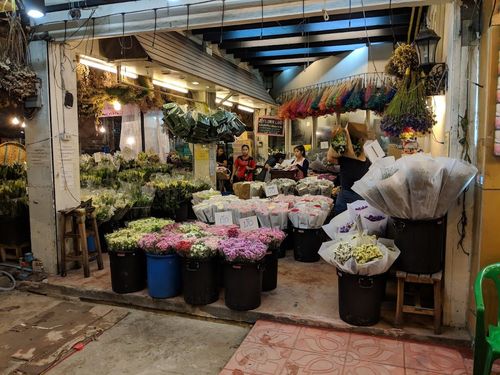
- Pak Khlong Talat (Flower Market) (flower market): Open late, fragrant and frenetic—neon bouncing off orchids and marigolds. A 35mm lens is your friend.
If we’re making a base near Khao San for this run, we look for a guesthouse with a pool and a quiet back soi—nothing like a cool plunge between sunrise and sunset shoots. Plenty of budget stays around Soi Rambuttri and Phra Athit keep us close to the action without the Grand Palace price tag.
Gear, Comfort, and Street-Smart Tips
- Light kit wins: One body, two lenses (ultrawide/standard or standard/short tele). Phones do damage too—especially in tight courtyards.
- Polarizer > ND: The CPL tames mosaic glare and deepens skies. ND is overkill unless you’re dragging shutter on water.
- Spare shirt: We sweat. You will too. Change at midday and thank us later.
- Wipes and a small towel: Temple marble is dusty; lenses and foreheads need love.
- Snacks and water: A coconut runs 40–60 THB; grilled pork sticks are 10–15 THB each—perfect pocket fuel between stops.
- Respect the line: If a monk begins chanting or a family starts a ceremony, we holster the camera and soak it in. The best shots sometimes come after.
Crafting Your Route (Our Tried-and-True Loop)
- Sunrise coffee on Phra Athit, then boat or stroll to Wat Pho for textures and that first soft light.
- Slide to the Grand Palace as it opens; work the gold and colonnades before the midday crush.
- Lunch near Tha Tien—grilled river prawns or a simple khao man gai—and a quick ferry look at Wat Arun for the postcard silhouette.
- Siesta back near Khao San (hello, blissful AC) before an ascent of Golden Mount for golden hour to blue hour.
- Optional nightcap along Phra Athit’s river bars—skyline glimmer, gentle breeze off the Chao Phraya, and your memory cards fat with keepers.
If you want even more granular angle-by-angle prompts for the Big Three, bookmark this companion: Bangkok Temple Run with the Best Photo Stops: Wat Pho, Grand Palace, and Golden Mount from Khao San Road.
Parting Shot
Bangkok rewards the early, the patient, and the curious. We’ll trade an extra hour of sleep for spires that glow and courtyards that belong to us and the stray cats. Pack light, smile often, and let the bells of Golden Mount ring you into blue hour. Tomorrow we’ll chase long-tail wakes on the khlongs and find a new angle on those yaksha—because in this city, sanuk never runs out, and neither do the bangkok temple photos.
Related Hotels & Places
Wat Phra Chetuphon Wimon Mangkhalaram Rajwaramahawihan
Temples
The Grand Palace
Attractions
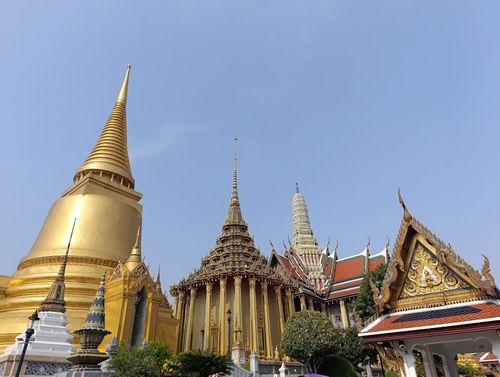
Bangkok’s royal showpiece a short hop from Khao San: glittering Wat Phra Kaew, Ramakien murals, and gold-on-gold rooftops. Go 8:30am to dodge the heat, dress modestly, and boat to Tha Chang for the prettiest arrival.
Wat Phra Kaew
Temples
Bangkok’s holiest temple inside the Grand Palace. Go early (8:30am–3:30pm). Buy the 500 THB ticket at Na Phra Lan Rd gate. Dress code enforced. Marvel at Ramakien murals and the tiny Emerald Buddha whose robes change with the seasons. 10–15 minutes’ walk from Khao San.
Wat Saket Ratchawora Mahawihan
Temples
Wat Arun Ratchawararam Ratchawaramahawihan
Temples
Wat Ratchanatdaram Worawihan
Temples
Bangkok’s Loha Prasat “metal castle” steals the scene—37 spires, serene courtyards, and golden-hour light. An easy 15‑minute walk from Khao San, open daily 8am–5pm. Come early for quiet, or late for the best photos.
Wat Suthat Thepwararam Ratchaworamahawihan
Temples
Serene counterpart to the Giant Swing: a soaring hall, Sukhothai‑era 8 m bronze Buddha, and some of Bangkok’s finest murals. An easy 15‑minute walk from Khao San; open daily till 8pm for golden‑hour visits.
Khao San Road
Attractions
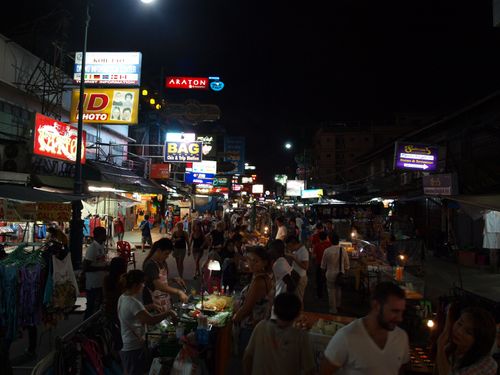
Bangkok’s backpacker carnival: curbside bars, live bands and DJs from 3pm–2am (midnight Sun). Street eats are cheap — pad thai 70–100 THB, mango sticky rice 60–100 THB. Come for wild people-watching; duck into Rambuttri for a calmer beer.
Pak Khlong Talat (Flower Market)
Markets
Bangkok’s 24‑hour flower market by Memorial Bridge. Best after midnight when trucks unload orchids, marigolds, roses and fragrant jasmine garlands. Photogenic, lively, and easy to reach from Khao San for a late‑night wander.
More Khao San Road Guides
- Bangkok Temple Run for Photographers: Best Morning Light, Viewpoints, and Photo Stops at Wat Pho, the Grand Palace, and Golden Mount
- Bangkok Temple Run for Photographers: The Best Light, Viewpoints, and Shot Order for Wat Pho, the Grand Palace, and Golden Mount
- Bangkok Temple Run for Photographers: Best Light, Angles, and Low-Crowd Shots at Wat Pho, the Grand Palace, and Golden Mount
- Bangkok Temple Day Photo Guide: Best Angles, Viewpoints, and Shot Ideas at Wat Pho, Grand Palace, and Golden Mount