Bangkok Street Food Ordering Guide: How to Read Menus, Point to Dishes, and Avoid Surprises Near Khao San Road
Order street food near Khao San with confidence: key Thai phrases, menu tips, prices, etiquette, spice levels, and how to avoid surprises.
We’re shoulder-to-shoulder on Soi Rambuttri, sweat beading as a wok hisses and spits garlic into the night air. A vendor fans the coals under moo ping skewers, sweet pork fat sizzling. Somewhere behind us a blender attacks a mango, and from Khao San Road the thump of bass spills over a chorus of sawadee hellos. This is why we came: to eat. This Bangkok Street Food Ordering Guide is our cheat sheet for getting fed around Khao San without pointing blindly, overpaying, or ending up with napalm-level chilies when we wanted mild.
Key Thai phrases you’ll actually use (and how to say them)
If we can say three words, it should be hello, please, and thank you. Toss in a few food terms and magic happens. Don’t stress tones—smile, be polite, and you’ll get fed.
- Sawadee krub/ka: Hello (krub for men, ka for women)
- Khob khun krub/ka: Thank you
- Kin tee nee / Ao glap baan: Eat here / Take away (also works: “sai toong” = put in a bag)
- Mai phet / Phet nit noi: Not spicy / A little spicy
- Mai sai …: Don’t add … (example: mai sai prik = no chili, mai sai tua-lisong = no peanuts)
- Phoem … / Lom …: Add more … / Less … (phoem nam = more soup, lom waan = less sweet)
- Khao: Rice
- Kaidao: Fried egg (add one: “sai kaidao”)
- Moo / Gai / Neua / Goong / Pla muek: Pork / Chicken / Beef / Shrimp / Squid
- Jay / Mangsawirat: Strict vegetarian (no egg/fish sauce) / Vegetarian
- Nam / Haeng: With soup / Dry (for noodles)
- Sen lek / Sen yai / Ba mee: Thin rice noodles / Wide rice noodles / Egg noodles
- Tao rai?: How much?
- Ok mai (ok dai)?: Is it okay/possible?
If you want a deeper dive into Thai food words and pronunciation tips, we’ve got a focused phrase guide here: Bangkok Street Food for Non-Thai Speakers: Essential Phrases, Menu Clues, and Easy Orders.
How to pick a vendor, read menu signs, and ID dishes by sight
We love Khao San’s circus, but the best bites usually orbit it: Soi Rambuttri’s tree-lined ring, Phra Athit Road by the river, Chakrabongse Road toward Banglamphu Market, and the little sois off Tanao and Samsen. Follow these rules and we eat well:
- Go where locals queue. A short line means turnover, freshness, and seasoned hands. Better to wait 5 minutes than risk sad noodles.
- Scan the setup. A tidy cart, separate cutting board for raw meats, a covered pile of herbs, and clean oil are green flags. If the oil looks black and smells burnt, we keep walking.
- Look for price boards. Handwritten signs with Thai numbers are common; if there’s no price anywhere on Khao San itself, expect a “tourist tax.” Normal plates: 40–70 baht around Banglamphu, more on the main strip late at night.
- Trust your nose. The sweet-charred smell of gai yang (grilled chicken), the lemongrass-lime punch of tom yum, and the caramel smoke of pad kra pao are hard to fake.
Reading signs and spotting dishes:
- “ข้าว” (khao) = rice dishes. You’ll see combos like ข้าวกะเพรา (khao kra pao), basil stir-fry on rice; ข้าวมันไก่ (khao man gai), Hainanese chicken rice; ข้าวหมูกรอบ (khao moo krob), crispy pork on rice.
- “ก๋วยเตี๋ยว” (guay tiao) = noodles. Pick noodle width (sen lek/yai/ba mee), broth (nam) or dry (haeng), and protein.
- “ผัดไทย” (pad thai) is usually spelled out in English around Khao San, but the stall with a blazing wok and a queue of aunties is the one we want.
- Visual clues: Pink soup with tofu and morning glory? That’s yen ta fo. Fat crispy pork cubes on the counter signal moo krob. Clay pots and piles of fresh papaya = som tam station.
If menus feel cryptic, this breakdown helps: How to Order Street Food in Bangkok: Thai Menu Words, Queue Etiquette, and Stall-Side Customs.
Step-by-step: ordering, spiciness, paying, and getting exactly what we want
Bangkok stalls follow a rhythm. Once we learn the dance, dinner becomes easy.
- Join the queue, mentally order early
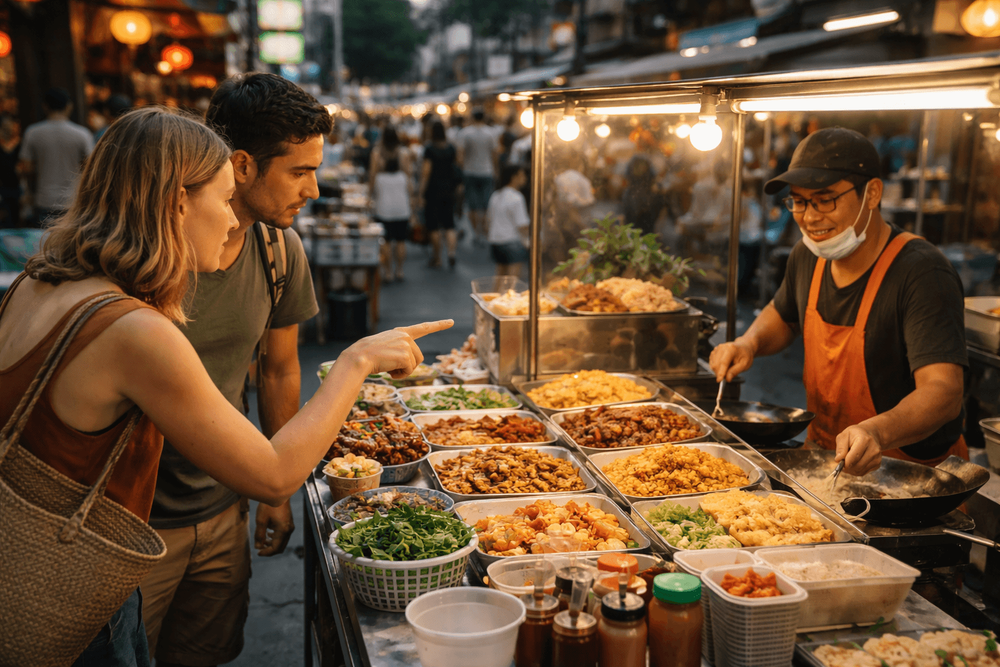
- Street queues are loose. If the vendor makes eye contact, we lift a finger and say “ao …” followed by our dish. If in doubt, stand behind the person being served and edge forward.
- At rice-and-curry shops (khao kaeng), we point at trays, say “ao an nee” (this one), hold up fingers for portions, and say “kin tee nee” or “ao glap baan.”
- Customization: noodles, soup, and spice
- Noodles: sen lek (thin), sen yai (wide), ba mee (egg), wun sen (glass noodles). If we don’t care, the cook will pick a default.
- Soup or dry: “nam” for broth, “haeng” for dry. Dry noodles come with a small broth on the side at some stalls.
- Spice: “mai phet” (not spicy) or “phet nit noi” (a little). We can always level up using the table caddy—chili flakes (prik pon), vinegar with chilies (prik nam som), fish sauce (nam pla), and sugar.
- Add-ons: “sai kaidao” (fried egg, usually +10–20 baht), “sai moo krob” (add crispy pork), “phoem khao” (extra rice), or “phoem sen” (extra noodles). Don’t want something? “mai sai …”
- Special diets and allergies
- Vegetarian: “gin jay” signals no meat, egg, or fish sauce at many stalls that know the term. If we just want vegetarian without strict rules: “mangsawirat” or “mai sai neua sat” (no meat) and “mai sai nam pla” (no fish sauce).
- Peanuts: “mai sai tua-lisong.” Shellfish: “mai sai goong/pla muek.” If it’s a serious allergy, we say “pae …” (allergic) and consider a place with clearer control.
- Takeaway vs eat-in
- Eat here: “kin tee nee” and point to an empty stool or table.
- Takeaway: “ao glap baan” or “sai toong.” Most stalls will bag soup separate from noodles; if not, we can ask “haeng dai mai?” (dry, please?) so it travels better.
- Payment
- Some carts take money up front; most shophouse stalls tally at the end. We keep small bills (20s, 50s, 100s). Around Khao San, more vendors accept Thai QR (PromptPay). If we need a refresher on safe paying and what to expect, see: Bangkok Street Food for First-Time Visitors: How to Order, Pay, and Eat Safely.
- Sauce yourself
- Bangkok street food comes balanced, then we tune it. A splash of prik nam pla on khao man gai, a dusting of chili on boat noodles, a spoon of sugar to round tom yum (yes, locals do it). The caddy is our paintbox.
Street food etiquette and hygiene that keep things sanuk, not stressful
Bangkok’s chaos works because everyone cooperates. A little etiquette goes a long way.
- Share the space. If there’s one free chair at a four-top, we sit and nod hello. It’s normal. Don’t sprawl.
- Order first, sit second. At busy ramen-fast pad thai carts, queue, order, then hover for a seat. If staff ask us to move, we move. No one’s offended.
- Don’t block the cart. Knees and bags tucked in—give scooters, delivery bikes, and aunties with soup pots a lane.
- Chopstick and spoon etiquette. Eat noodles with chopsticks and spoon; rice dishes with fork (to push) and spoon (to eat). No knives.
- Napkins are scarce. We carry tissues or a small towel; most stalls provide a box of thin napkins.
- Ice is fine. Bangkok’s ice is made from filtered water. Street drinks with ice are normal. If our stomach is fragile, we skip crushed ice and ask for “mai sai nam keng” (no ice).
- Hygiene triage. We look for busy turnover, hot food hot, cold food cold, separate raw/cooked stations, and covered ingredients. If cut fruit sits in direct sun or seafood smells off, we bail. Quick extra tips live here: Bangkok Street Food Etiquette: How to Order, Pay, Sit, and Eat Like a Local.
- Pricing transparency. If there’s no price on the board, we ask “tao rai?” before ordering. On Khao San itself, late-night pad thai can jump to 80–120 baht; a two-minute walk to Tanao or Chakrabongse can halve that.
- Tuk-tuk detours. If a driver promises a “famous cheap food market” instead of Banglamphu, we smile, say “mai ow krub/ka,” and hop out. We’re here to eat, not tour a gem shop.
Must-try Bangkok street foods near Khao San (with what to say and what you’ll pay)
We’ll never finish them all in one night, but here’s what we grab depending on craving, diet, and hunger level.
For the spice-curious (not too fiery)
- Khao man gai (Hainanese chicken rice) — Tender poached chicken on fragrant rice with a gingery dipping sauce. Say: “khao man gai, kin tee nee, mai phet.” Price: 50–70 baht. Add liver? “sai dtap.”
- Pad thai — The Khao San classic. Ask for “pad thai goong” (with shrimp) or “pad thai jay” (vegetarian). To keep it mellow: “mai phet.” Price: 60–100 baht on main strips, less on side sois.
- Kai jeow (Thai omelet on rice) — Fluffy, crisp edges. Customize: “kai jeow moo sap” (minced pork) or “jay” (veg). Add sriracha if you want heat. Price: 40–60 baht; +10–20 for kaidao add-ons elsewhere.
For noodle nerds
- Guay tiao rua (boat noodles) — Intense, aromatic broth; tiny bowls so we order 2–4 each. Say: “guay tiao rua, sen lek, moo, phet nit noi.” Price: 15–25 baht per small bowl off the main drag; touristy spots charge more.
- Guay jub (rolled rice noodles) — Peppery soup with crispy pork. “guay jub moo krob, phet nit noi.” Price: 50–70 baht.
- Yen ta fo — Pink fermented bean curd broth with fish balls and morning glory. Not spicy unless we add. “yen ta fo, mai phet.” Price: 50–70 baht.
For grill-and-go
- Moo ping — Sweet-grilled pork skewers, best with sticky rice (khao neow). “moo ping saam mai, khao neow neung.” Price: 10–20 baht per stick; sticky rice 10–15 baht.
- Gai yang — Charred, juicy chicken. We point to the piece (wing, thigh) and say “ao …” Price: 40–90 baht per piece depending on size.
- Sai krok Isan — Tart, garlicky fermented sausage with chilies and cabbage. “ao song, mai phet” if we’re spice-shy. Price: 20–30 baht per ball.
For salad lovers
- Som tam (papaya salad) — Customize everything. Our base order: “som tam thai, phet nit noi.” For no dried shrimp or fish sauce (veg-friendly): “mai sai goong haeng, mai sai nam pla.” Price: 50–70 baht. Sticky rice on the side is a must.
For curry cravings
- Khao kaeng (rice and curry) — We point to two trays and say “song yang” (two kinds). Go mild with massaman; go fragrant with green curry. Price: 40–60 baht for two curries over rice; add a fried egg for +10–20 baht.
For sweet teeth and night owls
- Roti (Thai-style pancake) — Banana and condensed milk is the Khao San crowd-pleaser. “roti gluay, mai waan maak” if we want it less sweet. Price: 35–60 baht.
- Mango sticky rice — Seasonal mango, coconut cream. “khao neow mamuang.” Price: 60–120 baht depending on mango.
- Thai iced tea/coffee — “cha yen” or “oliang.” Dial back sugar: “lom waan” or “mai waan.” Price: 25–45 baht.
Vegetarian and vegan strategies
We lean into stalls that cook to order: pad kra pao jay (basil stir-fry with tofu/mushrooms), pad see ew jay (stir-fried wide noodles), som tam thai without fish sauce, and tofu noodle soups. Phrases to keep handy: “gin jay,” “mai sai nam pla,” and “mai sai goong/pla muek.” Many vendors understand “vegetarian” in English near Khao San, but saying jay gets us further.
Know before you go: timing, cash, and little hacks
- Best windows: Early morning around Banglamphu Market for khao man gai and jok (rice porridge), lunch for noodles and curry, and 6 pm–late for grills and pad thai. Some carts pop up only after dark.
- Cash rules: Most carts are cash-only. Keep small bills. ATMs cluster on Khao San and Phra Athit.
- The 7-Eleven shuffle: Need a break? Duck into 7-Eleven for the blessed AC blast and grab wet wipes.
- Rain plan: Vendors throw up tarps fast, but puddles form faster. Wear sandals that don’t mind a khlong’s worth of splash.
- Stomach pacing: Start mild, build heat day by day. Bangkok chilies humble farang bravado.
- Late-night surge: Prices creep up after midnight on Khao San. If we want value, we drift to Phra Athit or the lanes toward Samsen.
If you want even more first-timer context—spotting the best stalls, what a fair price looks like, and extra hygiene pointers—bookmark this: Bangkok Street Food for First-Time Visitors: A Practical Guide to Ordering, Hygiene, and Must-Try Classics.
Getting there: Khao San, Soi Rambuttri, and the Banglamphu triangle
- By river: Ride the Chao Phraya Express Boat to Phra Arthit Pier (N13). From there it’s a 10-minute stroll to Soi Rambuttri and Khao San. Sunset on Phra Athit Road is a mood—grab your first skewer en route.
- By MRT: Sam Yot or Sanam Chai are the closest stations; from either, it’s a short taxi or tuk-tuk ride. Agree on a fare first or insist on the meter.
- By bus: Air-con buses run along Ratchadamnoen. They’re cheap, crowded, and a rite of passage—keep an eye on your stop.
- Walking grid: Khao San is the neon spine; Soi Rambuttri loops behind it under banyans; Phra Athit hugs the river; Tanao and Chakrabongse shoot toward old-town temples. We graze in circles.
Where we crash between feasts (without the hard sell)
Around Khao San, we usually pick a spot with a pool and quiet-ish nights so we can hit the morning market fresh. If you’re sticking close to Soi Rambuttri or Phra Athit, look for places set back from the main drag—courtyards mean fewer 3 am basslines. If you’re on a budget, simple guesthouses on Samsen Road trade nightlife noise for riverside breezes. Mid-range fans can find shophouse hotels near Phra Athit with rooftop nooks that make an excellent mango-sticky-rice perch.
Sample orders you can copy tonight
- “Pad kra pao moo sap, phet nit noi, sai kaidao, kin tee nee.” Basil pork with a little spice, fried egg, eat here.
- “Guay tiao sen lek moo, nam, mai phet.” Thin noodles with pork, in soup, not spicy.
- “Som tam thai, mai sai nam pla, ao glap baan.” Papaya salad, no fish sauce, take away.
- “Khao man gai nueng, lom waan, kin tee nee.” Poached chicken rice, less sweet sauce, eat here.
- “Roti gluay, mai waan maak.” Banana roti, not too sweet.
Final bite: our Khao San playbook
We roll in early evening, start with moo ping on Chakrabongse, slurp a bowl of guay jub on Tanao, claim a stool for pad thai on the quieter side of Soi Rambuttri, then finish with roti near the temple end of Khao San. We keep small bills, order in simple Thai, and let the condiment caddy do the heavy lifting. Tomorrow we’ll chase boat noodles off Samsen and a green-curry-over-rice lunch near Banglamphu Market—meet us by the stall with the biggest line. If you want a deeper “Bangkok Street Food Ordering Guide” toolbox to bring along, keep this page open and cross-check with our in-depth tips here: Bangkok Street Food Ordering Guide: Thai Phrases, Spice Levels, and Customization Tips.
Related Hotels & Places
Khao San Road
Attractions
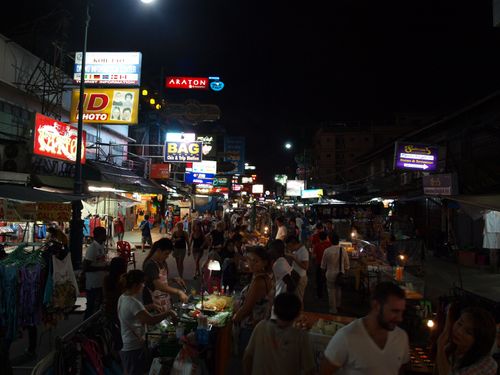
Bangkok’s backpacker carnival: curbside bars, live bands and DJs from 3pm–2am (midnight Sun). Street eats are cheap — pad thai 70–100 THB, mango sticky rice 60–100 THB. Come for wild people-watching; duck into Rambuttri for a calmer beer.
Coco Chao Phraya
Restaurants
Riverfront terrace with Rama VIII Bridge views, a short walk from Khao San. Modern Thai–European plates alongside pizzas and pastas; cold beers and cocktails for sunset. Open daily 10am–10pm.
7-Eleven
Shops
More Khao San Road Guides
- Bangkok Street Food for First-Timers: Must-Try Dishes Near Khao San Road and How to Spot the Real Version
- Bangkok Street Food for Breakfast, Lunch, and Dinner: A Meal-by-Meal Guide Beyond Khao San Road
- Best Thai Dishes to Try at Bangkok Street Food Stalls: A Khao San Road Ordering Guide
- Bangkok Halal Street Food Guide: Where to Eat Around Khao San Road and Beyond