
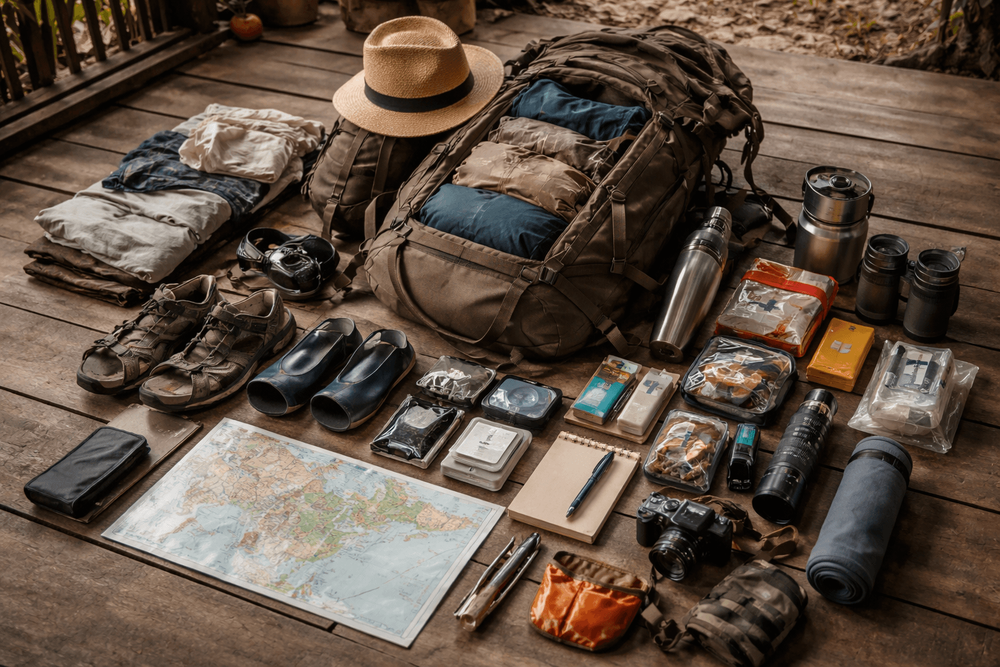
Backpacker Packing List for Thailand’s Remote Area Trips: Modest Clothing, Backup Supplies, and Self-Sufficiency Essentials
Field-tested gear for rural Thailand: modest clothes, first-aid, power backups, dry bags, and cash tips for islands, mountains, borders, and monsoon.
We step off the back of a songthaew at dusk and the road goes quiet—no Grab cars, just cicadas, a distant rooster, and smoke from a charcoal grill curling over a wooden porch. This is where the city stops and the real trip begins. Out here, in the gaps between bus schedules and cell towers, our Thailand remote area packing list becomes less about looking cute on Khao San and more about staying dry, respectful, charged, and sanuk—still having fun—when there’s nowhere to buy what we forgot.
Data Freshness + Pricing:
- Prices are approximate and in THB.
- Last checked: July 2026.
- Happy hour and promo details change frequently—confirm locally.
Thailand Remote Area Packing List: The Field-Tested Mindset
We’re packing for places like Koh Phayam without ATMs, the red-dirt backroads of Isaan, misty Mae Hong Son loops, and park stations at Khao Sok where leeches are hungrier than we are. Cash matters, modesty matters, and redundancy matters—spare power, spare light, spare copies. We’ll still play it by ear (this is Thailand), but we’ll be ready when the only shop sells instant noodles, fuel, and flip-flops two sizes too small.
Tip: When we say “approx.” for prices, think Bangkok 7-Eleven baseline; remote villages often charge a little more or simply won’t have it in stock.
Essential Clothing and Footwear for Heat, Humidity, Rain, and Rural Life
We love a breezy singlet on Soi Rambuttri, but in villages and border zones, modest comes first. Pack light, quick-dry layers you can wear respectfully in temples and homestays—and that still breathe when the air feels like a warm wet blanket.
Clothing
- Quick-dry tops (2–3): Lightweight, breathable fabrics. Long-sleeve sun shirts help in midday heat and reduce the need for constant sunscreen.
- Modest bottoms (2): Loose trousers or knee-length shorts/skirts. Save the short-shorts for the islands with farang crowds.
- One sarong/pha khao ma: Picnic blanket, temple cover-up, bus pillow, emergency towel. Buy local for approx. 80–150 THB.
- Light rain shell or poncho: A packable jacket or a market poncho (approx. 30–60 THB) for instant cloudbursts.
- Ultralight fleece or thin sweater: Nights get cool in the mountains (Dec–Jan) and on air-con buses where the AC blasts like the inside of a 7-Eleven.
- Sleepwear that doubles as layer: A thin base layer top/leggings for cool nights or modest homestays.
- Swimwear + cover-up: Reef-safe sunscreen later; cover up when not at the beach.
- Underwear (4–6) and quick-dry socks (3–4): Thick cotton never truly dries in the monsoon.
- Sun hat or cap + bandana/buff: Keeps sweat and sun off; the buff doubles as a dust mask on red roads.
If you’re temple-hopping while you bounce through small towns, we’ve got a dedicated clothing rundown here: Thailand Packing List for Backpackers Visiting Temples and Remote Towns.
Footwear
- Trail runners or sturdy sneakers: Enough grip for muddy tracks and steep park stairs.
- Strap sandals (tough soles): For ferries, wet markets, slippery piers, and khlong-side rambles.
- Cheap rubber flip-flops: Shower shoes, bungalow stoops, hostel floors—buy for approx. 80–150 THB if you didn’t bring them.
- Optional: Leech socks for deep jungle (Khao Sok, Kaeng Krachan) in rainy months.
Laundry and Drying
- Travel clothesline + a few pegs: String it under a bungalow awning; tropical rain can flop in suddenly.
- Soap sheets or a thumb-sized packet of powder detergent: 7-Eleven mini packs cost approx. 10–20 THB, but may not exist in tiny villages.
- Pack liner or dry bag doubles as a compression bag for damp clothes—contain that wet-dog smell.
Must-Have Health, Hygiene, and First-Aid for Limited-Access Areas
Out here, the pharmacy might close at sundown—or not exist. Bring a “tiny clinic” so we’re not stuck Googling symptoms on a single bar of AIS.
First-Aid Core
- Blister kit: Hydrocolloid plasters (Compeed-style), tape, antiseptic wipes.
- Elastic bandage + gauze + tape: Twists, scrapes, and scooter kisses.
- Small tweezers and a needle: Splinters, sea urchin spines.
- Oral rehydration salts: Lifesaver after heat, runs, or long treks (approx. 10–20 THB per packet in towns; pre-pack a few).
- Thermometer (compact) and a few pairs of gloves.
Meds to Consider
- Pain/fever: Paracetamol or ibuprofen.
- Antihistamine: For bites and mystery rashes.
- Anti-diarrheal + probiotics: Loperamide for buses; probiotics to reset the gut.
- Motion sickness: Mountain switchbacks and longtail boats don’t care how tough we are.
- Any prescription meds + copies of scripts: See a travel clinic before you go; pack enough for delays.
Bite Defense and Sun
- Repellent: DEET or picaridin. Small bottle for daypack, spare in main pack. Local brands run approx. 80–180 THB.
- After-bite balm: Tiger Balm or aloe (approx. 30–80 THB) to keep the itch from driving us feral.
- Sunscreen SPF 50, ideally reef-safe for islands. Expect approx. 250–550 THB; pricier in remote shops.
Water and Hygiene
- Filtration: A small squeeze filter or UV pen, plus backup chlorine dioxide tabs. Remote taps and tanks can be iffy.
- Bottles: One hard bottle for boiled water, one collapsible for extra capacity.
- Hand sanitizer + biodegradable soap sheets + a small pack of tissue. Rural squats don’t always provide paper.
- Quick-dry travel towel: Doubles as a scarf on freezing buses.
- Menstrual products: Pads are common; tampons less so. Cups work well—bring cleaning tabs.
- Light mosquito net (optional): Many bungalows have nets, but if you’re super rural, a compact one with cord weighs little and buys sleep.
- N95/FFP2 masks: Burning season in the North (roughly Feb–Apr) can spike PM2.5; budget approx. 30–60 THB each in cities.
For a deeper dive into tiny-town realities—cash, clinics, and gear that survives dirt roads—bookmark this: Backpacker Packing List for Thailand’s Remote Towns: Small-Town Basics, Cash, and Limited-Service Travel Gear.
Power, Connectivity, Navigation, and Document Essentials When Services Are Scarce
When the lights go out at 10 p.m. and the only outlet is a wonky two-prong under a TV shrine, we’ll be glad we packed backups.
Power
- Power bank 20,000 mAh: Big enough to juice phone + headlamp for a multi-day loop.
- Dual-port USB wall plug with built-in surge protection: Thailand uses 220V; most sockets accept flat or round pins. A slim universal adapter helps.
- Headlamp with red mode: Hands-free in bungalows, on night ferries, and for dawn temple walks.
- Spare cables + a short extension lead: Guesthouses often have that one awkwardly placed plug.
Connectivity
- SIM: AIS/DTAC/True—coverage varies, but AIS often does better in far-flung spots. Prepaid data packs run approx. 200–400 THB/week. eSIM helps if you lose a physical card.
- Offline maps: Download areas on your app of choice before leaving the big town. Pin the bus stop, ranger station, and your homestay while you’ve got signal.
- Backup phone or a tiny feature phone: Useful for calls when smartphones die, and cheap top-ups are everywhere.
Navigation and Docs
- Paper copies backed up to cloud: Passport, visa, travel insurance, emergency contacts.
- Waterproof pouch: For passport, vaccine docs, and cash on boat days.
- Small notebook + pen: Write Thai phone numbers, homestay names, and directions the old-school way.
- Cash stash: ATMs can be 50–100 km apart. Foreign ATM fees run approx. 220–250 THB per withdrawal—pull enough, keep small bills for songthaews (approx. 20–50 THB short hops).
If weight is tight because you’re hopping budget airlines with hard limits, plan your grams here: Thailand Backpacker Packing List for Budget Airlines and Weight-Limit Fees.
Practical Gear for Transport, Weather Protection, and Day-to-Day Comfort Off the Grid
Good gear turns chaos into a shrug and a smile. We’re not bringing a mountaineering kit—just smart, compact stuff that solves common Thailand problems.
Bags and Waterproofing
- 30–40L main pack + 15–20L daypack: Comfortable on dusty shoulders and ferry gangplanks.
- Pack liner or heavy-duty trash bags: Rainproof from the inside out.
- Dry bags (5L + 10L): Phones and clothes stay bone-dry on longtails and during monsoon dumps (approx. 120–250 THB at markets in bigger towns).
- Rain cover for daypack: Wind plus sideways rain is a thing.
Road-Trip Fixers
- Duct tape + zip ties + a few carabiners: Bungee your bag to a songthaew rail, hang a net, fix a sandal.
- Cable lock + small padlock: Locker insurance; also keeps your bag from walking off a pier.
- Compact multi-tool (check in luggage): Tighten a scooter mirror, snip a tag, open a can when the shop is closed.
Daily Comfort and Food
- Reusable utensil set + tiffin or collapsible bowl: Perfect for market curries and zero-waste leftovers.
- Electrolyte tabs and a couple of energy bars: There will be meals at weird hours.
- Insulated bottle or sleeve: Keeps that roadside cha yen cold longer.
- Lightweight umbrella: Shade at noon, shelter at midnight.
Sleep and Lights
- Sleep mask + earplugs: Roosters don’t care about our bedtime. Neither do feral geckos.
- Silk/cotton sleeping bag liner: Extra comfort in bamboo huts or basic homestays.
- Spare torch or keychain light: Headlamps roll under beds. Experience talking.
Water and Swim
- Reef-safe sunscreen + long-sleeve rash guard: For snorkel days when we roast.
- Lightweight water shoes: Coral cuts and rocky rivers ruin trips.
- Vinegar sachets in the first-aid kit: For jellyfish stings in known hotspots.
For longer countryside loops where roads turn to ruts and shops to silence, cross-check with our rural gear picks: Backpacker Packing List for Thailand’s Countryside: Small-Town Stays, Dirt Roads, and Rural Comforts.
Regional and Season-Specific Packing: Islands, Mountains, Borders, Monsoon
Thailand’s regions have personalities—and packing quirks—to match.
Islands (Andaman and Gulf)
- Dry bag all day, every day: Longtails and salt spray will test your zips.
- Waterproof phone pouch (approx. 100–200 THB at beach markets): Photos without panic.
- Snorkel rash guard + leggings: Sun protection beats reapplying sunscreen every hour.
- Antiseptic and butterfly strips: Coral scrapes are notorious.
- Cash buffer: Islands like Koh Phayam or Koh Jum may have limited ATMs or outages.
Mountains and the North (Chiang Mai, Mae Hong Son, Nan)
- Warm layers: Fleece, beanie, and thicker socks Nov–Jan. Dawn rides get nippy.
- Dust mask/N95: Burning season (often Feb–Apr) can be harsh.
- Motion sickness tabs: Mae Hong Son loops are a ballet of switchbacks.
- Respectful clothing: Hill-tribe villages are conservative; cover shoulders and knees.
Border Areas (Mae Sot–Umphang, Golden Triangle, eastern crossings)
- Passport on you, copies in your bag. Occasional checkpoints are normal.
- Turn off auto international roaming near borders to avoid surprise charges.
- Be drone-cautious: Sensitive zones exist. When in doubt, don’t launch.
- Extra snacks and water: Distances between villages stretch out.
Monsoon Travel (varies by coast)
- Fast-dry everything: Cotton becomes a soggy regret.
- Footwear strategy: Sandals for wet, runners for traction. Newspaper (or desiccant) to dry overnight.
- Pack liner + poncho redundancy: Storms can pin us down; we still need to move.
- Anti-fungal powder: Feet will thank us.
Isaan and Dry-Heat Plains
- Sun sleeves and a serious hat: Fields reflect heat like a mirror.
- Extra ORS: Work and transit can mean long, hot gaps between shops.
- Lightweight scarf: Dust guard on windblown rural rides.
Know Before You Go: Street-Smart Tips for Remote Thailand
- Cash and Change: Keep a stash of small bills (20s, 50s, 100s). Ferries and songthaews prefer exact change. Longtail transfers can run approx. 100–300 THB per person depending on distance.
- National Parks: Foreign entry fees typically run approx. 200–500 THB. Keep your ticket; re-entry policies vary.
- Transport Quirks: Rural buses don’t always match the posted times. Ask the market auntie. A smile and a “sawadee krub/ka” goes far.
- Scooter Smarts: Helmets on, lights checked, and never ride at night on unfamiliar rural roads. Potholes and dogs appear like ghosts.
- Stray Dogs: Be calm, don’t run. A firm “mai” (no) and steady pace usually works.
- Cultural Respect: Cover shoulders/knees in villages and temples; ask before photos. Your sarong is the Swiss Army knife of modesty.
- Insurance and Backups: Medical evacuations aren’t cheap. Screenshot policies and hotline numbers.
- Waste and Water: Pack out trash where bins are scarce. Use filters and refill when you can.
If you’re stringing these remote stops into a longer wander, we’ve road-tested a list that’ll hold up month after month: Thailand Packing List for Backpackers on a Long-Term Trip: Reusable Gear, Laundry Setup, and Durable Basics.
What We Actually Carry (A Quick Snapshot)
- Clothing: 2–3 quick-dry tops, 2 bottoms, 1 long-sleeve, 1 light fleece, sarong, swimwear, 4–6 underwear, 3–4 socks, hat.
- Footwear: Trail runners, strap sandals, flip-flops.
- Health: Mini first aid, ORS, meds, repellent, sunscreen, sanitizer, wipes, menstrual kit.
- Water: Filter, 1 hard bottle + 1 collapsible.
- Power: 20,000 mAh bank, wall plug, headlamp, cables.
- Docs: Passport + copies, insurance, cash pouch, waterproof sleeve.
- Bags: 35L pack, 15–20L daypack, pack liner, 5L/10L dry bags, rain cover.
- Extras: Clothesline, pegs, duct tape, zip ties, carabiners, utensil set, tiffin, snacks, umbrella, mask.
LifeStraw Personal Water Filter
We’ll leave the city lights of Phra Athit Road behind, catch the Chao Phraya Express to Chao Phraya Tourist Boat N13 Phra Arthit Pier, and ride whatever comes—bus, pickup, or longtail—to the quiet edge. Pack this way and we’ll still be laughing when the rain hits sideways and the power blinks out. Text us when you land; we’ll meet you by the noodle cart with a bag of mango sticky rice and a spare poncho.
Related Hotels & Places
Recommended Products
More Khao San Road Guides
- Backpacker Packing List for Thailand’s Countryside: Small-Town Stays, Dirt Roads, and Rural Comforts
- Backpacker Packing List for Thailand’s Remote Towns: Small-Town Basics, Cash, and Limited-Service Travel Gear
- What to Pack for Thailand for Rural Villages and Small-Town Stops: Modest, Practical Backpacker Essentials
- Backpacker Packing List for Thailand for Remote Areas and Small Towns: Cash, Power, and Hard-to-Buy Basics