
How to Spot the Best Bangkok Street Food Stall: Freshness, Queue Clues, Hygiene, and Value Near Khao San Road
Bangkok street food stall tips you can actually use near Khao San: freshness cues, queues, hygiene, ordering, and where to hunt without tourist markups.
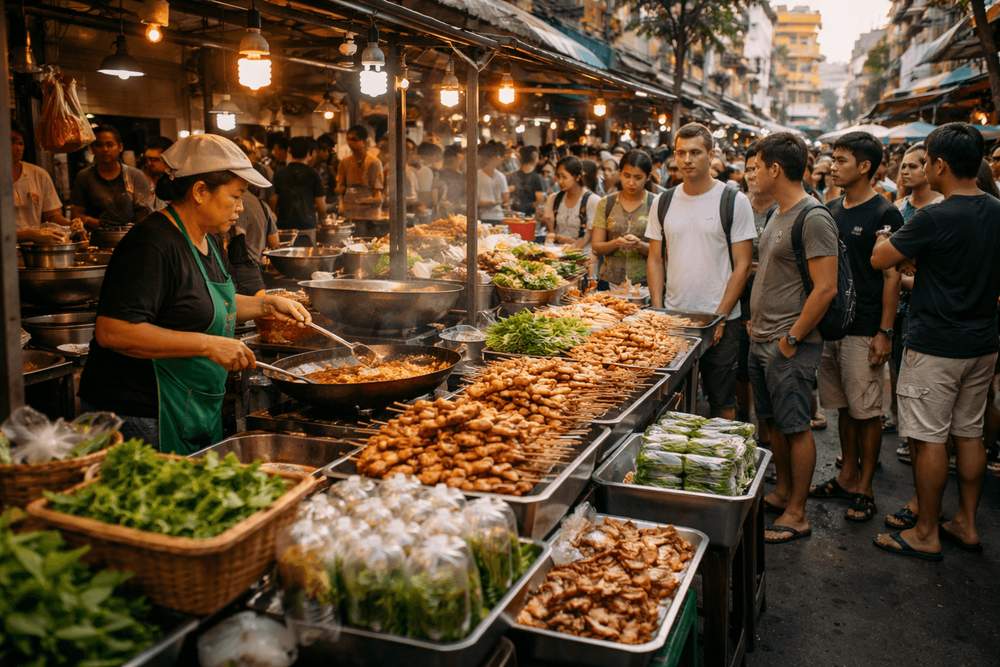
We’re shoulder to shoulder on [Soi Rambuttri](/articles/best-street-food-streets-near-Khao San Road), where the air smells like sizzling garlic and diesel, where a wok flares hot enough to singe our eyebrows and a fan clacks uselessly against Bangkok’s 32°C soup of a night. A tuk-tuk coughs by, a 7-Eleven door hisses open and blasts us with AC, and a line of office workers snakes toward a cart that looks like a stainless-steel spaceship. This is where our best Bangkok street food stall tips kick in: not a list of “famous” places, but the signals locals follow to eat well, safely, and without paying farang prices—especially around Khao San Road and the surrounding Banglamphu maze.
Why Bangkok Street Food Is Worth Your Jet Lag
Bangkok runs on street food the way the Chao Phraya runs on brown turbulence. Breakfast is jok (rice porridge) and soy milk near the khlong, lunch is a fast bowl of guay tiew (noodles) at a cart with six kinds of pork balls, and late-night is moo ping (grilled pork skewers) that drip fat and joy onto the curb. Around Khao San Road and Soi Rambuttri, we can graze all day: pad thai with a whisper of tamarind, khao kha moo (braised pork leg on rice) glossy with star anise, som tam (papaya salad) pounded to order with fish sauce thunder, and mango sticky rice sticky enough to glue our fingers together.
Street food is culture here—sanuk, fun, fast, cheap, and social. Expect plastic stools, shared tables, and the occasional gecko doing pull-ups on a fluorescent tube. The best stalls sell one thing exceptionally well, at volumes that would make a franchise blush. We don’t need a sign in English; we need turnover, smells that make us weak at the knees, and a cook who never stops moving.
Bangkok Street Food Stall Tips: How We Choose Where to Eat
We love a “best of” list as much as anyone, but in Bangkok, stalls move, owners retire, and today’s hero can be gone by next month. So we use repeatable signals.
1) Follow the queue—specifically, the right queue
- Office workers in ID lanyards, market aunties with shopping baskets, schoolkids in uniform—these are gold signals. If the line is 80% foreign tourists and it’s right on Khao San Road, we temper expectations (and prices).
- Peak hours matter: 7:00–9:00 breakfast carts; 11:30–13:30 lunch-rush rice and noodles; 18:00–21:00 dinner stir-fries and grills. Hit just before or after the crush to keep wait times low while turnover stays high.
2) Freshness you can see, hear, and smell
- Look for bubbling pots and roaring flames. Food should be reheated to a proper boil or cooked to order—never lukewarm trays sweating under sad lamps.
- Ingredients should be covered or stored on fresh ice. Greens look perky, not wilted; herbs smell bright; raw proteins sit on ice or in refrigerated bins, never languishing at room temp.
- Oil should be clear(ish) amber, not tar-black. Wok smoke is aromatherapy; burnt oil stench is a red flag.
3) Clean enough for the street
- A wipe-down rhythm matters. We want to see a cloth that actually gets rinsed, a trash bin with a lid, and hands washed between handling cash and food (or a money runner doing the payments).
- Gloves aren’t magic. We care more about separation: raw and cooked boards; different tongs for raw meat vs. finished skewers; utensils stored in hot water, not a grubby cup.
- Sauce bottles and condiment jars should be topped up and protected from flies. Clear tube ice (the kind with a hole) from sealed bags is standard and generally safe; crushed block ice without provenance is iffy.
4) Menu minimalism wins
- One to five dishes, max—that’s the sweet spot. If a cart lists 40 things, we read “Jack of all trades, master of meh.”
- A pot-only stall? Ask what’s today (wan-nee mee arai). If the pot looks half-empty at peak hour, it’s probably great. If three full pots sit untouched, maybe not.
5) Price and portion sanity
- Around Banglamphu, fair prices cluster in a band—think cheap stalls a short walk off Khao San vs. marked-up carts on the strip. We avoid exact figures here; confirm locally and watch what the person ahead pays.
- Boat noodles are famously small by design; a “piset” (special) ups the portion. Stir-fries and rice plates feed one hungry adult; add a “khai dao” (fried egg) if you’re extra peckish.
For more structured pointers, we also like these deep dives: picking clean, busy stalls and avoiding rookie mistakes, budget breakdowns by dish, and order etiquette. See: Bangkok Street Food for First-Time Visitors: What to Order, How to Spot the Best Stalls, and What a Fair Price Looks Like, Bangkok Street Food by Budget: What to Eat for 50, 100, and 200 Baht, and How to Order Bangkok Street Food Like a Local: Stall Signals, Queue Etiquette, and Customization Tips.
Ordering Basics Without Looking Like a Lost Farang
You don’t need tones like a news anchor. Keep it friendly and simple.
Reading the stall
- Visual menus: Pointing is fine. Many carts have pictures or trays of ready-cooked dishes (khao rad gaeng). For noodles, look for the station: soup pot, baskets, a lineup of meats and greens.
- Hidden menus: Some places just have a whiteboard in Thai script. Peek at what others get; copy their move.
Useful phrases
- One please: “Ao neung” or point + “neung.”
- Not spicy: “Mai phet.” A little spicy: “Phet nit noi.” Very spicy: “Phet mak.”
- No peanuts: “Mai sai tua.” No fish sauce: “Mai sai nam pla.” No seafood: “Mai ao talay.”
- Takeaway: “Sai toong.” Eat here: smile and point at the table.
Spice and sauce logic
- Condiment caddies—prik nam pla (chilies in fish sauce), sugar, vinegar with chilies, and chili flakes—are there to balance to your taste. Add in tiny steps. Bangkok heat sneaks up like a soi dog.
- If you have allergies, say it twice and watch the prep. Many sauces hide soy, oyster, or fish products. When in doubt, skip the nam jim (dipping sauce) or ask for salt and lime.
Paying and pacing
- Most carts are cash-first economies. Small notes (20s/50s) make friends. Some stalls take QR PromptPay; if you see the code, great—otherwise don’t hold up the queue.
- Order first, pay when food arrives or when you’re done. Watch local flow and mimic it. If they hand you a ticket, don’t lose it—your plate is tied to that slip.
For the full playbook on reading queues, calling your dish, and not stealing someone’s noodles by accident, dip into How to Order Bangkok Street Food Like a Local: Stall Signals, Queue Etiquette, and Customization Tips.
Safety and Hygiene We Actually Use
We’re not here to bubble-wrap you; we eat like locals and stay sensible.
- Go busy or go home: High turnover beats everything. If the wok hasn’t stopped since we arrived, we’re in.
- Temperature is truth: Piping hot is safest. Watch them bring soups to a rolling boil; ask for a reheat if a curry looks sleepy.
- Water and ice: Sealed bottles are everywhere. Tube ice from sealed bags is common and generally fine at reputable stalls. If you’re nervous, skip the ice the first day and see how you do.
- Utensils: If there’s a hot-water dip by the cutlery, use it. Otherwise, a quick wipe with a tissue is normal. Don’t use the communal rag.
- Sauces: If lids are off and flies are partying, sit downwind and skip them—or ask for fresh from the fridge if you spot one.
- Sensitive stomach? Start with grilled or fried items (moo ping, gai yang, pad kra pao) and clear soups. Creamy coconut curries and raw salads are delicious but can be riskier in the heat if turnover’s low. For a nerdy, practical look at “heat-safe” street eats, bookmark Bangkok Street Food for Heat-Safe Eating: The Best Low-Risk Dishes, Freshness Checks, and Stall Rules in Bangkok and our Bangkok Street Food Hygiene Guide: How to Spot Clean Stalls and Eat Safely Without Killing the Experience.
Khao San, Banglamphu, and Beyond: Where to Hunt (and How to Judge)
Khao San Road itself is a spectacle—bass drops from bars, neon roars, and pad thai carts hustle hard. We’ll still snack there for the theater, but the real eating happens 1–3 sois away.
Around Khao San and Soi Rambuttri
- Soi Rambuttri: Our default graze. Look for moo ping near the curve by the banyan tree, a jok cart setting up at dawn, and roti flippers after dark. Best value pops up on the quieter, temple-side stretch.
- Tani Road and Chakrabongse Road: Follow the lunchtime helmets and scooters. Expect fast khao man gai (Hainanese chicken rice), duck noodles, and pad kra pao.
- Phra Athit Road: University crowd = solid turnover. Early evening brings skewers, fried chicken, and fruit carts. The river breeze is a bonus.
Insider move: We often crash near Soi Rambuttri or Phra Athit for easy roll-out-of-bed breakfasts and walk-to-dinner options. Even if you’re staying elsewhere, this pocket is perfect for a low-stakes first-night food crawl.
Wang Lang Market (across the river)
Hop the cross-river ferry from Phra Arthit Pier to Wang Lang Pier. The market is a labyrinth of snacks: grilled squid waving like flags, khanom krok (coconut pancakes) hissing in cast-iron pans, and rice plates that move faster than gossip. Judging rules still apply—short menus, clear ice, clean boards, locals queuing.
Yaowarat Chinatown Heritage Center (Chinatown)
At night, Yaowarat Road becomes a neon-striped buffet. Expect lines. The longest queues aren’t always best—scan for stalls where the cook never pauses, ingredients are iced and covered, and plates land at a consistent clip. Bring patience, cash, and a sense of humor when you end up on a plastic stool in the road.
Old Town detours
Near the Golden Mount (Wat Saket Ratchawora Mahawihan) and along Mahannop Road, morning markets unfold with khao rad gaeng (rice + curries) and sticky rice snacks. Early is your friend; by late morning, the best pots are scraped clean.
Know Before You Go
- Cash is king: Bring small bills. ATMs near Khao San charge foreign fees; withdraw in one go to reduce hits.
- Sun and sweat: Hat, light clothes, and a pocket pack of tissues. We love the 7-Eleven AC break between snacks.
- Scams and “come, my friend”: Tuk-tuks may upsell “special” pad thai or gem detours. If the price sounds like a rooftop bar, it is. Smile, wai, and walk on.
- Allergies and preferences: State them twice, watch the wok. Peanuts can lurk in som tam; fish sauce is in everything from nam jim to stir-fries.
- Timing: Many carts sell out. If you see a sign that says “หมด” (mod), it’s gone—try tomorrow.
Getting There: Khao San to the Good Stuff
- By foot: Most Banglamphu gems are walkable—Soi Rambuttri, Tani Road, Phra Athit are within 5–15 minutes of each other.
- By river: From Phra Arthit Pier, ride the Chao Phraya cross-river ferry to Wang Lang Market. Fares are small change; confirm locally and have coins ready. For Chinatown, use the Chao Phraya Express Boat (orange flag) to Ratchawongse Pier and walk up to Yaowarat Road.
- By khlong boat: From Phanfa Leelard Pier near the Golden Mount, the Saen Saep boat zips east; handy if you’re exploring beyond Old Town. Boats run frequently during the day; confirm schedules locally.
What to Order When the Signals Look Good
- Moo ping + sticky rice: Sweet-salty char, best eaten standing up. Watch for fresh grills and meat kept on ice.
- Boat noodles: Dark, herbal broth. Expect small bowls; order two or three.
- Pad kra pao moo krob: Holy basil, crispy pork, garlic, chilies. Add a fried egg. “Phet nit noi” if you’re spice-shy.
- Khao man gai: Poached chicken, fragrant rice, gingery sauce. Look for clear soup on the side and birds resting on clean racks.
- Som tam: Pounded to order. “Mai sai tua” if you avoid peanuts; “mai sai pla ra” to skip fermented fish.
- Mango sticky rice: Choose ripe fruit and coconut cream ladled fresh, not crusted over in the sun.
For stall-by-stall archetypes, skim Bangkok Street Food by Food Stall Type: Cart Classics, Skewers, Soups, and Grab-and-Go Meals.
Quick Plan (Walking + Boat Crawl)
Day 1: Khao San → Phra Athit → Wang Lang → Khao San (4–5 km walking total, boats 10–15 min each way). Key stops: breakfast jok on Soi Rambuttri; lunch rice plates on Tani Rd; afternoon snack crawl in Wang Lang Market. Overnight base: Banglamphu. Day 2: Khao San → Ratchawongse Pier (boat) → Yaowarat → Sampheng → Khao San (6–7 km walking, boat 20–30 min total). Key stops: evening Yaowarat seafood and dessert carts; late-night moo ping near Democracy Monument. Overnight base: Banglamphu.
ASCII route: KSR → Phra Athit Pier ≈ (ferry) → Wang Lang → (ferry) → KSR → (express boat) → Ratchawongse → walk → Yaowarat
Costs at a Glance (THB)
- Fuel (per liter): Not applicable for this walking/boat plan; if you drive in Bangkok, confirm locally as prices fluctuate.
- Estimated fuel cost per segment: n/a (walking/boats).
- Tolls per segment: n/a for this plan.
- National park/attraction fees per person: n/a for this food-focused crawl.
- Parking per night: n/a if you’re not driving; hotel lots vary—confirm locally with your property. Last checked: Sep 2026
Final Bite
Tonight we’ll start on Soi Rambuttri, let the wok breath hit our face, and follow the lanyards. If the queue’s right and the oil smells clean, we’re in—khun, two bowls, phet nit noi, and don’t skimp on the holy basil.
Where to stay
Stays we list in Khao San Road and Yaowarat. Each place page includes the Agoda booking link.

Related places
7-Eleven
Shops
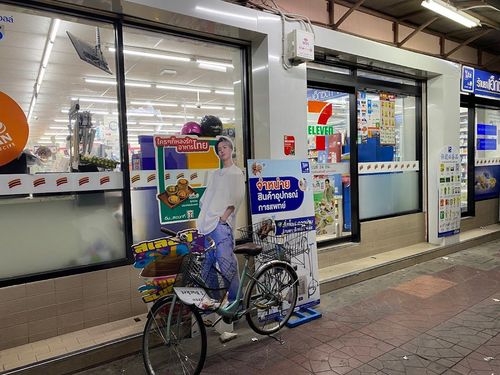
Khao San’s 24/7 reset button: ice‑cold A/C, ham‑cheese toasties, All Café iced lattes, water for 7–14 THB, and late‑night supplies from snacks to sunscreen—right by Rikka Inn.
Khao San Road
Attractions
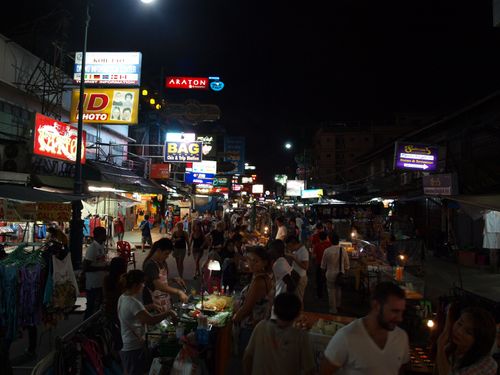
Bangkok’s backpacker carnival: curbside bars, live bands and DJs from 3pm–2am (midnight Sun). Street eats are cheap — pad thai 70–100 THB, mango sticky rice 60–100 THB. Come for wild people-watching; duck into Rambuttri for a calmer beer.
Staying near Khao San Road? Compare Khao San Road hotels with Expedia booking links.
Flights to Khao San Road
Compare flight options on Expedia.
More Khao San Road Guides
- Where to Find Bangkok's Best Regional Street Food Near Khao San Road
- Best Street Food Streets Near Khao San Road: Where to Walk for Snacks, Meals, and Local Flavors
- Bangkok Street Food for First-Timers: Must-Try Dishes Near Khao San Road and How to Spot the Real Version
- Best Thai Dishes to Try at Bangkok Street Food Stalls: A Khao San Road Ordering Guide