Bangkok Street Food for First-Time Visitors: What to Order, How to Spot the Best Stalls, and What a Fair Price Looks Like
First-timer’s guide to Bangkok street food: what to order, how to spot the best stalls, and what a fair price looks like—plus tips on spice, hygiene, and paying.
The wok hisses, a motorbike threads past our knees, and the sweet rot of durian drifts in from a cart down the soi. We’re shoulder-to-shoulder on Yaowarat Road, chopsticks in one hand, cold water in the other, grinning like we just unlocked a cheat code. This is where Bangkok street food for first-time visitors goes from myth to mouthful—messy, loud, alive—and we’re here for it.
We’ll walk you through what to order, how to pick a great stall, the Thai phrases that actually matter, and what a fair price looks like so you don’t overpay for a plate of pad thai under a neon crab sign.
Why Bangkok Street Food for First-Time Visitors Is Essential
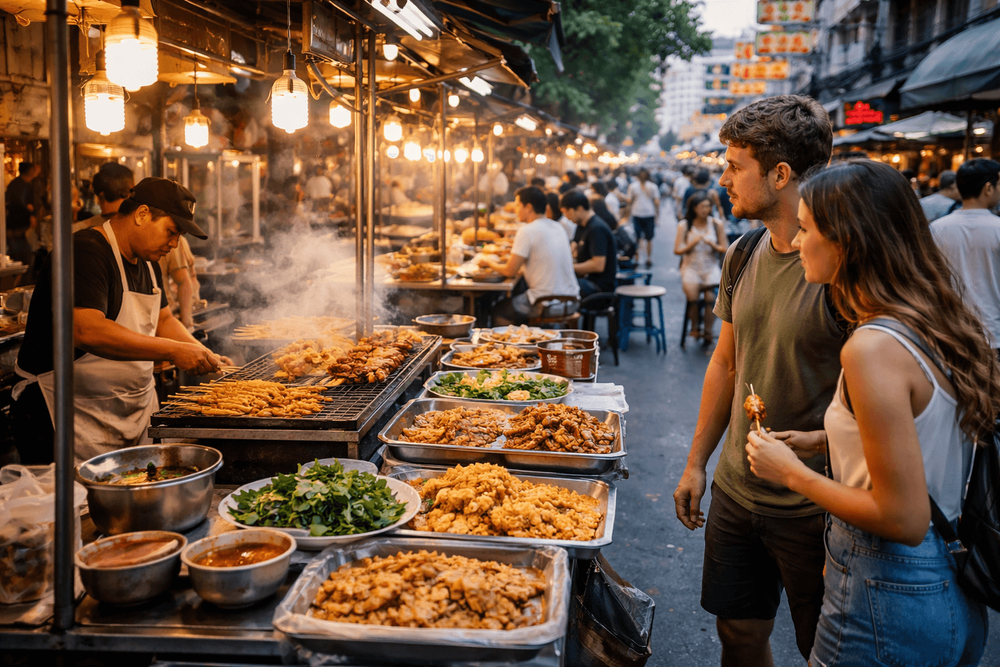
Bangkok runs on street food the way a tuk-tuk runs on attitude. It’s fast, fragrant, and woven into daily life—breakfast bowls on a plastic stool before work, late-night skewers outside 7-Eleven after the bars on Khao San Road thump to silence. Compared to restaurant dining, street food is nimble and hyper-focused: one auntie, one wok, one legendary dish she’s perfected over 30 years. It’s also where you feel the rhythm of the city—the sizzle of oil, the ring of a spoon on a steel pot, the chatter in Thai and English and everything in between.
And for Bangkok street food for first-time visitors, it’s the ultimate crash course: you learn spice the fun way, find your favorites fast, and figure out that a 60-baht bowl of boat noodles can feel like a Michelin star you eat on a curb.
Beginner-Friendly Bangkok Street Food: What to Order
If you’re new to Thai flavors, start with simple, balanced dishes. Look for vendors who cook one or two specialties really well.
- Pad thai (ผัดไทย): Stir-fried rice noodles with egg, tofu or shrimp, tamarind, and crushed peanuts. Mild by default. Fair price: 60–100 baht on the street, more if you add big prawns.
- Khao man gai (ข้าวมันไก่): Hainanese chicken rice. Gentle, garlicky, soothing. Comes with a gingery-chili sauce on the side. Fair price: 50–70 baht.
- Moo ping (หมูปิ้ง) + khao niao (sticky rice): Charcoal-grilled pork skewers with sweet-salty glaze; sticky rice comes in a plastic bag. Fair price: 10–15 baht per skewer; rice 10–15 baht.
- Guay tiew (ก๋วยเตี๋ยว): Noodle soups. Start with boat noodles near Victory Monument (small bowls, rich broth) or a lighter clear-broth pork noodle. Fair price: 40–60 baht per bowl (boat noodles are often 20–30 for mini bowls).
- Som tam (ส้มตำ): Papaya salad. Ask for “mai phet” (not spicy) or “phet nit noi” (a little spicy). Fair price: 50–70 baht.
- Khao kha moo (ข้าวขาหมู): Soy-braised pork leg over rice with pickled greens and egg. Fair price: 60–80 baht.
- Kai jeow (ไข่เจียว): Thai omelette over rice with nam prik ketchup or chili sauce; add minced pork if you like. Fair price: 40–60 baht.
- Mango sticky rice (ข้าวเหนียวมะม่วง): Seasonal dessert with coconut cream. Fair price: 60–120 baht depending on mango size.
Vegetarian or vegan? Say “gin jay” (we eat strict vegan style) or “mang-sa-wee-rat” (vegetarian). Look for pad see ew with tofu, pad thai jay, tofu-and-veggie stir-fries, or stalls marked with the yellow-red “เจ” sign. Fish sauce and oyster sauce sneak into everything, so be clear.
Want to go deeper on dish choices? We break down the must-tries in more detail here: Best Thai Street Foods for First-Time Visitors in Bangkok: What to Try and Why.
Where to Eat and How to Spot the Best Stalls
Bangkok is a sprawl; your best bet is to anchor street-food exploring to a few proven neighborhoods and night streets. Then use quick visual checks to pick winners.
Neighborhoods and Night Streets We Love
- Yaowarat (Chinatown): Come after 6 pm when neon signs flick on and the grills heat up. Expect seafood, dim sum, desserts, peppery soups. Nearest MRT: Wat Mangkon. It’s crowded—embrace the shuffle.
- Banglamphu triangle: Khao San Road, Soi Rambuttri, and Phra Athit Road. Rambuttri is the sweet middle ground—lively but less chaotic than Khao San’s bassy bar row. Pad thai, banana roti, noodles, fruit shakes until late. If you’ll be staying nearby, our Khao San–area primer covers where to eat and how to order: Bangkok Street Food Guide for First-Time Visitors: What to Order, How to Order, and How to Eat Safely Around Khao San Road.
- Victory Monument: Daytime boat noodles in little canal-side shophouses off the roundabout. BTS: Victory Monument. Order two or three small bowls; the point is variety.
- Wang Lang Market (Thonburi side): Lunchtime paradise opposite Siriraj Hospital, reached by river ferry from Tha Chang or Tha Phra Athit. Great for curries over rice, fried chicken, and snacks.
- Ratchawat & Sriyan (Dusit): Old-school markets with roast duck, beef noodles, and crisp pork belly. Quieter, more local, best in the daytime.
If you want an at-a-glance sense of prices and what different stalls look like, we’ve got a practical breakdown here: Bangkok Street Food Guide for First-Timers: What to Order, How to Spot the Best Stalls, and What It Costs.
How We Judge a Stall in 10 Seconds
- A line of locals: Not just farang. A steady queue is the best hygiene and taste signal.
- One specialty: “Pad thai” or “chicken rice” or “pork noodles”—not a laminated menu of 40 dishes.
- Turnover: Ingredients moving fast, cooked to order, hot pots bubbling. Pre-cooked curries should look glossy, not congealed.
- Clean hands and tongs: Watch how they handle money vs. food. Separate roles or regular glove changes are ideal.
- Covered garnishes: Limes, beansprouts, and herbs under a mesh or lid, not sweating in the sun.
- Posted prices: In Thai or English. If seafood is sold by weight, you should see the price per 100g.
- Smell and smoke: Wok hei (that smoky kiss on noodles) is a green light. Old-oil funk is a red one.
Want a deeper dive on safety checks? Keep this in your back pocket: Bangkok Street Food for Newcomers: How to Choose Safe, Busy Stalls and Avoid Common Mistakes.
What a Fair Price Looks Like (So You Don’t Overpay)
Prices vary by neighborhood and protein, but these ranges keep us honest:
- Basic noodle soups: 40–70 baht (mini boat noodles can be 20–30 each)
- Fried noodle/rice dishes (pad thai, pad see ew, khao pad): 50–90 baht; +20–40 for big prawns
- Grilled skewers (moo ping, gai yang wings): 10–25 baht per stick
- Chicken rice / pork leg rice: 50–80 baht
- Som tam + grilled chicken + sticky rice set: 100–160 baht total
- Mango sticky rice: 60–120 baht depending on mango season
- Desserts (mochi, grass jelly, bua loy): 25–50 baht
- Drinks (iced tea/coffee, lime soda): 20–40 baht; fruit shakes 40–70 baht
- Seafood in Yaowarat: 120–300 baht for simple plates; weight-priced prawns/crab can jump—always confirm per-100g price before ordering
If someone tries to quote you something wild for a standard dish—say, 200 baht for a regular pad thai on a side street—smile, wai, and walk away. There’s always another wok firing 10 meters down.
How to Order, Pay, and Navigate Spice and Etiquette
Ordering is half mime, half magic words. Here’s a simple playbook:
- Grab a seat or queue first. Many stalls run table numbers; others expect you to order at the cart and then sit.
- Point and speak: “Ao …” means “I’d like …” as in “Ao pad thai goong” (I’d like pad thai with shrimp). Add “krap” (male) or “ka” (female) at the end to be polite.
- Spice levels: Say “mai phet” (not spicy), “phet nit noi” (a little spicy), or “phet phet” (very spicy). For papaya salad, you can also say “mai sai pla ra” (no fermented fish) if that flavor is new to you.
- Customizing noodles: “Sen lek” (thin rice noodles), “sen yai” (wide), “ba mee” (egg noodles). Dry or soup? “Haeng” (dry), “nam” (with broth).
- Allergies: “Phom/chan phae …” (I’m allergic to …). Peanuts = “thua”, shellfish = “an talay”, egg = “khai”. Street kitchens are tiny, so manage expectations.
- Paying: Cash is king. Have small bills (20s and 50s). You’ll often pay after eating at a seated stall; at carts, you pay on the spot. Many places will have QR PromptPay—but don’t count on it.
- Condiments are your toolkit: Chili flakes, vinegar with chilies, nam pla prik (fish sauce with chilies), sugar, crushed peanuts. Adjust at the table—cooks won’t be offended.
- Sharing tables is normal: Slide in, smile, and share the chili caddy. Don’t camp forever; these seats turn fast.
Tip: Bring pocket tissues or napkins. Wipe your chopsticks if you like, and toss waste in the shared bin. And yes, that blast of AC from 7-Eleven is fair game between bowls.
For more ordering language and hygiene pointers tailored to Khao San and Rambuttri, scope this: Bangkok Street Food Guide for First-Time Visitors: What to Order, How to Order, and How to Eat Safely Around Khao San Road.
Know Before You Go: Getting There and Timing
Bangkok rewards those who ride the rails and the river.
- Yaowarat (Chinatown): MRT Blue Line to Wat Mangkon, then walk 5–10 minutes. Best after 6 pm; peak 7:30–10 pm.
- Khao San / Soi Rambuttri / Phra Athit: Take the Chao Phraya Express boat to Phra Arthit Pier (N13). Eat along Rambuttri, detour to Phra Athit for quieter bars, and dive into Khao San if you crave that bass.
- Victory Monument boat noodles: BTS to Victory Monument, then walk the skywalk and slip down into the sois around the canal.
- Wang Lang Market: Ferry from Tha Chang or Tha Phra Athit across to Wang Lang Pier. Best 10 am–2 pm on weekdays.
- Ratchawat & Sriyan: Metered taxi or city bus from Dusit/Old Town; mornings and lunch are best.
Street food moves with the sun. Morning = rice porridge, soy milk, fried dough sticks. Lunch = curries, noodles, markets buzzing. Night = grills and neon. Mondays can be a little quieter; some vendors rest.
If you’re planning to eat your way through Banglamphu, we like staying within walking distance of Soi Rambuttri or along Samsen Road so we can roll out of bed and into a bowl. Near the river means breezes and an easy hop to the boat when the heat hits.
Hygiene, Heat, and Staying Comfortable
- Pick busy stalls with fast turnover. Food doesn’t sit long, which is the simplest safety rule.
- Watch the water: Clear ice from big bags is standard and generally safe; if in doubt, order sealed bottles (10–20 baht).
- Daytime shade matters: Aim for covered markets or shophouse seating at noon. Save the curbside grills for evening.
- BYO sanitizer and a small pack of tissues. Handy after saucy som tam sessions.
- Dress light, carry a reusable water bottle, and take AC breaks—in a mall, in the MRT, or yes, in 7-Eleven.
We’ve got a full playbook on stall selection and staying healthy right here: Bangkok Street Food for Newcomers: How to Choose Safe, Busy Stalls and Avoid Common Mistakes.
Caution Points: Allergies, Drinks, Peak Times, and Common Mistakes
- Allergies and hidden ingredients: Fish sauce, shrimp paste, and dried shrimp appear where you least expect them—salads, dips, even omelettes. Say “mai sai nam pla/koong” (no fish sauce/shrimp) and double-check.
- Raw shellfish and blood soups: Delicious to some, risky to others. Skip if you’re sensitive—or choose high-turnover spots.
- Seafood pricing: Weight-based menus can creep up. Confirm per-100g price, ask for the total before cooking, and keep the receipt.
- Spice bravado: Don’t start at “phet phet.” You can always add heat at the table; you can’t un-nuke your tongue.
- Drinks and alcohol: Most street carts won’t serve beer. Grab a drink from a convenience store if the area allows it, or sit at a nearby shophouse eatery that serves both food and beer.
- Peak times: Expect queues 12–1:30 pm and 7–9:30 pm. If a stall is famous, arrive 30 minutes before the rush or just after.
- Tuk-tuk detours: If a driver insists on “best pad thai, very cheap,” we smile and walk. You’re two sois from something better that isn’t a commission stop.
- Cash matters: ATMs are everywhere, but they love to charge fees. Carry small change; street food is a 20–100 baht economy.
- Plastic and planet: Bring a collapsible container or say “gin tee nee” (eat here) to avoid takeaway plastic.
A Simple Night Out, Step by Step
- Start at Phra Athit Road around sunset for breezes off the Chao Phraya and a light bite—maybe chicken rice.
- Wander to Soi Rambuttri for moo ping and a fruit shake. Check a few carts and pick the one with a steady line.
- Cut through to Khao San for sensory overload—grab pad thai if the wok smoke smells right or skip it and find noodles in a quieter side soi.
- Finish with mango sticky rice as you amble back, with the Golden Mount peeking over Old Town if you look south-east.
By now, you’ve mastered the nod, the “ao … krap/ka,” the chili caddy, and that little grace note of a wai to say thanks. This is Bangkok street food for first-time visitors the way we like it—unscripted, affordable, and full of sanuk.
When you’re ready for round two, we’ll be waiting on a plastic stool under a flickering tube light, chopsticks up and napkins down, listening for that sizzle that means another great plate is seconds away.
Related Hotels & Places
7-Eleven
Shops
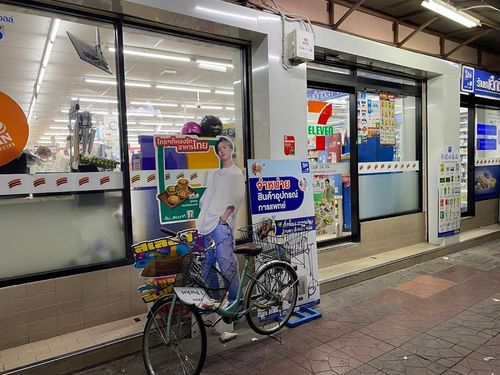
Khao San’s 24/7 reset button: ice‑cold A/C, ham‑cheese toasties, All Café iced lattes, water for 7–14 THB, and late‑night supplies from snacks to sunscreen—right by Rikka Inn.
Khao San Road
Attractions
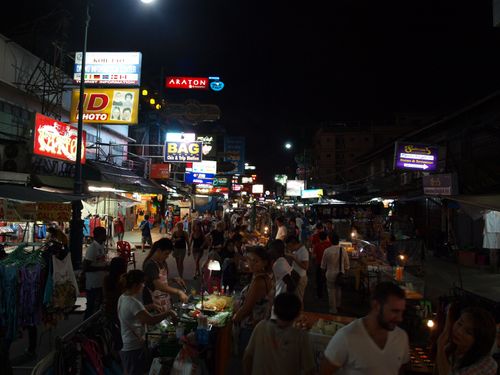
Bangkok’s backpacker carnival: curbside bars, live bands and DJs from 3pm–2am (midnight Sun). Street eats are cheap — pad thai 70–100 THB, mango sticky rice 60–100 THB. Come for wild people-watching; duck into Rambuttri for a calmer beer.
More Khao San Road Guides
- Bangkok Street Food for First-Time Visitors: A Practical Guide to Ordering, Hygiene, and Must-Try Classics
- Best Thai Street Food Dishes to Try in Bangkok: A First-Timer’s Guide to Noodles, Rice Plates, and Skewers
- Bangkok Street Food Guide for First-Timers: What to Order, How to Spot the Best Stalls, and What It Costs
- Bangkok Street Food for First-Time Visitors: How to Order, Pay, and Eat Safely