
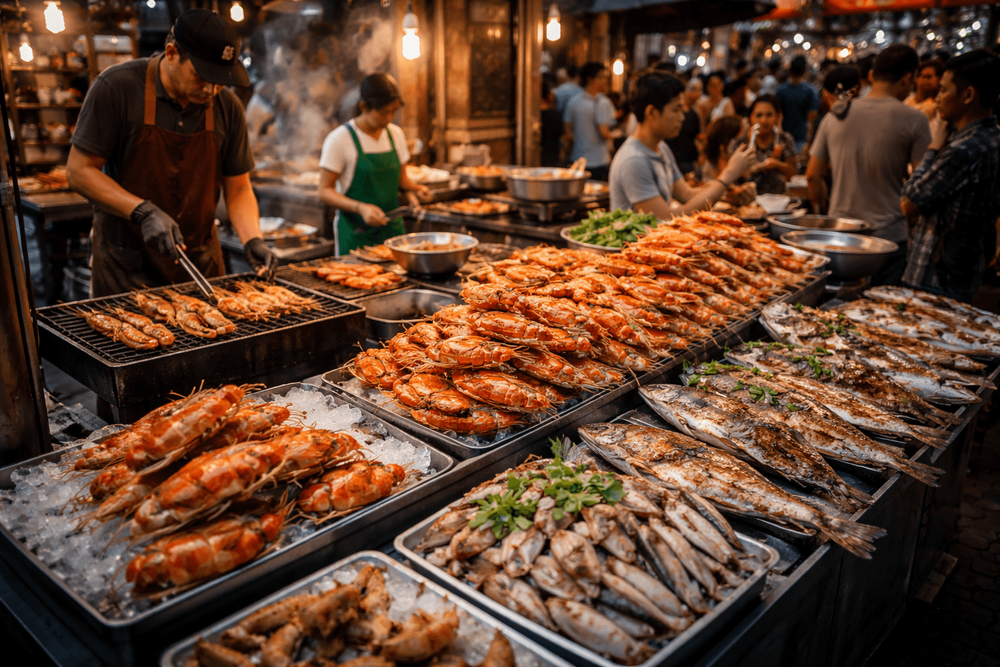
Bangkok Street Food for Seafood Lovers: Crab, Prawns, and Grilled Fish Around Old Town
Grills, clams, and salt-crusted fish by the river—where to find the best Bangkok seafood street food around Old Town, what to order, and how to eat it right.
We hit Tha Tien just as the sky goes tangerine behind Wat Arun Ratchawararam Ratchawaramahawihan, and the first thing we catch is the smell: salt and smoke. A guy in flip-flops slaps a whole fish onto a charcoal grill, crusted in coarse salt so thick it looks snowed on. Oil spits, the skin blisters, and a fan made from old cardboard beats back the smoke and the Bangkok heat. This, right here, is Bangkok seafood street food—the noisy, messy, delicious heart of eating by the river.
Why Bangkok seafood street food hits different
Bangkok sits on the Chao Phraya, with the Gulf of Thailand just down the khlong (canal) highway. Fresh catch rides in before dawn, and by late afternoon it’s on grills across Old Town and Chinatown. The seafood here is Thai-Chinese in soul but pure Bangkok in spirit: charcoal-grilled, wok-tossed at warp speed, dunked in neon-green nam jim seafood sauce (lime, garlic, fish sauce, and devastating chilies), and eaten under strings of bulbs while motorbikes thread past our plastic stools.
What sets Bangkok’s seafood scene apart from other Thai street food?
- Fire first: grills and wok burners blast like jet engines. Seafood hits high heat fast.
- Sauce culture: sour-spicy dips that wake up jet-lagged taste buds—no timid flavors here.
- Turnover: the busiest carts sell out nightly, which means fresher prawns and clams.
- Range: from 10-baht fish cakes to fat river prawns that are date-night fancy without the white tablecloth.
Yes, it can be sweaty. Yes, we’ll leave smelling like a campfire. That’s part of the sanuk—the fun of eating in Bangkok.
Key seafood dishes to hunt (and how to order them)
Pla pao (salt-crusted grilled fish)
A Bangkok classic. Whole tilapia (pla nin) or snakehead fish (pla chon) stuffed with lemongrass and pandan, caked in salt, and slow-grilled over charcoal. The skin peels off; you flake silky white meat onto lettuce leaves with herbs, dunk in nam jim seafood, and forget your jet lag. Expect 180–350 baht depending on size and fish.
Ordering tip: Point to your fish, say “khon diao” (one), and choose noodles (kanom jeen) or rice. Ask for sauce on the side if you’re chili-shy: “sai nam jim kha noi, phet nit noi” (give sauce, only a little spicy).
Goong yang (grilled prawns)
Big river prawns (goong mae nam) get split and seared until the head fat turns to orange butter. Fingers will be messy; happiness level will be obscene. Street prices range widely: 200–500 baht depending on size and count.
Look for: shells that shine and feel heavy for their size, and grills with steady queues.
Pla muek yang (grilled squid)
Crosshatched squid scored like dragon skin, brushed with sweet-salty marinade, served with limey green sauce. Quick-cooking and forgiving—great beginner seafood. Small skewers 40–80 baht; full plates 120–200 baht.
Hoy kraeng luak and hoy lai pad prik pao (cockles and clams)
- Blanched cockles (hoy kraeng luak): served just-cooked so they stay tender. Dip fast; don’t linger in the heat.
- Stir-fried clams with roasted chili jam (hoy lai pad prik pao): sweet, smoky, and basil-fragrant.
Prices: 100–180 baht per plate. If you’re iffy on doneness, say “suk suk” (well cooked).
Hoy tod (crispy oyster or mussel omelette)
Woks roar, batter hisses, and you get a crusty-edged pancake topped with soft oysters (hoi nang rom) or mussels (hoi malaeng puu) and a punchy chili sauce. Street stalls serve small plates for 80–140 baht.
Tod man pla and tod man goong (fish cakes and shrimp cakes)
Patties of spiced fish or shrimp, flecked with kaffir lime leaf. They come hot, bouncy, and cheap—5–10 baht per piece from daytime markets, 60–100 baht for a mixed plate at night.
Yum talay and som tam talay (seafood salads)
- Yum talay: a mixed seafood salad in a lime-chili bath with celery and onion. Bright and bracing.
- Som tam talay: papaya salad upgraded with squid and prawns.
Both run 80–150 baht. Ask for “phet nit noi” (a little spicy) unless you want to breathe fire.
Note: Goong chae nam pla (raw shrimp) is beloved but higher risk in the heat. We skip it on sweltering afternoons and choose grilled or boiled instead.
Tom yum talay and khao tom pla (soups)
- Tom yum talay: the famous hot-and-sour soup with mixed seafood.
- Khao tom pla: gentle rice soup with fish—perfect late-night stomach soother after the thump of bass on Khao San Road.
Bowls run 80–150 baht, more if you load on prawns.
Khao pad talay and pad kra pao talay (fried rice and basil stir-fry)
When we’re hungry and indecisive, seafood fried rice never fails. Basil stir-fry with squid or prawns over rice plus a fried egg—comfort in 6 minutes flat. 60–120 baht depending on seafood.
Where to find the best seafood street food in Bangkok
Old Town and the river piers (Tha Tien, Tha Chang, Phra Athit)
If we’re starting near the temples, we eat around the ferry piers. At Tha Tien (by Wat Phra Chetuphon Wimon Mangkhalaram Rajwaramahawihan) and Tha Chang (for the Grand Palace), late afternoons bring grills of pla pao, squid skewers, and fried fish balls with cucumber and sweet chili dip. Phra Athit Road and the small sois off it hide evening carts with grilled prawns and basil squid. It’s relaxed, a little artsy, and you can park on the river wall to watch express boats gun past.
- Best time: 5 pm–9 pm. Lunch sees more rice-and-curry; seafood grills come as the heat drops.
- Vibe: students and temple workers, plus farang who wandered off Khao San and got lucky.
Wang Lang Market (Siriraj side)
Hop the cross-river ferry to Wang Lang (Thonburi). The market lanes are tight, sweaty, and absolutely loaded with fried fish snacks, hoy tod, and made-to-order seafood salads. Vendors bark, tongs clack, and you’ll bump shoulders with nurses from Siriraj Hospital on quick breaks.
- Best time: 11 am–3 pm for full stall variety; a second wave pops up after 5 pm.
- What to try: fish cakes by the piece, clams with chili jam, and squid-on-a-stick you eat on the ferry back.
Soi Rambuttri and Chakrabongse Road (Banglamphu)
When the neon wakes up on Khao San, we cut around to Rambuttri and Chakrabongse for simpler grills without the tourist-tax menu. Expect skewers of squid, cockles tossed with basil, and the occasional salt-crusted fish parked over a sidewalk brazier.
- Best time: 7 pm–late, especially on weekends.
- Pro move: grab a seat under a fan; your shirt will thank you.
Chinatown (Yaowarat Road)
Not Old Town, but a 10-minute ride away—and the city’s most famous seafood circus. After sunset, Yaowarat turns into a hot-and-loud runway of red aprons, metal tables, and nonstop wok clang. Grilled prawns, chili clams, and whole fish fly out. It’s pricier and touristy, yes, but still a spectacle worth a lap.
- Best time: 7 pm–11 pm. Crowds peak around 8:30 pm.
- Watchouts: price boards that quote by 100 grams. Do the math before ordering king prawns or crab.
Nang Loeng Market and Ratchadamnoen side streets
Daytime only, this old market focuses on rice-and-curry but hides excellent fish cakes, fried fish, and occasional oyster omelettes. Good for a lunchtime wander between the Golden Mount and Democracy Monument.
Markets beyond Old Town if you want to roam
- Or Tor Kor Market (near Chatuchak): premium produce and clean cooked-food stalls; excellent grilled prawns and steamed fish. Higher prices, high quality.
- Khlong Toei Market: the city’s raw seafood hub. Not much street eating, but great if you want to see where the day’s catch starts. Bring closed shoes and a sense of adventure.
For route ideas that string these together without melting, see our walking-and-boat picks in Bangkok’s Old Town here: Bangkok Street Food Near Transit: Best Eats by Boat, MRT, and Old Town Walking Routes.
How to order like we’ve been doing this for years
Learn three Thai phrases
- “Phet nit noi” = a little spicy. Default spice can be volcanic.
- “Mai phet” = not spicy. They’ll still likely include a little chili in the dip—smile and roll with it.
- “Suk suk” = well cooked. Useful for cockles and squid.
Pointing and smiling helps. So does ordering one dish first and adding more if it’s great.
Read the grill and the ice
- Turnover is king: if prawns are flying off the grill, you’re in good hands.
- Ice should be plentiful and clean, not gray and half-melted. Seafood should feel cold to the touch before it hits heat.
- Live tanks are a bonus, not a guarantee of greatness. We’ve had transcendent squid from a humble cooler.
Price sanity checks
- Pla pao: 180–350 baht depending on fish and size.
- Grilled prawns: 200–500 baht per plate, more for jumbo river prawns.
- Squid skewers: 40–80 baht; plates 120–200 baht.
- Cockles/clams: 100–180 baht per plate.
- Hoy tod: 80–140 baht.
- Fried rice/stir-fries: 60–120 baht.
If you see prices “per 100 grams,” ask to weigh before cooking. We’re not shy about confirming the total: “Ra-ka tao-rai, tung mot?” (How much, all together?) For more ways to stretch baht, our price-by-budget guide helps: Bangkok Street Food by Budget: What to Eat for 50, 100, and 200 Baht.
Sauce strategy
Bangkok seafood lives and dies by its dips. The green nam jim seafood is limey, garlicky, and hot enough to wake the dead. Red sauces skew sweeter. We like to double-dip between the two and cut both with sticky rice.
Sides that make the meal
- Rice (khao suay) or rice noodles (kanom jeen) with pla pao
- Som tam (papaya salad) to slice through grilled-fat richness
- Morning glory stir-fry (pak boong fai daeng) if there’s a wok station nearby
Staying safe, staying happy
Seafood is more sensitive than grilled pork skewers. We still go hard—we just play smart. If you want deeper food-safety pointers, we’ve got a hygiene guide here: Bangkok Street Food Hygiene Guide: How to Spot Clean Stalls and Eat Safely Without Killing the Experience and a seafood-specific heat-safe playbook here: Bangkok Street Food for Heat-Safe Eating: The Best Low-Risk Dishes, Freshness Checks, and Stall Rules in Bangkok.
Our on-the-street rules:
- Cooked beats raw when it’s blazing out. We save raw shrimp dishes for cool nights at trusted spots.
- Watch the hands: vendors who handle cash and food without washing are a pass. Bonus points for tongs and plastic gloves.
- Freshness test: seafood should smell like the ocean, not sweet rot. If you get a whiff of ammonia, walk.
- Shellfish check: with blanched cockles/mussels, toss any that don’t open after cooking.
- Eat while it’s hot. Lingering in the forgiving cool of a fan is fine; lingering food is not.
- Hydrate. We chase chilies with ice water or a Singha; if you’re heat-wobbly, the blast of AC at 7-Eleven two doors down is your best friend.
Getting there (without melting)
- Chao Phraya Express Boat: the orange-flag boats run up and down the river for roughly 16–20 baht. Hop off at Tha Tien (N8) for Wat Pho and grills, or Phra Athit (N13) for a gentler scene. Cross-river ferries to Wang Lang are 5–10 baht and constant.
- MRT: for Chinatown, ride the Blue Line to Wat Mangkon and follow your nose to Yaowarat Road.
- BTS + boat: take the BTS to Saphan Taksin (Sathorn Pier) and transfer to the river boats north.
- Tuk-tuk: fun for short hops, but confirm the price up front. If the driver insists on a gem shop detour, we bail with a smile and a sawadee.
If you’re plotting a full street-eat crawl around stations and piers, this roundup is gold: Bangkok Street Food Around Transit Hubs: Easy Eats Near MRT, BTS, and River Ferry Stops.
First-timer playbook for seafood nights
- Start early. Hit your first grill at 5:30 pm to beat lines and snag the freshest fish.
- Share plates. We order one dish per stall and graze. It keeps the pace up and the food hot.
- Cash rules. Small bills make life easier; change is tight at peak hours.
- Mind the monsoon. If the sky bruises purple, choose a stall with a tented awning—you’ll be happier than the folks sprinting with a pla pao in a soggy plastic bag.
- Sit where the fans point. Bangkok heat is a beast; airflow is your ally.
- Respect the queue. Some places run a whiteboard ticket system; others are organized chaos. A wai and a smile get you further than elbows.
- Drinks? We pair grilled prawns with fresh coconut, lime soda, or cold beer. Avoid milk teas if your stomach’s unsure—dairy and chilies aren’t always friends.
Where we base ourselves for seafood crawls
If we’re planning a river-and-Old-Town seafood circuit, we like staying within striking distance of the piers—Phra Athit or Rambuttri puts us five minutes from grills and ten from bed. If your trip tilts toward Chinatown, bedding down near the MRT Blue Line makes late-night slinks home painless. No need to splurge; what matters is a shower that actually blasts and a location that lets you walk to your first skewer.

Our perfect Old Town seafood night
We time it to sunset. Orange boat to Phra Athit, a walk under the tamarinds, then a salt-crusted pla pao that we peel slow and dunk in limey fire. We follow with a flash-fried hoy tod that crackles at the edges, then cross to Wang Lang for squid on a stick and a bag of fish cakes we keep “for later” and never make it back to the room. The bass from Khao San thumps in the distance; the river wind comes off the Chao Phraya cool and a little fishy. Tomorrow we chase chili clams in Chinatown. Tonight we smell like smoke and lime and we’re completely, utterly happy.
Related Hotels & Places
Wat Arun Ratchawararam Ratchawaramahawihan
Temples
Wat Phra Chetuphon Wimon Mangkhalaram Rajwaramahawihan
Temples
Khao San Road
Attractions
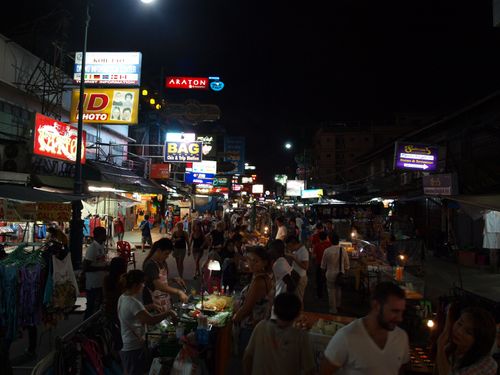
Bangkok’s backpacker carnival: curbside bars, live bands and DJs from 3pm–2am (midnight Sun). Street eats are cheap — pad thai 70–100 THB, mango sticky rice 60–100 THB. Come for wild people-watching; duck into Rambuttri for a calmer beer.
Recommended Products
More Khao San Road Guides
- Bangkok Street Food for Seafood Lovers Near Khao San Road: Crab Omelets, Grilled Prawns, and Stir-Fried Shellfish
- Bangkok Street Food for Pescatarians: Fish Balls, Seafood Noodles, and Easy Order Favorites
- Where to Eat on a Bangkok Street Food Crawl: Old Town, Banglamphu, and Riverside Stops
- Bangkok Street Food by District: Where to Eat in Old Town, Chinatown, Silom, and Sukhumvit