
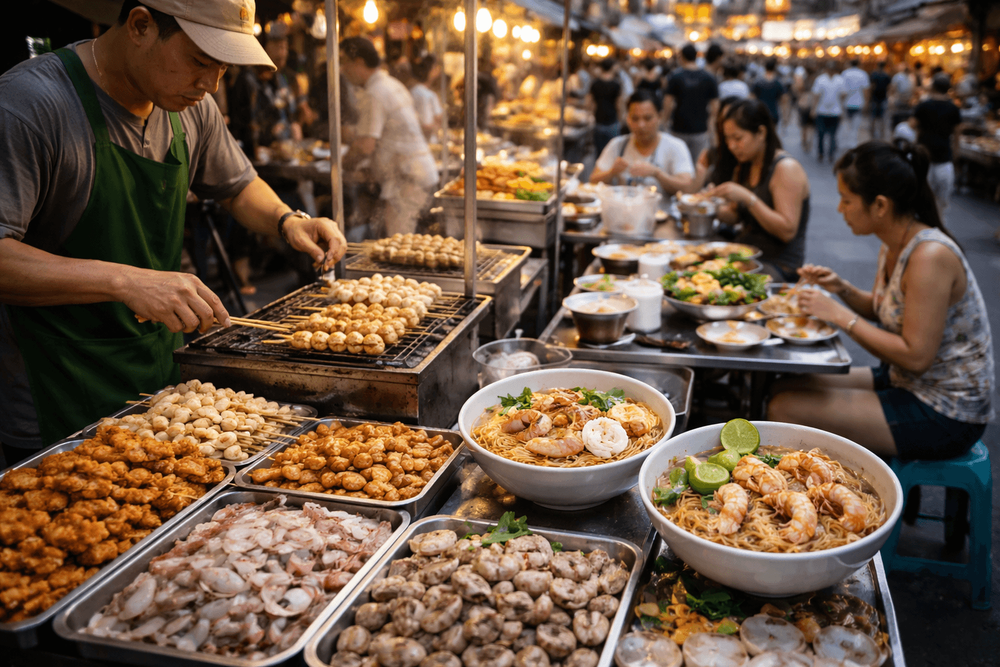
Bangkok Street Food for Pescatarians: Fish Balls, Seafood Noodles, and Easy Order Favorites
Where to eat Bangkok street food pescatarian-style: the best seafood noodles, grilled fish, key phrases, and markets to hit—without falling into tourist traps.
We step off the Chao Phraya Tourist Boat ICONSIAM Pier at Tha Chang Bangkok, nose-first into the perfume of grilled lemongrass and charcoal. A tuk-tuk coughs by, durian ghosts the air, and a wok somewhere snaps with oil. If you’re navigating bangkok street food pescatarian style, don’t worry—we’ve been doing the fish-and-seafood shuffle for years. There’s a whole ocean of options between Yaowarat Chinatown Heritage Center’s neon crabs and a humble khao tom pla simmering near Rambuttri.
Bangkok Street Food Pescatarian: What You Can Eat
Street-side, “pescatarian” translates to keeping it ocean-and-egg friendly: fish, prawns, squid, mussels, eggs, tofu, veg—and skipping chicken, pork, and beef. In Bangkok, that’s easier than you’d think.
- Everyday seafood: goong (prawns/shrimp), pla meuk (squid), pla (fish, often sea bass or tilapia for grilling), hoi malaeng phu (mussels), hoi nang rom (oysters).
- Noodles and rice: many wok stalls can make your favorite as talay (seafood) or goong (prawn). Always check the stock: some soups use pork or chicken broth by default.
- Sauces and seasonings to clock: nam pla (fish sauce), nam man hoi (oyster sauce), kapi (shrimp paste). Most pescatarians are fine with these; if you’re not, just say mai sai—don’t add it.
- Egg and plant friends: kai dao (fried egg) on top of rice, tofu (tao-hu), morning glory (pak boong), Chinese broccoli (kailan), basil (holy basil) dishes sans land meat.
If you need a deeper primer on what to ask and what to watch for, we’ve got a handy companion read: Bangkok Street Food for Vegetarians and Pescatarians: Safe Picks, Hidden Ingredients, and Easy Orders.
Best Pescatarian Street Dishes We Hunt Down
You’ll spot these all over—from Banglamphu’s alleys to Chinatown’s thrum. We’ll point out landmines (hidden broths, shrimp paste) and how to order it your way.
Pla Pao (Salt-Crusted Grilled Fish)
The granddaddy of riverside dinners. A whole fish—usually tilapia or seabass—stuffed with lemongrass, sealed in salt, and grilled until the skin crackles. Eat the juicy flesh with a fistful of herbs, lettuce wraps, and a bright nam jim seafood sauce. Order: “pla pao, khor seabass/tilapia.” If avoiding fish sauce: “mai sai nam pla nai nam jim.” Expect a safe range for street prices; confirm locally.
Pad Thai Goong or Pad Thai Talay
Pad Thai with prawns or mixed seafood. At busy carts along Phra Athit Road and in Chinatown’s side sois, you’ll hear the sizzle and smell tamarind before you see the wok. Ask for an extra lime wedge, and if you don’t do oyster sauce: “mai sai nam man hoi.”
Guay Tiew Pla (Fish Noodle Soup)
Clear, clean, and comforting—rice noodles with fish slices or fish balls (look chin pla), morning glory, and a sprinkle of fried garlic. Watch the broth: “nam soup chai kraduk moo mai?” (Is the soup made with pork bones?) If yes and you’d rather avoid, ask for “nam sai kraduk gai mai?” (chicken stock) or go dry-style (haeng) with soup on the side.
Tom Yum Goong or Tom Yum Talay
The Bangkok national mood in soup form—hot, sour, fragrant. Street versions can be clear (nam sai) or creamy (nam khon with evaporated milk). Confirm stock if you’re strict about poultry bases. Spice-o-meter phrase: “pet nit noi” (a little spicy) or “pet mak” (very spicy).
Hoi Tod / Hoy Lai Tod (Crispy Oyster or Mussel Omelette)
A golden, starchy crisp-omelette, smoky from the flat-top. Dip into chili sauce and get a side of beansprouts. If the griddle’s jet-black with yesterday’s pork, move on—there will be another cart 30 seconds away.
Khao Pad Goong (Shrimp Fried Rice)
A reliable fallback. Woks banging at lunchtime near offices along Charoen Krung churn out solid plates. Add a kai dao (fried egg) for a silky top.
Hor Mok (Steamed Fish Curry Mousse)
A soft, custardy curry of fish steamed in banana leaves. Street markets in the morning often sell mini hor mok—perfect with sticky rice.
Khanom Jeen Nam Ya Pla (Rice Noodles with Fish Curry)
Morning dish alert. Rice noodles with a mild fish-based curry. Check the pot—some stalls do a porky version. Ask: “nam ya pla chai mai?”
Som Tam Variations
- Som tam thai usually includes dried shrimp and fish sauce—pescatarian-friendly for many. If you avoid either, order: “som tam thai, mai sai kung haeng, mai sai nam pla/mai sai pla ra.”
- Som tam pu (with salted crab) is briny and bold; if the idea of crab shells in your papaya doesn’t thrill you, steer toward som tam thai or som tam mamuang (green mango).
Seafood Skewers and Grills
Goong yang (grilled prawns), pla meuk yang (grilled squid), and occasionally scallops on half-shell. Look for seafood laid on clean ice with bright eyes and sweet-sea smell.
Desserts to Cool the Flames
- Mango sticky rice when in season, coconut ice cream in bread with peanuts, kanom krok (coconut rice pancakes). All pescatarian-friendly and blessedly soothing after a tom yum frenzy.
Where to Find It: Streets and Markets That Deliver
We chase crowds, smoke, and turnover. Here’s where we drag you—and why.
Yaowarat (Chinatown)
At night, Yaowarat Road turns into a neon-lit seafood runway. Piles of prawns on ice, crab claws waving from buckets, waiters hustling in red shirts. It’s spectacular and a bit of a circus; prices drift touristy, but the energy makes up for it. We like to wander the side sois—Charoen Krung Soi 16 and 22 often hide quieter stalls with honest wok work.
- Getting there: MRT Wat Mangkon drops you right in the thump of things.
- What to eat: tom yum talay, hoi tod, and midnight pad thai goong.
Wang Lang Market (Across from Tha Chang)
Hop the cross-river ferry from Tha Chang or Tha Phra Chan to Wang Lang, and you’re in a daytime wonderland: guay tiew pla, hor mok, grilled squid, fruit shakes. The seafood here turns over fast thanks to the hospital-and-student crowd.
- Hours: late morning through late afternoon; confirm locally as stalls vary.
- What to eat: guay tiew pla and hor mok.
Banglamphu: Khao San Road, Soi Rambuttri, Phra Athit
You’re on home turf. Early evenings hum with skewers, noodles, and fruit carts. For tips focused on this area, bookmark our guide to nearby meat-free picks with pescatarian angles: Bangkok Street Food Around Khao San Road for Vegetarians and Pescatarians.
- What to eat: pad thai talay from a cart with a line, pla pao along Phra Athit where the river breeze takes the smoke.
Bang Rak and Old Charoen Krung
From Saphan Taksin up Charoen Krung, the old Thai-Chinese quarter is stacked with wok stalls and rice shops. Lunch is king here. Pescatarian-friendly plates—khao pad goong, pad kee mao talay—fly out of tiny kitchens.
- Getting there: BTS Saphan Taksin, then walk up Charoen Krung or catch the orange flag boat.
Or Tor Kor Market (Opposite Chatuchak)
One of Bangkok’s cleanest "wet" markets and food courts. It’s pricier than your average soi cart but immaculate, with great hor mok, grilled seafood, and tropical fruit.
- Getting there: MRT Kamphaeng Phet, Exit 3.
Food Courts for AC and Easy Choices
Terminal 21’s Pier 21 and MBK’s food court aren’t “street,” but they’re clutch when the heat wins. You’ll find seafood pad thai, tom yum, guay tiew pla, and dessert stalls with clear signage in English and Thai. Ideal if you want to avoid cross-contact chaos.
Ordering Like a Local: Phrases, Checks, and Allergy Tips
You don’t need to be fluent—just brave and polite. Smile. Lead with “sawadee krub/ka.” Then get specific.
- I eat seafood and fish, but no meat: “phom/chan gin ahan thale lae pla, tae mai gin neua, moo, gai.”
- No fish sauce: “mai sai nam pla.” No oyster sauce: “mai sai nam man hoi.” No shrimp paste: “mai sai kapi.”
- Is the soup made with pork/chicken bones?: “nam soup chai kraduk moo/gai mai?”
- Little spicy/very spicy: “pet nit noi” / “pet mak.”
- Allergy (shrimp/shellfish/peanut): “phom/chan phae kung / phae hoi / phae tua-li-song.” Follow with “mai sai” (don’t put).
- Cooked-to-order helps avoid cross-contact. Point at the wok and ask nicely: “tham mai dai mai? (Can you make it special?) mai sai moo/gai.”
Hidden ingredients to double-check:
- Yen ta fo’s pink soup can be seafood-rich but often simmered with pork bones—ask first.
- Pre-fried toppings (crisp pork) share oil with fried tofu at some stalls—watch the fryer.
- Nam chim (dipping sauces) almost always include fish sauce or shrimp paste; if you avoid, request plain lime, chilies, and salt.
For more diet-specific landmines (vegan, halal, gluten-free) you can cross-reference this broader cheat sheet: Bangkok Street Food for Dietary Restrictions: Vegetarian, Vegan, Halal, and Gluten-Free Options.
Prices, Hygiene, and Peak-Hour Sanity
We’re not here to baby you, but a few street smarts go a long way.
- Prices: Bangkok still rewards the curious. Simple noodle bowls and fried-rice plates run in a modest range; seafood grills cost more, especially by weight. Confirm locally—prices float with catch and neighborhood.
- Freshness tells: clear fish eyes, bright gills, shellfish on clean ice, and a sweet-sea smell (not funky). If the prawns look cloudy or dry, skip.
- Oil check: Jet-black fry oil and a smoking, tired wok can ruin otherwise good seafood. Choose a stall where oil looks golden and the cook is actually frying to order.
- Turnover: Follow the lines. Busy lunch crush (11:30–13:30) and dinner rush (18:00–21:00) mean your prawns haven’t been sunbathing for hours.
- Heat and hygiene: If it’s a 38°C scorcher, stick to cooked-to-order dishes, avoid raw oysters, and go for AC food courts in the midday. Always watch the cutting boards—separate boards for raw and cooked is a green flag.
- Water & ice: Drink sealed bottles and check ice is clear and delivered in bags—not scooped from a bucket with mysterious tongs.
Getting Around for the Feast
- Chao Phraya Express Boat: Cheap and breezy. Use the orange-flag boats to jump between Phra Athit, Tha Chang, and Saphan Taksin for riverside eats.
- MRT/BTS: MRT Wat Mangkon for Chinatown, BTS Saphan Taksin for Charoen Krung, MRT Kamphaeng Phet for Or Tor Kor. Buy a stored-value card if you’re hopping around.
- Tuk-tuk vs Taxi: Tuk-tuks are fun, but agree on a price before rolling; taxis should run the meter—“meter dai mai?” is your friend.
Know Before You Go
- Cash rules most carts; small bills are king. Many food courts use stored-value cards.
- Bring wet wipes and hand gel. Street napkins are basically tissue confetti.
- If you’re squeamish about cross-contact, spend your lunches at made-to-order wok stalls or food courts; save your grill adventures for the evening when seafood turns faster.
- Accommodation: We like to base near Phra Athit Road for river hops or around Silom/Sathorn for easy BTS access—keeps every seafood binge a short ride away.
When the wok is roaring and your plate is gleaming with tamarind and prawns, you’ll get it. Tomorrow, we’ll chase that perfect bowl of guay tiew pla by the khlong, and maybe a second dessert—because sanuk isn’t complete without a coconut-sweet chaser.
Quick Plan
- Day 1: Banglamphu → Chinatown (3–4 km, ~15–25 min by taxi/boat depending on traffic). Key stops: pad thai goong near Phra Athit, tom yum talay on Yaowarat Soi 22. Overnight base: Old Town/Banglamphu.
- Day 2: Or Tor Kor Market → Wang Lang Market → Bang Rak (8–12 km combined, ~30–50 min by MRT/boat/walk). Key stops: hor mok at Or Tor Kor, guay tiew pla at Wang Lang, khao pad goong on Charoen Krung. Overnight base: Riverside/Silom area.
ASCII route: Banglamphu → Yaowarat → Or Tor Kor → Wang Lang → Bang Rak
Costs at a Glance (THB)
- Fuel price per liter: 30–45 THB (range; confirm locally). Last checked: Sep 2026.
- Estimated fuel cost per segment (we recommend MRT/boat/taxi, not self-drive): 0 THB (not driving). Last checked: Sep 2026.
- Tolls per segment (city surface routes/river): 0 THB. Last checked: Sep 2026.
- National park/attraction fees per person: 0 THB for the listed markets/streets (public areas). Last checked: Sep 2026.
- Parking per night (if you self-drive and stay central): 0–100 THB at small guesthouses/streets; confirm locally. Last checked: Sep 2026.
Booking Pathways
- Car rental: Compare rental deals at DiscoverCars (https://www.discovercars.com/thailand/bangkok) if you plan day trips beyond Bangkok.
- Hotels: Browse Bangkok Old Town and riverside stays on Booking.com (https://www.booking.com/city/th/bangkok.en-gb.html) for easy access to boats and markets.
- Tickets/tours: Check Chinatown night food tours and Chao Phraya passes on Klook (https://www.klook.com/en-TH/city/1-bangkok-things-to-do/).
Verification
- We avoid exact prices/hours unless confirmed; Bangkok street food prices vary by catch, stall, and neighborhood. Ranges above are conservative and marked “confirm locally.”
- Transit access points (MRT/BTS stations and piers) are widely posted on-site; confirm last-boat/train times locally or via the official operators on the day you travel.
- Seafood freshness and hygiene guidance is based on on-the-ground experience and standard food-safety best practices; conditions vary by stall.
EVAL_DATA
- has_quick_plan: true
- has_costs_at_a_glance: true
- has_booking_pathways: true
- booking_outbound_links_count: 3
- has_verification_block: true
Related Hotels & Places
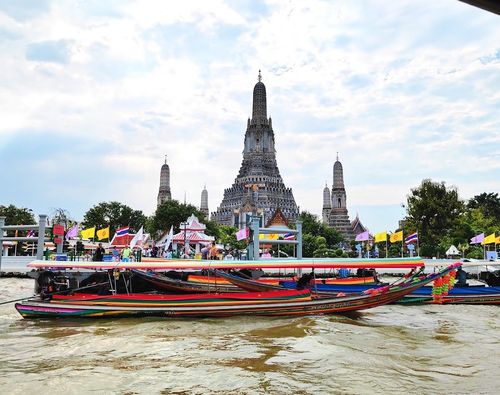
Chao Phraya Tourist Boat ICONSIAM Pier
Services
Hop on the blue‑flag tourist boat at ICONSIAM to cruise Wat Arun, Wat Pho, the Grand Palace and Chinatown. Day pass ~150 THB, boats every ~30 mins, last runs around 7:15pm. Easiest river launchpad via BTS Gold Line to Charoen Nakhon.
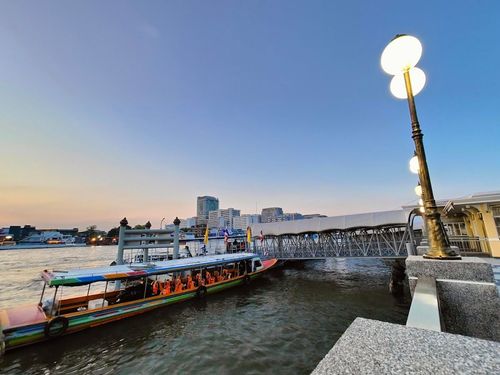
Tha Chang Bangkok
Bars
Bar on Khao San Road.
Yaowarat Chinatown Heritage Center
Attractions
Inside Wat Traimit by Chinatown Gate, this tidy museum charts Yaowarat’s Chinese roots with bilingual displays, period photos and short films. Open Tue–Sun 8:30am–4:30pm; closed Mon. Pair it with the Golden Buddha upstairs.
Rambuttri
Markets
Khao San’s calmer cousin: a tree‑shaded lane of VW van cocktail bars, open‑air foot massages, pad thai grills, and easygoing live bands. Best from sunset to 11pm; beers 80–120 THB, cocktails 150–220 THB. One block from the chaos, all the charm.
More Khao San Road Guides
- Bangkok Street Food Near Transit: Best Eats by Boat, MRT, and Old Town Walking Routes
- Bangkok Street Food Near Ferry Piers: Easy Local Eats by Phra Athit, Tha Chang, and the Chao Phraya River
- Bangkok Street Food at Tourist Landmarks: What to Eat Near the Grand Palace, Wat Pho, and Along the River
- Bangkok Street Food Around Transit Hubs: Easy Eats Near MRT, BTS, and River Ferry Stops