
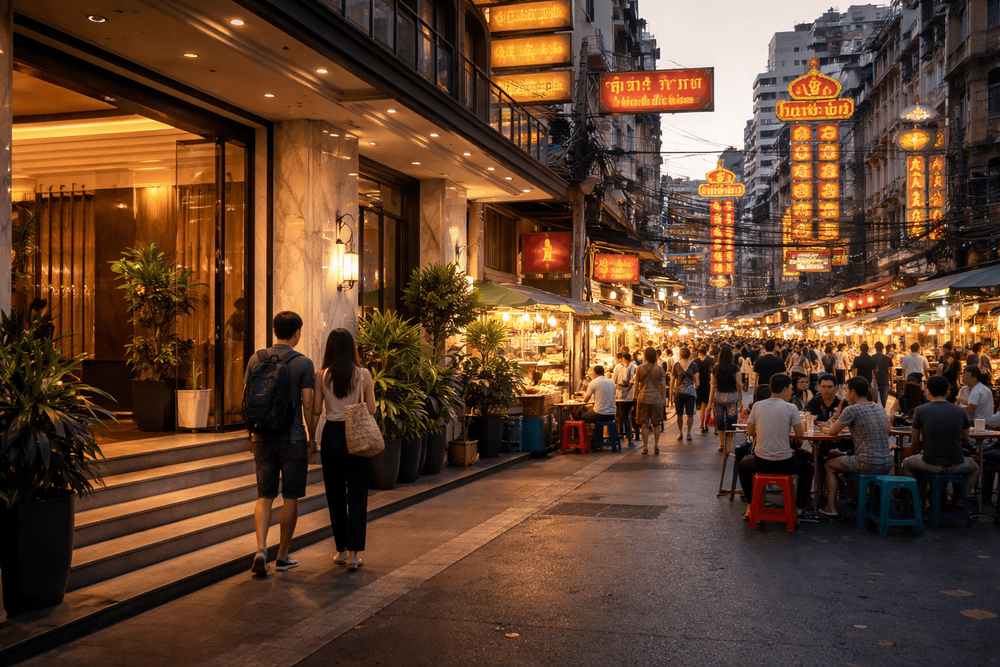
Best Hotels Near Yaowarat for Foodies: Walkable Stays for Late-Night Street Eats, MRT Access, and Easy Old Town Day Trips
Our insider guide to Yaowarat hotels—walkable stays for street food, MRT access, and river hops. Where we actually book, plus tips on noise, prices, and transit.
We step off Yaowarat Road into a spill of neon and steam, dodging a tuk-tuk that noses through the crowd like a curious fish in a khlong. Woks roar, chilies sting our eyes, and a vendor fans charcoal under skewers that smell like heaven and trouble. This is where Bangkok eats. And if we’re here to feast, we want a bed close enough to stumble back to with a bag of patongo still warm. We’ve road-tested a stack of Yaowarat hotels, the ones that keep us within fork’s reach of the action while still making Old Town day trips and late-night MRT rides a breeze.
Why We Stay in Yaowarat (Chinatown)
Because food. Simple as that. Yaowarat is Bangkok’s dinner bell—crispy oyster omelets popping on cast-iron, peppery guay jub (rolled rice noodles) at 1 AM, mango sticky rice that somehow tastes brighter under red lanterns. But staying here is also practical:
- MRT Blue Line puts us everywhere fast (Wat Mangkon and Hua Lamphong stations bracket the neighborhood).
- The Chao Phraya Express boat from Ratchawong Pier hops us to Wat Arun, Tha Tien for the Grand Palace, or up to Phra Athit Road.
- Walkability is real: Sampeng Lane’s fabric maze, Talad Noi’s street art, and Wat Traimit’s Golden Buddha all tuck inside a 10–20 minute stroll.
Yes, it’s hot, loud, and gloriously chaotic—that’s part of the sanuk (fun). Our trick is picking Yaowarat hotels that temper the street’s thump with cold AC, clean sheets, and quick exits to food and transit.
Best Yaowarat Hotels by Traveler Type
We don’t do bland top-10s. We do beds we’d book again, broken down by how we actually travel.
Budget and Solo: Keep It Simple, Keep It Clean
- Luk Hostel on Soi Wanit 1 puts you a few quiet steps from the neon blast of Yaowarat. Dorms are crisp, social vibes without the chaos, and you can wander Talad Noi for morning coffee when the street cats own the alleys.
- Loftel 22 Hostel sits close to Song Wat Road’s new cafés and mural-lined lanes. Solid AC, friendly staff, and you’ll be first in line for morning soy milk and youtiao.
- HOSTEL URBY leans shipside-cool by the river, an easy amble to Ratchawong Pier for those boat rides that feel like cheating the traffic gods.
Expect: 300–800 THB per bed, Wi‑Fi that’s fine for maps and messages, lockers, and (usually) curtains for privacy. Bring earplugs—neon neighborhoods don’t whisper.
Mid-Range and MRT-Minded: Walk to Dinner, Zip Everywhere Else
When we’re eating hard and moving fast, we base near Wat Mangkon MRT. Two minutes downstairs and we’re halfway to wherever.
- We often book ASAI Bangkok Chinatown for design-forward rooms, lobby buzz, and a two-minute wander to Wat Mangkon’s station and night stalls. It’s the rare spot that feels both local and easy-going for farang first-timers. ASAI Bangkok Chinatown
- W22 by Burasari is our “we want quiet-ish but central” pick—clean lines, dependable AC, and close enough to slip to Soi Nana’s cocktail bars when the wok smoke turns to juniper.
- Hotel Royal Bangkok sits right on the action; grab a high floor to mute the scooter symphony and you’ll wake steps from peppery guay jub.
- On the station side, The Quarter Hualamphong by UHG makes late arrivals painless and puts the blue line at your doorstep.
Expect: 1,200–2,500 THB for doubles, private bathrooms, reliably cold AC, and front desks that won’t blink when you check in with a bag of durian candy.
Boutique and Design: Mood Lighting, Vintage Tiles, River Whispers
When we want a little romance with our noodles, Chinatown delivers character in spades.
- For on-Yaowarat swagger and old-Shanghai velvet, we duck into Shanghai Mansion Bangkok—hard to beat for location when you plan to live on the street-food strip. Shanghai Mansion Bangkok
- The Mustang Blu in Talad Noi is a fever dream of antique wood and teal walls; wake early, wander to Song Wat for a flat white, then circle back for boat noodles.
- Baan 2459 Heritage House is a quiet-in-the-courtyard refuge when the night’s gotten loud and the satay smoke clings to your shirt.
- Loy La Long Hotel on the river is pure mood at dusk—the Chao Phraya becomes your screensaver while longtails mutter past.
Expect: 2,500–5,000+ THB, smaller properties with charm over checklist. Book early—these places vanish fast for Chinese New Year and long weekends.
Families and Groups: Space to Sprawl, Kitchens for Snacks
We love Chinatown with kids: short walks, snack every five meters, boat rides when patience melts.
- When we need room to spread out, we go for apartment-style convenience at I’m Chinatown Residence—bigger layouts and kitchenettes right by the main drag, ideal for napping toddlers and post-midnight fruit raids. I'm Chinatown Residence (Yaowarat)
- Grand China Bangkok at the top of Yaowarat grants broad views over the old city sprawl; high floors hush the road and give you sunrise bragging rights.
- The Quarter Hualamphong by UHG wins for transit: wheeling strollers straight to the MRT beats wrangling taxis at rush hour.
- Traveling as a pack? The “Private Full-Floor Spacious 5 Bedrooms in China Town” listing is exactly what it says—gather everyone, claim a bedroom, then argue over which dessert cart to hit first.
Expect: 2,000–4,500 THB for family rooms/suites, elevators (not always given in heritage buildings), and staff who’ll smile when you ask for extra bowls for mango sticky rice.
The Best Areas to Stay in and Around Chinatown
Yaowarat isn’t one vibe; it’s a handful of micro-neighborhoods stitched by history and hunger.
Right on Yaowarat Road
This is the red-and-gold artery. You’re sleeping in the postcard.
- Pros: Step out to T&K Seafood, Nai Ek Roll Noodles, Sweet Time’s taro boba, and Jek Pui’s green curry under the umbrellas. Great for first-timers and night owls.
- Cons: Noise. Scooter horns, clattering woks, late deliveries. Ask for higher floors or interior rooms. Mondays can be quieter as some vendors rest.
Talad Noi and Soi Wanit 1
We adore this pocket: old machine shops, Chinese shrines, and street art splashed across crumbling shophouses.
- Pros: Calmer lanes, creative cafés, and easy access to Ratchawong Pier for river boats. Fantastic daytime grazing—soy milk stands, patongo, roast duck rice.
- Cons: Narrow, winding sois; taxis sometimes struggle to find you. Walk to main roads for rideshares.
Around Wat Mangkon MRT
Anchor yourself near the blue-line station and you win Bangkok.
- Pros: Fast hops to Hua Lamphong, Sanam Chai (for the Grand Palace/Tha Tian), and onward to Asok/Chatuchak with one transfer. Night markets bloom right outside after 6 PM.
- Cons: Fewer river views, and some newer builds mean smaller rooms—check the square meters before you book if you sprawl.
Hua Lamphong Side
Old station, new convenience. Edges into Bang Rak and Pathum Wan quickly.
- Pros: MRT interchange, quick rides to Silom and Siam, and easier taxi pickups. Good if your train or airport bus timing is odd.
- Cons: You’ll walk 10–15 minutes to the thick of Yaowarat’s street food or hop one MRT stop to Wat Mangkon.
What Food-First Guests Should Prioritize
You can have it all—sizzle downstairs, sleep upstairs—if you tick the right boxes.
Cleanliness and AC That Actually Hurts a Little
Old buildings are charming until the shower grout fights back. We look for recent renovations or solid review photos. In Bangkok heat, we want AC that slaps; older rooms sometimes need a beat to cool down, so arrive, blast it, then duck out for a drink while it chills.
Room Size and Layout
Yaowarat hotels run from capsule-chic to suite-style. If you’re carrying camera gear or traveling with family, check room size (m²). Interior rooms (no windows) can be quieter and darker—great for jet lag, less great if you get claustrophobic.
Wi‑Fi and Work Nooks
Most places have decent Wi‑Fi; if you’re working, scan for mentions of co-workingish lobbies. We’ll often answer emails in a cool café on Song Wat, then sprint back out when the first woks ignite.
Breakfast vs. Street Breakfast
Hotel breakfasts are convenient, but Chinatown mornings are a playground: jok (rice porridge) with ginger and century egg, doughy patongo dunked in pandan custard, Thai iced coffee that’ll jitter you onto the MRT. We often skip hotel buffets and spend 60–120 THB eating curbside.
Rooftops and River Views
Chinatown’s charm is street-level, but if views matter, scan for high floors over Odeon Circle or riverside stays in Talad Noi. Sunset over the Chao Phraya with a Leo is a good way to forgive the day’s heat.
Three Stays We Personally Rebook
- When our itinerary screams “eat, ride, repeat,” we reach for ASAI Bangkok Chinatown. Compact rooms, big community spaces, and Wat Mangkon MRT right there—it saves time and shoe leather.
- For on-Yaowarat swagger and soft-lit nights, we slip into Shanghai Mansion Bangkok. You’re mid-neon, mid-noodles, mid-everything.
- Traveling with friends or little ones, we like the extra elbow room at I'm Chinatown Residence (Yaowarat). Having a kitchenette means midnight fruit becomes a ritual, not a quest.
Practical Booking Tips for Yaowarat Hotels
- Peak seasons: Late November–February is “cool” season; rates often float 20–40% higher. Chinese New Year (Jan/Feb, dates shift) and the Vegetarian Festival (Sep/Oct) send prices and occupancy soaring—book 4–8 weeks ahead.
- Weekends vs weekdays: Friday–Sunday sees heavier domestic crowds; midweek can be calmer and cheaper.
- Noise strategy: Ask for high floors, back-facing rooms, or interior rooms. Pack earplugs. Street food cleans up around 1–2 AM but deliveries start early.
- Late-night food access: Yaowarat Road keeps flickering well past midnight. If you want guaranteed post-1 AM snacks, aim for a base within 1–2 blocks of Odeon Circle to Ratchawong.
- Transport costs: MRT rides usually 17–43 THB depending on distance. Chao Phraya Express boat is 16–32 THB; the special tourist boat is pricier but simpler. Short taxi hops in light traffic run 60–120 THB; tuk-tuks at night often quote 80–200 THB—negotiate or book Grab.
- Scams happen everywhere: If a tuk-tuk offers a 20 THB “tour,” it’s a detour to a gem shop. Smile, say “mai ao, khop khun” (no thank you), and keep walking.
- Heat management: Plan noodles by night, temples by morning. Duck into a 7‑Eleven for an AC blast and a 13 THB water when the asphalt starts to shimmer.
Nearby Eats and Things To Do From Each Base
Sleeping on Yaowarat Road
- Dinner crawl: T&K Seafood for quick-fire stir-fries, Nai Ek Roll Noodles for pepper bomb guay jub, and Sweet Time for warm black sesame dumplings in ginger tea.
- Daytime: Wat Traimit’s Golden Buddha just off Odeon Circle, and Sampeng Lane’s fabric labyrinth where shoulder brushes shoulder.
- Cafe fix: Eiah Sae—old-school coffee, toast, and the feeling your granddad’s pocket watch might tick on the saucer.
Staying in Talad Noi or Along Soi Wanit 1
- Snack map: Soy milk and patongo at dawn, roast duck rice by noon, limey boat noodles mid-afternoon. Feast, nap, repeat.
- Wander: Street art loops past machine shops, tiny shrines, and the odd teetering ancestral house. When the sun dips, slide to Ratchawong Pier for the river breeze.
Basing Near Wat Mangkon MRT
- Night markets blur into each other—skewers, crab fried rice, Thai-Chinese desserts. This is also your springboard to Sanam Chai for Old Town temples; ten minutes underground beats twenty above ground.
Hua Lamphong Side
- Transit: It’s the grown-up corner—easy MRT, easier taxis. If we’re catching an early flight, we like staging here so our morning is logistics, not luck.
- Eats: Fewer neon carts, but noodle joints and curry shops still dot the grid. A quick MRT hop drops you back under the lanterns when hunger calls.
Getting There and Around
- From Suvarnabhumi (BKK): Airport Rail Link to Makkasan (35 THB), connect to MRT Phetchaburi, then ride to Wat Mangkon or Hua Lamphong (roughly 40–50 THB total). Taxi runs 250–400 THB on the meter plus tolls; late-night is faster.
- From Don Mueang (DMK): A1/A2 bus to Mo Chit, hop MRT at Chatuchak Park (via BTS) or grab a taxi/Grab direct (200–350 THB depending on traffic).
- River route: Chao Phraya Express Boat to Ratchawong Pier for the Chinatown heart, or Marine Department Pier for Talad Noi. It’s cheap, breezy, and beautiful.
- On foot: Sidewalks are a contact sport. Cross at lights, follow vendors, and remember that in Bangkok, the shade belongs to the wise.
If you want the neighborhood deep-dive before you book, our Chinatown primer is a good warm-up jog: Yaowarat Chinatown Heritage Center.
Quick Price Guide (So You Don’t Overpay)
- Dorm beds: 300–800 THB
- Basic doubles: 900–1,500 THB
- Mid-range boutique: 1,800–3,500 THB
- Heritage/design and riverside spots: 2,500–5,000+ THB
Holidays, festivals, and late bookings can nudge these up. If a rate looks too low on peak weekends, double-check room type and whether tax/service are included.
Final Word from the Curb
We’ll be honest: Yaowarat is not for travelers who want whisper-quiet nights and uniform lobbies. It’s for anyone who smiles at a plastic stool, chases the sizzle of a wok down a side soi, and judges a stay by how fast we can get from bed to noodles. Pick your base, lace up, and meet us under the red lanterns—we’ll save you a seat and a second bowl of guay jub.
Related Hotels & Places
Luk Hostel
Hotels
A 1.5-star hotel in Bangkok.
Loftel 22 Hostel
Hotels
A 2.5-star hotel in Bangkok.
HOSTEL URBY
Hotels
A 2-star hotel in Bangkok.
ASAI Bangkok Chinatown
Hotels
A 3-star hotel in Bangkok.
W22 by Burasari
Hotels
A 3-star hotel in Bangkok.
The Quarter Hualamphong by UHG
Hotels
A 4-star hotel in Bangkok.
Shanghai Mansion Bangkok
Hotels
A 4-star hotel in Bangkok.
The Mustang Blu
Hotels
A 5-star upscale hotel in Bangkok.
Baan 2459 Heritage House
Hotels
A 5-star upscale hotel in Bangkok.
Loy La Long Hotel
Hotels
A 3-star hotel in Bangkok.
I'm Chinatown Residence (Yaowarat)
Hotels
A 4-star hotel in Bangkok.
Grand China Bangkok
Hotels
A 4-star hotel in Bangkok.
Yaowarat Chinatown Heritage Center
Attractions
Inside Wat Traimit by Chinatown Gate, this tidy museum charts Yaowarat’s Chinese roots with bilingual displays, period photos and short films. Open Tue–Sun 8:30am–4:30pm; closed Mon. Pair it with the Golden Buddha upstairs.
More Khao San Road Guides
- Best Hotels Near Yaowarat (Chinatown) for Easy Street Food, MRT Access, and Old-Bangkok Exploring
- Best Hotels Near Yaowarat for Foodies: Street Food Access, Late Check-In, and Quiet Sleep
- Best Hotels Near Yaowarat (Chinatown) for Food Lovers, Night Markets, and Easy MRT Access
- Where to Eat Street Food in Yaowarat: Bangkok’s Chinatown Night Market Guide