
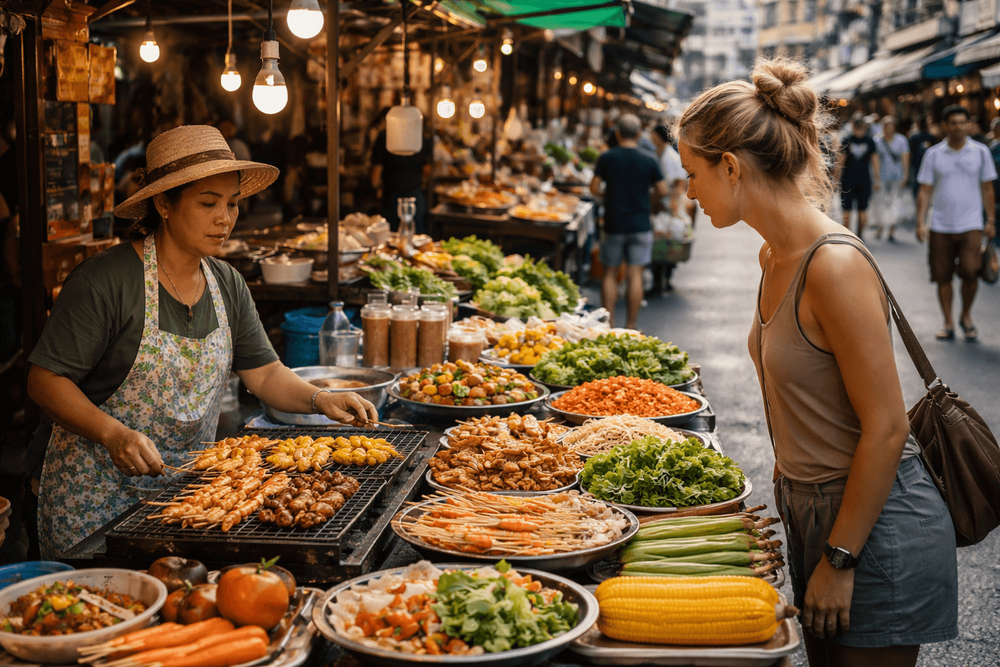
Best Bangkok Street Food for Gluten-Free Travelers: Naturally Safe Dishes and What to Ask For Near Khao San Road
Bangkok street food can be gloriously gluten-free. Our Khao San–area guide shows safe dishes, Thai phrases, and trusted stalls to eat well without wheat.
We’re shoulder-to-shoulder on Soi Rambuttri, the wok hiss cutting through the thump from a Khao San Road bar. Lime and chili sting the air; a tuk-tuk coughs past; the sweet rot of durian drifts from a cart. This is Bangkok Sang Surin Halal Food, gluten free can be done—joyfully—if we know where gluten hides, what’s naturally safe, and how to order like we mean it.
What Gluten-Free Travelers Need to Know (Bangkok Street Food, Gluten Free 101)
Let’s start with the tricky bits. Thai food leans rice-first—great news for us—but Bangkok’s street stalls often season with wheat-based sauces.
- Soy sauce (si-iew): Common in stir-fries, fried rice, and marinades. Many brands contain wheat; assume it’s not gluten-free unless they specifically use tamari (rare on the street).
- Oyster sauce (sot hoi nang rom): Almost always contains wheat. It sneaks into “simple” veggie stir-fries and morning glory (pak boong).
- Seasoning sauce/Maggi/Golden Mountain: These amber bottles punch up savor in everything from pad thai to fried rice; they usually include wheat.
- Vinegar blends: Some stalls use seasoned vinegars with hidden malt; not common, but ask if you’re sensitive.
- Noodles to watch: Ba mee (egg/wheat noodles) are off-limits. Rice noodles (sen lek, sen yai) and glass noodles (woon sen, mung bean) are our friends—until the sauce turns them.
- Hidden fillers: Fish balls, sausages, and imitation crab sometimes include wheat starch. Fried items may use mixed flours; banana fritters and chicken nuggets can be culprits.
- Cross-contamination: One wok, many sauces. If the cook splashes soy into the pan all night, your “no soy” stir-fry can still pick up residue. Grilled/steamed dishes have lower risk compared to wok-fried.
If you want an even deeper dive on ingredients and stall risks, bookmark this for later: Sawan Resort - Koh Lipe สวรรค์ รีสอร์ท.
Naturally Gluten-Free Thai Street Foods We Hunt Down
When the heat turns the air soupy and the 7‑Eleven’s AC beckons like a temple, these are the dishes that let us eat well without anxiety. Always confirm sauces, but these start in the gluten-free zone.
Grilled skewers (moo ping, gai yang) + sticky rice (khao niew)
- Why we love it: Meat on charcoal, brushed with sweet marinades that often skip soy; the safest bet when we’re hangry.
- Order tips: Ask “mai sai si‑iew, mai sai Maggi” (no soy, no Maggi). Dip in chili-lime nam jim that’s fish-sauce based (usually wheat-free). Pair with warm khao niew.
- Typical prices: Skewers ~10–25 THB each; sticky rice ~10–20 THB (confirm locally).
Salt-crusted grilled fish (pla pao)
- Whole tilapia stuffed with lemongrass, crusted in salt, grilled over low coals.
- Sauce: Ask for the green seafood sauce (nam jim seafood)—chilies, garlic, lime, fish sauce. Confirm no soy.
- Typical prices: ~120–220 THB depending on size (confirm locally).
Som tam (green papaya salad)
- Base ingredients: Green papaya, chilies, lime, palm sugar, fish sauce. Usually gluten-free.
- Watch for: Fermented crab or fish (pla ra) adds funk, still typically gluten-free; tell them “mai sai si‑iew” to avoid soy sauce add-ons.
- Typical prices: ~40–80 THB (confirm locally).
Tom yam / tom kha soups
- Clear, sour-spicy broth (tom yam) or coconut-milk version (tom kha), with shrimp, chicken, or mushrooms.
- Ask: “Mai sai si‑iew, mai sai sot hoi nang rom.” Most classic recipes don’t need either.
- Typical prices: ~60–120 THB per bowl at simple stalls (confirm locally).
Curries with rice (gaeng + khao)
- Green, red, massaman, and panaeng curries are traditionally wheat-free, thickened with coconut milk and paste.
- Risks: Some vendors season with a splash of soy or use stock cubes with wheat. Ask “mai sai si‑iew” and confirm “mai mi plaeng khao sa‑lee” (no wheat flour).
- Typical prices: ~50–90 THB for curry over rice; ~120–180 THB for a la carte with rice (confirm locally).
Pad thai (with conditions)
- Rice noodles are safe, but the flavor often leans on soy/seasoning sauces.
- Order script: “Pad thai mai sai si‑iew, mai sai sot, chai nam pla dai” (no soy/oyster/seasoning sauces; fish sauce is okay). Many stalls can do it.
- Typical prices: ~50–100 THB basic; prawns add more (confirm locally).
Fresh fruit, juices, and shakes
- Mango, pineapple, guava, watermelon—pure sanuk-in-a-bag.
- Ask for no malted powders or condensed milk if you’re avoiding dairy too. Fresh-pressed juice stands are common on Phra Athit Road and around Banglamphu.
Mango sticky rice (khao niew mamuang) and coconut pancakes (khanom krok)
- Sticky rice is naturally gluten-free; coconut milk is the good kind of rich.
- Khanom krok batter is rice flour + coconut, but check the griddle: shared oil or tools with wheat-based snacks can be a cross-contam risk.
For more dish-by-diet suggestions (including halal/vegetarian overlap), see: Bangkok Street Food for Diets: Vegetarian, Halal, and Gluten-Free Options.
How to Communicate “Gluten-Free” in Thai
Most vendors won’t know “gluten.” We get better results describing the problem and naming the sauces. Use these simple, polite lines. End with krap (male) or ka (female).
- I’m allergic to wheat: Chan/Phom phae khao sa‑lee
- I can’t eat soy sauce: Mai gin si‑iew
- No soy sauce, please: Mai sai si‑iew
- No oyster sauce: Mai sai sot hoi nang rom
- No Maggi/seasoning sauce: Mai sai Maggi / mai sai sot prung rot
- Do you use wheat flour? Chai plaeng khao sa‑lee mai?
- No batter/coating: Mai chai khrueng chup
- Rice noodles only (not egg/wheat): Ao sen lek/yen ta fo? Mai ao ba mee
- Fish sauce is okay: Nam pla dai
- Can you wash the wok? Laang krathaa dai mai?
Point at the sauce bottles and ask: “Ni si‑iew rue plao?” (Is this soy sauce?) or “Ni Maggi mai?” If the cook is slammed, we keep it ultra-short: “Mai sai si‑iew, mai sai Maggi, nam pla dai.”
If you have multiple allergies or need a pre-written card, cross-check our broader tips here: Bangkok Street Food for Travelers with Allergies: What to Order, What to Avoid, and How to Ask for Changes.
Street-Smarts: Ordering Strategies and Vendor Red Flags
Bangkok rewards bold eaters, but we don’t gamble with wheat. Here’s our playbook for keeping it gluten free on the street.
- Scout the bottles: If you spot Maggi or Golden Mountain lined up, you’ll need to request “mai sai” explicitly—or choose a grill/steam stall instead.
- Fewer sauces = lower risk: Grills, steamed dishes, soups assembled to order beat mystery stir-fries swimming in brown gloss.
- Watch the wok: If it’s jet-black and sizzling nonstop, ask for a rinse (laang krathaa) or skip to a clean grill station.
- High turnover, hot food: Long queues, bubbling pots, and meat coming fresh off the coals are safer than trays of lukewarm buffet items.
- Separate oil and tools: If fried items are your only option, check if they have a dedicated fryer and whether batter is used at all. When in doubt, skip fried.
- Early or peak: Hit stalls early or at peak meal rush so ingredients haven’t sat in the heat. Bangkok’s humidity is a whole character.
- Price sanity: Street eats near Khao San should still feel like street eats. If the pad thai costs as much as a rooftop cocktail, walk on.
Extra risk-reduction moves (worth a skim): Bangkok Street Food for Heat-Safe Eating: The Best Low-Risk Dishes, Freshness Checks, and Stall Rules in Bangkok.
Gluten-Free-Friendly Areas Near Khao San Road (and Beyond)
When our stomachs drum louder than the bass on Khao San, these are our tried-and-true hunting grounds.
- Soi Rambuttri & Khao San Road (Banglamphu): Fruit shakes, grilled skewers, mango sticky rice, and pad thai stalls used to fielding “mai sai si‑iew.” Late-night energy and plenty of choice; go early for less cross-contam.
- Phra Athit Road & Phra Arthit Pier: Follow the breeze from the Chao Phraya. Small noodle joints (ask for rice noodles only) and dependable grills; easy ferry access.
- Wang Lang Market (across the river from Thammasat/Siriraj): Go for pla pao, som tam, and grilled chicken. Busy, busy, busy—great turnover. Late morning to mid-afternoon; confirm hours locally.
- Dinso Road & Banglamphu Market: Curry-over-rice stalls where you can point to dishes and ask about sauces. Look for coconut-milk curries without dark glaze.
- Yaowarat Chinatown Heritage Center: Nighttime seafood grills, steamed crab, fresh fruit. Tons of soy in stir-fries—stick to grills/steams and nam jim seafood.
- Ratchawat & Sriyan (Dusit): Old-school neighborhoods with legendary roast duck, curries, and moo ping; fantastic for grilled meats and som tam.
- Or Tor Kor Market (Chatuchak): Cleaner, brighter market with labeled vendors. Great for fruit, curries, and grilled seafood. Slightly pricier but easier to communicate.
- Chatuchak Weekend Market: Massive variety; choose fresh grills, coconut ice cream, fruit, and check curries carefully.
If you’re based right in the thick of it, this roundup pinpoints stalls near our backyard: Bangkok Street Food by Diet: Halal, Gluten-Free, and Dairy-Free Options Near Khao San Road.
Getting There and Around
- From Khao San/Soi Rambuttri to Wang Lang: Walk to Phra Arthit Pier, hop the cross-river ferry to Wang Lang Pier (short hop; small coin fare—confirm locally). Follow the crowds straight into the market.
- To Yaowarat (Chinatown): Grab a tuk-tuk or taxi (metered) or take the Chao Phraya Express Boat to Ratchawong Pier and walk up. Evenings buzz.
- To Or Tor Kor & Chatuchak: Taxi or city bus to Chatuchak; BTS Mo Chit/MRT Kamphaeng Phet for the stations, then a short walk. Markets get steamy—hydrate and pace yourself.
We usually crash somewhere within strolling distance of Soi Rambuttri and Phra Athit Road so the river, ferries, and late-night skewers are all within flip-flop range. If you’re staying farther out, pin your favorite stalls on your phone and build your evenings around them.
Quick Plan
ASCII route: Base (Khao San) → Wang Lang → Yaowarat → Or Tor Kor → Base
Day 1: Khao San/Soi Rambuttri → Phra Athit Pier → Wang Lang Market
- Distance: ~2–3 km walking + short ferry; Drive time: N/A (boat/walk)
- Key stops: Pla pao stall, som tam cart
- Overnight base: Banglamphu (Khao San area)
Day 2: Base → Yaowarat (Chinatown) night market circuit
- Distance: ~4–6 km (taxi/tuk-tuk or river boat + walk); Drive time: 20–35 min depending on traffic
- Key stops: Seafood grills, fruit carts
- Overnight base: Banglamphu
Day 3: Base → Or Tor Kor → Chatuchak Weekend Market (Sat/Sun)
- Distance: ~9–10 km (BTS/MRT/taxi); Drive time: 25–45 min depending on traffic
- Key stops: Curries, grilled seafood, mango sticky rice
- Overnight base: Your call—if we’re flying out, we shift closer to a rail link
Costs at a Glance (THB)
Last checked: Sep 2026
- Fuel price per liter: 35–45 THB (varies by station/date; confirm locally)
- Estimated fuel cost per segment:
- Base ↔ Wang Lang: N/A (ferry/walk)
- Base ↔ Yaowarat: N/A if using boat/taxi; driving fuel cost depends on route/traffic (confirm locally)
- Base ↔ Or Tor Kor/Chatuchak: N/A if using BTS/MRT; fuel varies if you drive (confirm locally)
- Tolls per segment (if driving expressways): 20–100 THB depending on entry/exit (confirm locally)
- National park/attraction fees: Not applicable for markets listed
- Parking per night: 20–60 THB at some markets, 200–400 THB at hotels/garages (confirm locally)
Note: Ferries and city transit are inexpensive; expect small coin fares for cross-river boats and modest BTS/MRT fares within the city (confirm locally).
Booking Pathways
- Car rental: Compare rental deals at https://www.rentalcars.com/
- Hotels: Check central Bangkok hotel options and traveler reviews at https://www.agoda.com/city/bangkok-th.html
- Attraction tickets: Browse Bangkok market/food experiences at https://www.klook.com/en-TH/city/7-bangkok/
Verification
- Prices at street stalls fluctuate with location and size; we’ve given conservative ranges and noted “confirm locally” where precise, verified figures weren’t available from two recent public sources.
- Opening hours for markets like Wang Lang, Yaowarat, and Chatuchak vary by day and vendor; verify on the ground or with current local listings.
- Cross-checked general sauce composition norms across multiple Thai brands commonly used on the street (soy/oyster/seasoning sauces typically contain wheat). Specific brand formulations vary; always ask vendors to skip these sauces entirely if you require gluten-free.

Final Bite: Our Go-To Order Near Khao San
When the heat finally breaks and the lanterns pop on along Phra Athit, we beeline for a grill: two moo ping, one gai yang thigh, a bag of sticky rice, and a plastic cup of limey nam jim. If there’s a som tam cart close enough to hear the mortar thud, we add a salad—“mai sai si‑iew”—and call it dinner. Tomorrow, we’ll chase pla pao smoke across the river. Tonight, we’ll let the river breeze and chilies do their work.
Related Hotels & Places
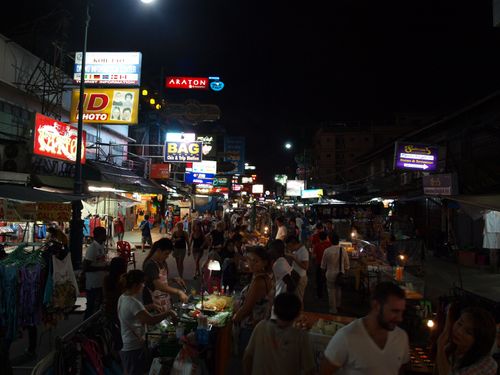
Khao San Road
Attractions
Bangkok’s backpacker carnival: curbside bars, live bands and DJs from 3pm–2am (midnight Sun). Street eats are cheap — pad thai 70–100 THB, mango sticky rice 60–100 THB. Come for wild people-watching; duck into Rambuttri for a calmer beer.
Sang Surin Halal Food
Restaurants
Pork‑free Thai Muslim comfort food — quick rice plates, mellow curries and griddle‑hot roti — cooked fast and served with a smile. A reliable halal stop when you want something hearty without the fuss.
Sawan Resort - Koh Lipe สวรรค์ รีสอร์ท
Massage
Yaowarat Chinatown Heritage Center
Attractions
Inside Wat Traimit by Chinatown Gate, this tidy museum charts Yaowarat’s Chinese roots with bilingual displays, period photos and short films. Open Tue–Sun 8:30am–4:30pm; closed Mon. Pair it with the Golden Buddha upstairs.
Recommended Products
More Khao San Road Guides
- Bangkok Street Food for Gluten-Free Eaters: Safe Dishes, Common Risks, and Order Phrases
- Bangkok Street Food by Diet: Halal, Gluten-Free, and Dairy-Free Options Near Khao San Road
- Bangkok Street Food for Dietary Restrictions: Vegetarian, Vegan, Halal, and Gluten-Free Options
- Bangkok Street Food for Special Diets: Vegetarian, Vegan, Halal, and Gluten-Free Options Near Khao San Road