
Bangkok Street Food Soups and Noodle Stalls: Where to Find the Best Bowls Around Khao San Road
Our insider guide to Bangkok street food noodles around Khao San Road: what to order, where to find the best bowls, prices, and how to slurp like a local.
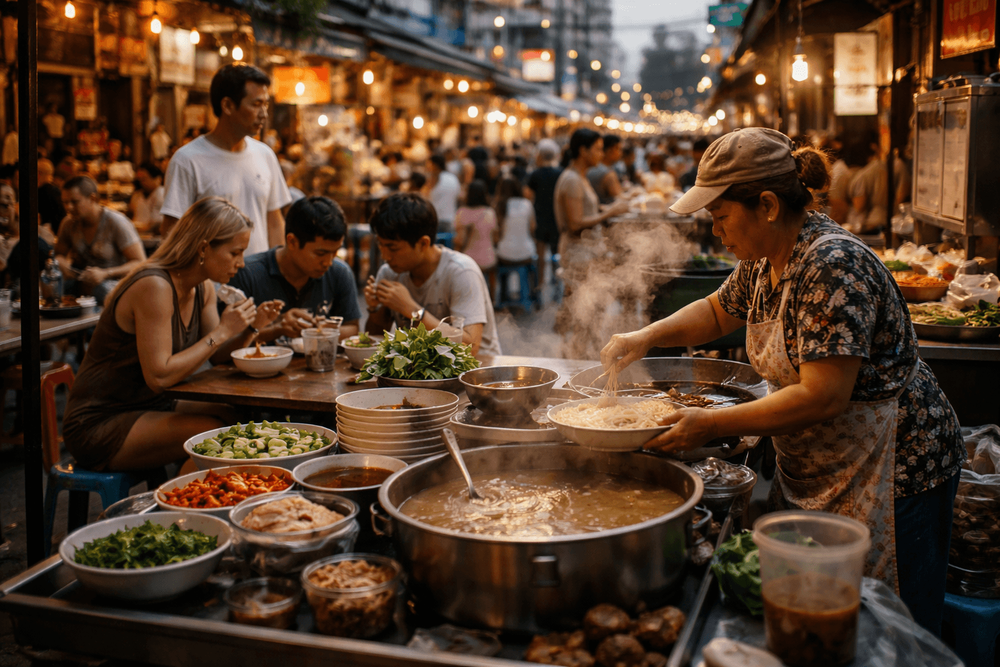
We drift down Soi Rambuttri just as the wok flames lick higher than the awning. Chili hits the back of our throat before we even see the cart. Motorbikes purr, a tuk-tuk belches laughter, and somewhere across the soi a cleaver thunks through roasted pork. The air tastes like garlic, soy, and a promise: tonight we’re eating bangkok street food noodles until the bowls stack and the ice in our glass begs for mercy.
Bangkok Street Food Noodles: The Bowls to Know
Before we start slurping our way around Khao San Road and Banglamphu, let’s get the noodles straight. If you can name your bowl, you can order like a local and avoid the dreaded tourist “mystery noodles.”
Boat noodles (kòoay tiáo ruea)
Dark, rich, and a little wild. The broth is spiked with spices, herbs, and often a splash of pig’s blood for body (don’t panic—think silky, not metallic). Expect pork or beef slices, meatballs, morning glory, and crackly pork rinds. Traditionally served in palm-size bowls so you can stack three or four. We’ll usually go “haeng” (dry) for one bowl and “naam” (with soup) for the next and chase each with a sip of icy cha yen.
Pad Thai
Yes, it’s everywhere, especially around Khao San, and it’s good when the wok is blazing. Tamarind-tangy, sweet-savory, with chewy rice noodles and that elusive wok hei—the breath of the wok—you can smell from halfway down the soi. We add extra lime and a fistful of bean sprouts for crunch.
Pad see ew
Fat, silky “sen yai” noodles seared with egg, soy, and Chinese broccoli until the edges char. When the wok sizzles loud enough to make you jump, you know you’re about to get the good kind.
Yen ta fo
Bubblegum-pink soup thanks to fermented red bean curd. It’s sweet-sour-salty with fish balls, tofu, squid, and morning glory. If you love complexity, this is your Bangkok sleeper hit.
Tom yum noodles
All the lime-lemon grass-chili fireworks of tom yum soup, but poured over noodles. Choose your noodle width (sen yai, sen lek, ba mee egg noodles, or woon sen glass noodles) and your protein. Ask for “tom yum moo” (pork) if you want classic comfort with an acidic kick.
Bonus bowls you’ll see
- Rad na: gravy-drenched wide noodles with Chinese kale, usually mellow and peppery.
- Guay jub: rolled rice noodles in peppery broth with crispy pork belly; we order this when the night cools and the bass from Khao San starts to thump.
If you want a deeper dive into what to try near Khao San, save this handy guide: Bangkok Street Food Guide to Iconic Dishes: Where to Find Pad Thai, Boat Noodles, and Mango Sticky Rice Near Khao San Road.
What Makes Bangkok Noodle Stalls Special
Bangkok noodle carts are tiny stages where serious cooking happens fast. Watch closely and you’ll understand why one 50-baht bowl can stop traffic.
Broths built on bones and time
Even the simplest “naam sai” (clear soup) has layers—from pork bones simmered all afternoon to daikon, garlic, and white pepper. “Naam tok” (boat noodle broth) gets depth from spices and a thicken-the-waters secret splash that makes it cling to noodles.
The wok is a flamethrower
For stir-fried noodles, the cook’s best friend is a scarred carbon-steel wok that sounds like a drumline. That high heat flash-sears noodles and caramelizes soy in seconds. If the flame roars and the cook’s arm looks like it’s done this ten thousand times, queue up.
The four-jar condiment set
Every table gets the classic quartet:
- prik pon (chili flakes) for heat
- nam som (vinegar with chilies) for tang
- nam pla (fish sauce) for salt
- sugar for balance
Bangkok is a dress-it-yourself city. Taste first, then tweak. Locals don’t blink at three spoonfuls of sugar in boat noodles; it’s about balance, not rules.
Local rhythms
- Breakfast bowls: clear broths and pork on sleepy Samsen sois as vendors hose down the sidewalk.
- Lunchtime rush: workers on Phra Athit slurp fast—high turnover means fresh pots.
- Late-night fuel: after the bars kick up on Khao San, carts shift to tom yum and pad thai. Follow the smell of garlic and the brightest lightbulb.
Where to Find Great Noodles Near Khao San Road
We’re keeping it walkable (or a quick riverside hop), with a couple of classic detours when the craving turns serious.
Around Khao San and Soi Rambuttri
- Soi Rambuttri (both loops): After dark, carts line the curve with pad thai, pad see ew, and quick-fry glass noodle dishes. Look for the stations where the wok never rests.
- Tani Road and Chakrabongse: Smaller mom-and-pop shophouses do daytime bowls—clear pork soup with “moo daeng” (red BBQ pork), wontons, and ba mee egg noodles. Great for a late breakfast when your brain is still in airplane mode.
- Phra Athit Road: Between the bookshops and bars you’ll find tidy noodle dens. Mid-evening is peak; we grab a stool, a fan breeze, and a bowl of tom yum with sen lek.
For a night-specific run at the best steaming options nearby, bookmark our after-dark walkthrough: Bangkok Street Food Soups and Noodle Stalls Near Khao San Road: What to Try After Dark.
Banglamphu Market and side sois
Morning around Banglamphu Market is pure sanuk for eaters—grandmas with knife skills that would make a sushi chef gasp. Clear soups, braised duck noodles, and fishball stands open with the sunrise and wind down after lunch. If you see a mountain of fresh herbs and a vat of simmering bones, you’re in the right place.
Thewet Market and Samsen sois
Walk or tuk-tuk up to Thewet Market along the khlong and you’ll find no-nonsense bowls—fish balls with peppery broth, or guay jub with crispy pork. Wander back via Samsen Soi 2–4 for shophouse pad see ew that tastes like somebody’s aunt has had the same wok since ‘89.
Chinatown (Yaowarat) detour
When the city cools and you want a noodle crawl that glows neon, hop the Chao Phraya Express boat from Phra Arthit Pier to Ratchawong Pier and walk up to Yaowarat Road. Duck noodles, tom yum seafood, hand-pounded fish balls—this is where you discover your second stomach. Plan for queues; it’s worth it.
Victory Monument boat noodle alley
The granddaddy of boat noodles. Take the Saen Saep canal boat from Phanfa Leelard Pier (near the Golden Mount) to Victory Monument, or grab the BTS there from Saphan Taksin after a river ride. You’ll find clusters of small-bowl specialists ringing the khlong. Order two at a time; they disappear in three bites.
If you’re budgeting your way through Bangkok one bowl at a time, this breakdown helps: Bangkok Street Food by Budget: What to Eat for 50, 100, and 200 Baht.
How to Order Noodles Like a Local
Bangkok menus bend to you if you know the script. Here’s the play.
Step 1: Soup or dry
- naam = with soup
- haeng = dry (sauce or tossed with a little broth)
We often go haeng for boat noodles (lets the flavors hang on), naam for tom yum so the lime and lemongrass sing.
Step 2: Pick your noodle
- sen yai = wide, flat rice noodles
- sen lek = thin rice noodles
- sen mee = very thin rice vermicelli
- ba mee = yellow egg noodles
- woon sen = glass noodles
- mama = the beloved instant noodles (don’t knock it until you’ve had tom yum with mama)
Step 3: Pick your protein and style
- moo = pork (slices, minced, meatballs)
- neua = beef
- gai = chicken
- pla/seafood = fish, squid, prawns
- ped = duck
- Look for “moo daeng” (red pork), “moo krob” (crispy pork), and “luk chin” (meatballs). If you see “tom yum,” “yen ta fo,” or “naam tok” on the signboard, that’s the broth personality.
Step 4: Size and spice
- “Tum-ma-da” = regular, “phi-set” = special (bigger portion or extra toppings)
- “Mai phet” = not spicy, “phet nit noi” = a little spicy, “phet phed” or “phet mak” = very spicy
After it lands, adjust with the four-jar set. We go one spoon vinegar, half spoon fish sauce, pinch of chili, then taste and tweak. If you hate cilantro, say “mai sai phak chee.”
What it costs
- Standard noodle bowls around Khao San: 40–80 baht
- Special size or extra meat/egg: +10–20 baht
- Boat noodle minis (Victory Monument): often 15–25 baht per bowl
- Stir-fried plates (pad thai/pad see ew): 60–120 baht depending on protein and location
If you want a quick primer on how to spot the best stalls and what your baht buys, our first-timer cheat sheet is gold: Bangkok Street Food Guide for First-Timers: What to Order, How to Spot the Best Stalls, and What It Costs.
Hygiene, Timing, and Dining Advice
Bangkok is a street food city, not a museum. Things get hot, sweaty, and real—and that’s the charm. A few smarts keep it delicious.
- Follow the crowd: High turnover equals fresh ingredients. We’ll happily wait five minutes for a stall that’s sending out a bowl a minute.
- Watch the pot: Clear, gently bubbling broth is a good sign. If it’s crusted over or lukewarm at peak hour, keep walking.
- Fresh fry, fresh chop: For stir-fries, listen for that explosive sizzle; for soups, look for meat sliced to order, not sitting in a sunbath.
- Hands and water: Bring tissues or a small packet of wet wipes. Most places have a water jug or sell bottles; always hydrate—Bangkok heat is no joke.
- Spice control: If you’re new to Thai heat, say “mai phet” first, then adjust with table condiments. You can always add; you can’t subtract.
- Allergies and dietary needs: Pointing works. Show a list on your phone: “mai sai kung” (no shrimp), “mai sai nam pla” (no fish sauce), “jay” (vegan Buddhist style—no meat, fish sauce, egg, or pungent herbs). Not every stall can accommodate, but many will try.
- Money and manners: Cash is king. Small bills are polite. Order first, sit where they point, and don’t be shy about sharing a table. Slurping is a love language here.
For a deeper safety check on choosing clean, fresh stalls, we wrote this for you: Bangkok Street Food Safety Guide: How to Choose Clean, Fresh Stalls Like a Local.
Getting There and Getting Around from Khao San
- On foot: Soi Rambuttri, Tani Road, and Phra Athit are quick strolls from Khao San. You’ll smell dinner before you see it.
- Chao Phraya Express boat: From Phra Arthit Pier, ride south to Ratchawong Pier for Chinatown. Boats run frequently; fares are cheap and the river breeze beats any tuk-tuk AC.
- Khlong Saen Saep boat: From Phanfa Leelard Pier near the Golden Mount, zip east toward Victory Monument for that boat-noodle binge. It’s splashy, fast, and very Bangkok.
- BTS/MRT connect: From Saphan Taksin (via river boat), the BTS can sling you across town fast. When time is tight, trains beat traffic every time.
- Taxis and tuk-tuks: Tuk-tuks are fun for short hops; agree on the fare first and skip any “special tour” detours. Taxis should use the meter—if not, wave the next one down.
The Joy Is in the Slurp
Bangkok street food noodles are about pace and pleasure. We stand, we sit, we sweat a little, we gossip with the auntie behind the pot. We’re not hunting white tablecloths; we’re chasing steam and sizzle. Start with a clear pork soup at a Banglamphu shophouse, work your way to pink yen ta fo on Phra Athit, then finish with pad see ew under the fairy lights of Soi Rambuttri. If the night still hums, we can slip to the river and ride for one more bowl in Chinatown.
We’ll be the ones at the corner table, lime wedge in one hand, chopsticks in the other, plotting tomorrow’s noodles before the broth even cools. Come hungry. Leave with a new favorite bowl—and a soft spot for the way this city seasons its nights.
Related Hotels & Places
More Khao San Road Guides
- Bangkok Street Food Soups and Noodle Stalls Near Khao San Road: What to Try After Dark
- Bangkok Street Food for Soups and Noodles: Where to Find the Best Bowls Near Khao San Road
- Bangkok Street Food for Cheap Meals: How to Eat Well on a Budget Around Khao San Road
- Bangkok Street Food for Non-Spicy Eaters: What to Order Near Khao San Road