Bangkok Street Food for Soups and Noodles: Where to Find the Best Bowls Near Khao San Road
Steam, spice, and slurp: our guide to Bangkok noodle soup near Khao San—styles, toppings, where to eat, how to order, and what it should cost.
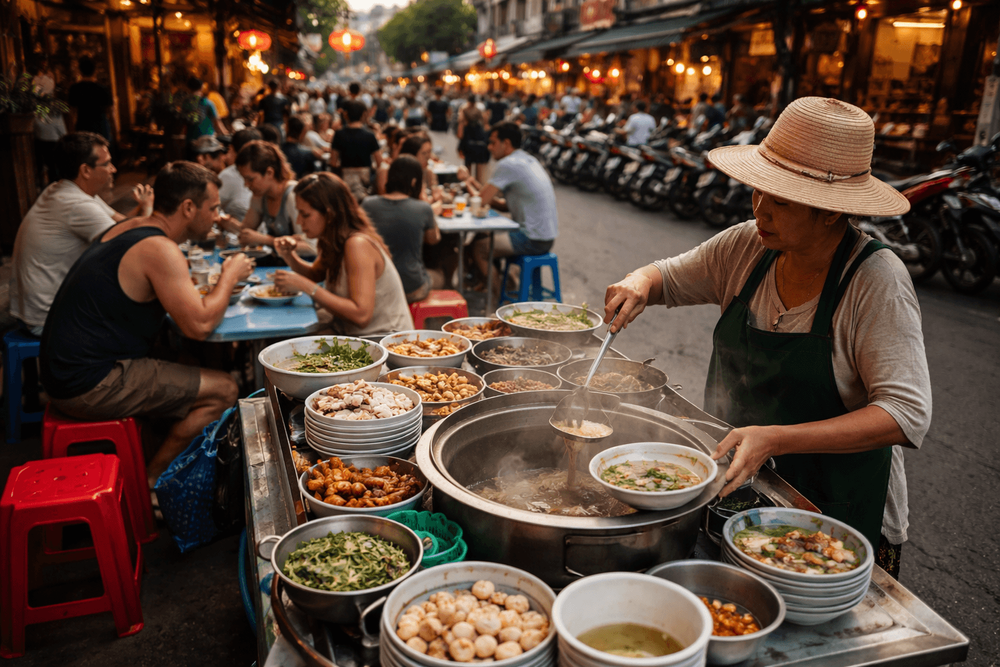
We’re shoulder-to-shoulder on Tanao Road, steam fogging our glasses while a pot hisses like monsoon rain. The bass line from a Here We Go Bangkok bar thumps in the distance, tuk-tuks growl past, and a vendor flicks pork crackling into a bowl like confetti. This is Bangkok noodle soup at street level—cheap, fast, fragrant, and absolutely alive.
What is Bangkok noodle soup?
Bangkok noodle soup isn’t one dish; it’s a whole family of bowls you’ll meet within a 10-minute walk of Khao San Road. Think of it as a choose-your-own-adventure of broths, noodles, proteins, and toppings. The city’s greatest hits include:
- Boat noodles (kuai tiao reua): Dark, deeply spiced broth, often enriched with beef or pork and a splash of blood for body—don’t panic, it’s for texture and depth, not gore. Traditionally served in small bowls so you can stack a few. Expect morning glory, bean sprouts, and fried pork skin on top.
- Beef noodle soup (guai tiao neua): Clear or aromatic brown broth scented with star anise and cinnamon, loaded with brisket, tendon, and beef balls. Clean, restorative, and perfect after a late night on Rambuttri.
- Pork noodle soup (guai tiao moo): Light, clear broth with minced pork, slices of char siu-style red pork, pork balls, and crisp garlic oil. Comfort in a bowl.
- Tom yum noodles: Sour, spicy, salty, sweet—lime, chili, fish sauce, and a hit of sugar tango together. Usually sprinkled with crushed peanuts and fried wonton strips for crunch.
- Yen ta fo: The pink one. Fermented red tofu gives the broth a quirky magenta hue; expect a seafood-leaning mix-ins parade—fish balls, tofu, morning glory.
- Rolled rice noodle soup (guay jub): Peppery, garlicky broth with curled rice noodles, pork offal, and crispy pork belly. A Bangkok night-owl classic.
- Duck noodles (ba mee ped or sen lek ped): Aromatic duck leg or slices in a dark, herbal broth that tastes like a Chinatown apothecary in the best possible way.
Each style is its own universe, but all of them are fast, affordable, and infinitely customizable—one of the reasons Bangkok street food by dish.
The anatomy of flavor: broths, noodles, toppings
Bangkok noodle soup starts with broth. You’ll meet two main personalities:
- Clear broth (naam sai): Light, clean, sometimes peppery. Pork or chicken bones simmered with daikon, cilantro roots, and white pepper. Great for mornings or when the heat is already headlocking us.
- Dark broth (naam tok or braised): Enriched with soy, herbs like cinnamon and star anise, and often thickened with blood (in boat noodles). Deeper, sweeter, and a bit sticky on the lips.
Noodle choices are the next fork in the road:
- Sen yai: Wide, flat rice noodles—silky and filling.
- Sen lek: Medium rice noodles—balanced and slurpable.
- Sen mee: Thin rice vermicelli—light and tangle-prone.
- Ba mee: Egg noodles—springy, yellow, with a wheaty bite.
- Wun sen: Glass noodles—bouncy and light, perfect for tom yum.
Proteins and textures define the mood:
- Pork (moo): Slices, minced pork, pork balls, or crispy pork belly.
- Beef (neua): Brisket, tendon, tripe, and beef balls.
- Duck (ped): Braised leg or slices with a herby broth.
- Seafood: Fish balls, squid, shrimp—especially in yen ta fo or tom yum.
Freshness and crunch matter. Expect bean sprouts (tua ngok), water morning glory (pak boong), Chinese celery, and a handful of herbs like culantro (pak chi farang) and coriander. A spoon of fried garlic oil is the mic drop.
Condiment choreography—the famous kruang prung quartet—lets you tune the bowl:
- Prik bon: Roasted chili flakes for heat.
- Nam pla: Fish sauce for salt and umami.
- Prik nam som: Chilies in vinegar for brightness.
- Sugar: To round the edges—yes, really.
We always taste first, then calibrate. The beauty of Bangkok noodle soup is that it meets you where your palate lives.
Where to find Bangkok noodle soup near Khao San Road
Within noodle-throwing distance of Khao San, you’ve got a buffet of options. Follow your nose—steam and garlic lead the way.
Soi Rambuttri, Tanao Road, and the Banglamphu grid
Morning to late night, carts bloom and vanish like fireflies. On Soi Rambuttri, you’ll find clear-broth pork or chicken noodle vendors setting up before the sun starts cooking us. Tanao Road is a reliable bet for beef noodle shophouses with bubbling brown pots in the window and tiles that could tell a hundred years of stories. Portions run 40–80 baht for a standard bowl; add 10–20 baht for extra meat or egg noodles. Late-night? A few vendors ladle tom yum until the bar crowds thin out.
If you’re serious about after-dark slurping, we put together a rundown of stalls that come alive when the fairy lights flick on: check the guide to noodle stalls near Khao San after dark here: Bangkok Street Food Soups and Noodle Stalls Near Khao San Road: What to Try After Dark.
Phra Athit Road and the riverside
Between Phra Sumen Fort and Phra Arthit Pier, shophouse noodle spots post up with fans whirring and aunties in aprons orchestrating the lunch rush. Look for hand-written Thai menus, lidded condiment jars, and a kettle that never rests. Duck noodles are common here, and the afternoon shade off the river makes it a pleasant slurp.
Dinso Road and Democracy Monument
As streetlights blink on, Dinso Road hums with office workers and students grabbing peppery guay jub or ultra-satisfying pork-broth bowls. If the chili catches your throat, we’ll duck into a 7-Eleven for that blessed AC blast and a 13-baht bottle of water before rejoining the line.
Samsen Road to Thewet Market
A stroll north lands us on Samsen, where daytime pork-noodle carts park under banyans. Keep going to Thewet Market for old-school shophouses with clear-broth comfort bowls. Morning is best here—by 2 pm, the good stuff is often sold out.
Boat noodles: small bowls, big mood
While Victory Monument is the citywide mecca for boat noodles, you don’t have to cross half the city to get your fix. The Banglamphu area has a few boat-noodle specialists tucked into narrow shopfronts—just look for stacks of tiny bowls and a dark, shiny broth. Prices hover around 15–30 baht per mini bowl; stack three or four and you’re golden. If you want the full-tilt boat noodle pilgrimage—canalside vibes, rapid-fire bowls, and a table that disappears under crockery—bookmark this: Best Boat Noodle Spots Near Khao San Road: Small Bowls, Big Flavor, and Where to Order Like a Local.
Chinatown (Yaowarat) detour
When we’re itching for late-night tom yum or peppery rolled noodles after midnight, we hop the Chao Phraya Express boat from Phra Arthit Pier to Ratchawong, then a short walk into Yaowarat’s neon river. It’s a detour, sure, but the sanuk factor—fire-breathing woks, clattering ladles, smoky pork belly—pays us back.
Hungry to plan by budget? We broke down the best street eats, noodle bowls included, for 50, 100, and 200 baht here: Bangkok Street Food by Budget: What to Eat for 50, 100, and 200 Baht.
How to order and customize your bowl
Ordering Bangkok noodle soup is like building a playlist. A little guidance and you’re jamming in no time. Here’s the flow most vendors expect:
- Choose your broth style
- Naam sai: Clear broth
- Naam tok: Darker, richer broth (often for boat noodles)
- Tom yum: Spicy-sour with lime and chili
- Haeng: “Dry” style—no broth, but with a saucy sheen
- Pick your noodle
- Sen yai (wide rice), sen lek (medium rice), sen mee (thin rice vermicelli), ba mee (egg), wun sen (glass)
- Choose your protein
- Moo (pork), neua (beef), ped (duck), talay (seafood)
- Tune the toppings and spice
- Pet mak: Very spicy
- Pet nit noi: A little spicy
- Mai pet: Not spicy
- Mai sai pak chee: No coriander
- Mai sai tua hua/mai sai tua phu: No peanuts (useful for allergies)
- Mai sai pongchuet: No MSG (some stalls will nod, some will shrug—no judgment either way)
- Finish with condiments Taste first, then adjust with fish sauce, chili flakes, vinegar chilies, or a pinch of sugar. A squeeze of lime is never wrong in tom yum.
A few Thai phrases that get us fed and happy:
- Sawadee krub/ka: Hello
- Kor… (item)… noi krub/ka: Please give me…
- Tao rai?: How much?
- Aroi mak!: Very delicious!
- Check bin duai krub/ka: The bill, please
If the menu is only in Thai, point and smile. Stall owners have fed farang since before Khao San got its first reggae bar—they’ll steer you right.
First-timer tips: prices, portions, and prime slurping windows
- Prices: Standard bowls near Khao San run 40–80 baht. Mini boat noodle bowls are 15–30 baht each. Add-ons like extra meat or wontons are 10–20 baht. A duck leg might bump you to 90–120 baht.
- Portions: Street bowls are modest—designed for one sitting, not a food coma. If you’re hungry, order two styles back-to-back. No one is judging.
- Best times: Morning (7–10 am) for clear broths and gentle starts; lunch (11 am–2 pm) is peak for shophouses; late night (8 pm–1 am, sometimes later on weekends) is tom yum o’clock. Some carts sell out early—when the pot’s empty, that’s it.
- Seating: Plastic stools, shared tables, and fan breeze are the norm. Wipe your spot with the provided tissue roll; it doubles as napkins.
- Water and ice: Many stalls serve iced water for 2–5 baht. Bottled water at 7-Eleven is 13–20 baht if you want to BYO.
- Hygiene: Watch turnover. A line of hungry locals is your Michelin star. Boiling broth is your friend.
- Payment: Cash is easiest. Small bills win smiles. Some shophouses take QR payments.
- Heat management: We embrace the sweat, then blast ourselves in a 7-Eleven afterward. Or we pick riverside shophouses on Phra Athit where the breeze sneaks in off the Chao Phraya.
- Scams: Rare at noodle stalls. If a tuk-tuk driver insists a place is “closed” and wants to whisk us elsewhere, we walk—Khao San’s stalls never all close at once.
Getting there from Khao San (and when to wander farther)
- On foot: Soi Rambuttri, Tanao Road, Dinso Road, and Phra Athit are all 5–15 minutes’ walk from Khao San Road. Street crossings here are a sport; move with confidence and look both ways—twice.
- River boat: From Phra Arthit Pier, the Chao Phraya Express boat connects us to Ratchawong (for Chinatown) and Sathorn (for BTS). It’s breezy, cheap (16–20 baht), and scenic—khhlong and skyline both.
- Taxi/Grab: For Victory Monument’s boat noodle alley or other far-flung cravings, a taxi is usually 15–30 minutes depending on traffic. Make sure the meter is on; otherwise, renegotiate or hop out.
If you want a bigger-picture lowdown on the city and how neighborhoods connect, skim our main city primer here: Bangkok.
Why Bangkok noodle soup sticks with us
It’s the choreography—the ladle dipping, the clack of chopsticks, the sweet rot of durian drifting over from a fruit cart, the hiss of garlic oil hitting the wok for your neighbor’s fried wontons. It’s being able to point at a pile of sen lek, say “nam tok moo, pet nit noi,” and watch a bowl built for you in under a minute. It’s the fact that for 60 baht, we can eat something that tastes like someone’s grandmother has been perfecting it since Rama V.
When we’re staying near Khao San, we like to base ourselves close to Phra Athit or a quieter slice of Soi Rambuttri so we can roll out of bed and roll into soup within five minutes. A pool helps, too—nothing beats slurping a peppery guay jub, sweating through our shirt, then diving into cool water before round two.
Bangkok noodle soup is more than a meal; it’s a map. Follow it and you’ll stitch together sois, markets, and river piers into your own mental city. Meet us by the corner of Tanao just before midnight—we’ll order sen lek nam tok moo with extra crackling, you bring the lime squeeze, and we’ll let the night decide the second bowl.
Related Hotels & Places
Khao San Road
Attractions
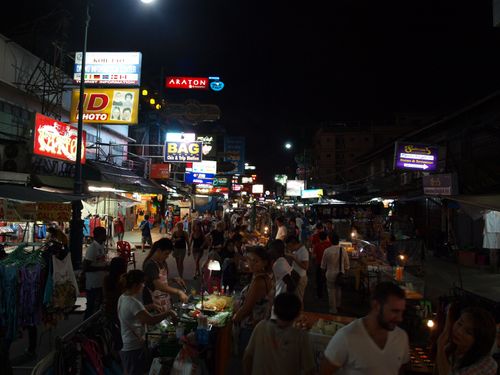
Bangkok’s backpacker carnival: curbside bars, live bands and DJs from 3pm–2am (midnight Sun). Street eats are cheap — pad thai 70–100 THB, mango sticky rice 60–100 THB. Come for wild people-watching; duck into Rambuttri for a calmer beer.
Here We Go Bangkok
Hotels
Lively hostel with a bar, pool table and karaoke, 6–8 mins from Khao San and near Sam Yot MRT. Clean A/C dorms, 24/7 reception, beds from ~400 THB. Pre-game downstairs, then wander to Khao San; street snacks by the Giant Swing on the way back.
Chillax Bar
Bars
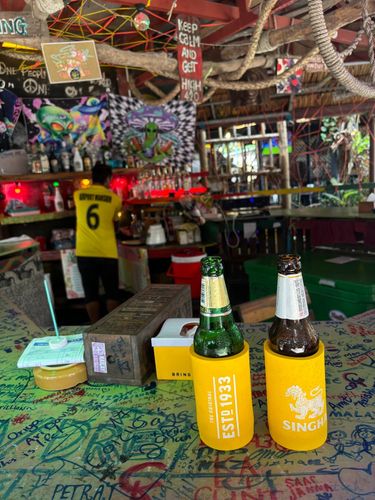
Easygoing bar a short walk from Khao San: cold Chang, simple cocktails, and a reggae‑leaning playlist. Beers ~100–120 THB; a relaxed pregame spot before the louder clubs.
Rambuttri
Markets
Khao San’s calmer cousin: a tree‑shaded lane of VW van cocktail bars, open‑air foot massages, pad thai grills, and easygoing live bands. Best from sunset to 11pm; beers 80–120 THB, cocktails 150–220 THB. One block from the chaos, all the charm.
Phra Sumen Fort
Attractions
1783 riverfront fort on Phra Athit with white battlements, park breezes, and killer sunset views over Rama VIII Bridge. Free entry; best from 5–7pm before the gates close at 9pm.
Wat
Temples
More Khao San Road Guides
- Bangkok Street Food Soups and Noodle Stalls: Where to Find the Best Bowls Around Khao San Road
- Bangkok Street Food for Soups and Noodle Lovers: Best Bowls to Try Around the Old City
- Bangkok Street Food Soups and Noodle Stalls Near Khao San Road: What to Try After Dark
- Best Boat Noodle Spots Near Khao San Road: Small Bowls, Big Flavor, and Where to Order Like a Local