
Bangkok Street Food by Dish: Must-Try Classics Near Khao San Road and the Old Town
A dish-first guide to Bangkok street food near Khao San: what each classic tastes like, where to find it in Old Town, plus ordering tips, prices, and phrases.
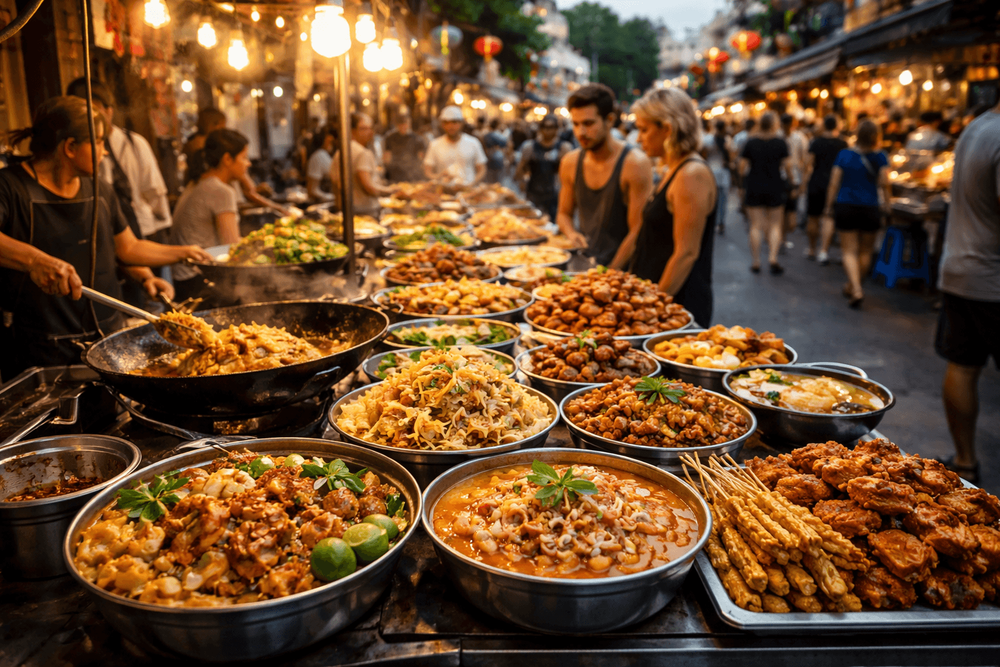
We step off Soi Rambuttri and into the glow of a charcoal wok. Lemongrass hits the nose, garlic crackles, and someone is pounding chilies into a mortar with the rhythm of a nightclub bass on Khao San. This is where Bangkok street food dishes really sing—quick, hot, a little chaotic, and always alive. We’re here to eat dish-first: what it is, what it tastes like, and exactly where to hunt it down around Khao San Road and the Old Town.
If you want an even broader sweep of the scene before diving in, we’ve got that too: see Bangkok street food by area in our guide: Bangkok Street Food Guide: Khao San Road and Beyond.
Bangkok street food dishes you can’t leave without trying
Pad Kra Pao Moo Kai Dao (holy basil pork with fried egg)
- What it is: Minced pork stir-fried with holy basil (kra pao), garlic, and chilies, slapped over rice, crowned with a runny fried egg.
- Taste: Fiery, garlicky, savory-sweet. The basil’s peppery perfume is the heartbeat.
- Why locals love it: It’s Thailand’s unofficial national fast food—ready in 90 seconds, satisfying at any hour. We order it “pet nit noi” (a little spicy) if we’re easing in.
- Price: 50–70 baht; add 10–15 baht for the egg.
Pad Thai
- What it is: Stir-fried rice noodles with tamarind, fish sauce, egg, tofu, chives, bean sprouts; sometimes prawns. Wok-fired on charcoal along Maha Chai Road near the Giant Swing.
- Taste: Tangy-sweet from tamarind, smoky from wok hei, with a crunchy lime-peanut finish.
- Tip: The hype is real if there’s smoke and a queue. Beware overly sweet tourist versions—watch for orange flames and busy pans.
- Price: 70–120 baht, more with prawns.
Moo Ping + Khao Niao (grilled pork skewers with sticky rice)
- What it is: Pork marinated in coconut milk, palm sugar, and white pepper, grilled on the curb next to a stack of banana leaves and a fan blowing smoke down the soi.
- Taste: Caramelized edges, juicy center, a whisper of sweetness. Sticky rice on the side to dunk in chili jaew.
- Why we snack it: Perfect 2 a.m. fuel between Khao San bars when the tuk-tuks are revving and the bass is thumping.
- Price: 10–15 baht per skewer; 10–15 baht for sticky rice.
Khao Man Gai (Hainanese-style chicken rice)
- What it is: Poached chicken on rice simmered in chicken fat and stock, with a gingery-soy-chili sauce and a light broth.
- Taste: Clean, comforting, deeply chicken-y. The sauce brings funk and kick.
- Where it shines: Mornings on Tanao Road and around Banglamphu Market, when the rice is steamy and the aunties are ladling at speed.
- Price: 50–70 baht; “piset” (special) portions a bit more.
Boat Noodles (Kuai Tiao Ruea)
- What it is: Intense, small bowls of pork or beef noodles in a dark, spiced broth once sold from boats on the khlongs.
- Taste: Rich, peppery, a touch iron-y from herbs and spices, topped with crackly pork rinds and scallions.
- Eat like a local: Stack the bowls—two to four per person is normal. Season to taste with fish sauce, chili, and vinegar.
- Price: 15–25 baht per small bowl near Old Town; pricier around Victory Monument.
Som Tam (papaya salad) + Gai Yang (grilled chicken)
- What it is: Green papaya pounded with lime, fish sauce, sugar, chilies, tomatoes, and peanuts; often paired with smoky grilled chicken and sticky rice.
- Taste: Electric—sweet, sour, salty, spicy in one bite. Add salted egg or fermented fish (pla ra) if you like it rustic.
- Where to find: Late afternoons on Phra Athit Road and side streets off Chakrabongse Road. You’ll hear the mortar and pestle.
- Price: Som tam 50–70 baht; chicken quarter 60–100 baht.
Khao Kha Moo (braised pork leg on rice)
- What it is: Pork leg simmered with Chinese five spice until the fat turns to jelly, draped over rice with mustard greens and a soft-boiled egg.
- Taste: Savory, star-anise warmth, sticky-lipped richness. Hit it with chili-vinegar to cut the fat.
- Price: 60–80 baht; egg +10 baht.
Guay Jub (peppery rolled rice noodle soup)
- What it is: Rolled rice noodles in a white pepper broth with crispy pork belly, offal optional, and a shower of fried garlic.
- Taste: Brothy heat—pepper-forward, porky, addictive. A rainy-night savior.
- Where to sniff it out: Maha Chai Road by the Giant Swing; you’ll spot the bubbling cauldron and a cloud of pepper steam.
- Price: 60–80 baht.
Pad See Ew vs. Pad Kee Mao (drunken noodles)
- What they are: Wide rice noodles seared with egg and Chinese broccoli in sweet soy (pad see ew) or blasted with chilies, garlic, and holy basil (pad kee mao).
- Taste: Pad see ew is smoky-sweet and kid-friendly; pad kee mao is chaotic heat with a herbal punch.
- Where: Evenings around Soi Rambuttri and the alleys behind Wat Chana Songkhram.
- Price: 60–90 baht; add meat +10–20 baht.
Tom Yum Noodles (Kuai Tiao Tom Yum)
- What it is: Noodle soup with a tom-yum-style broth—limey, chili-bright—with minced pork, fish balls, peanuts, and crispy wonton skins.
- Taste: Zingy and crunchy in one bowl. Adjust sour and heat at the table.
- Price: 50–80 baht.
Hoy Tod (oyster or mussel omelet)
- What it is: A sizzling griddle omelet—part crispy starch, part custardy egg—loaded with oysters or mussels, with a chili sauce.
- Taste: Crunchy-edged, briny, greasy in the best way. Eat with a pile of bean sprouts.
- Where: Night vendors around Tanao Road and certain carts on Phra Athit.
- Price: 80–150 baht depending on oysters.
Sai Krok Isan (fermented sausage)
- What it is: Tangy, garlicky pork sausage, often balled and skewered, served with ginger, chilies, and cabbage.
- Taste: A gentle sour twang meets barbecue smoke. Great beer food.
- Price: 10–20 baht per ball/skewer.
Pla Pao (salt-crusted grilled fish)
- What it is: Whole tilapia stuffed with lemongrass, coated in salt, slow-grilled until the skin turns crusty and the meat steams inside.
- Taste: Clean, herb-laced fish you flake into lettuce with noodles and a searing nam jim seafood sauce.
- Where: Evening grills along Chakrabongse Road and pop-ups near Santi Chai Prakan Park on Phra Athit.
- Price: 180–300 baht per fish—share with friends.
Kai Jeow Moo Sab (Thai omelet over rice)
- What it is: Puffy deep-fried omelet with minced pork over rice, fish sauce and chilies on the side.
- Taste: Crispy edges, custardy center, salty-savory comfort.
- Price: 40–60 baht; add “khai dao” if you want double-egg indulgence.
Mango Sticky Rice (Khao Niao Mamuang)
- What it is: Ripe mango with sweet coconut sticky rice and a sprinkle of mung beans.
- Taste: Fragrant, creamy, sunshine in dessert form.
- Where: Night carts along Khao San and Soi Rambuttri, or daytime at Wang Lang Market.
- Price: 60–120 baht depending on mango season.
Khanom Buang and Khanom Krok (Thai crepes and coconut pancakes)
- What they are: Street-side sweets; khanom buang are crisp taco-like crepes with coconut cream and egg floss, while khanom krok are gooey coconut cups cooked in a dimpled pan.
- Taste: One snaps, one melts. Both smell like toasted coconut heaven.
- Price: 20–40 baht a packet.
Coconut Ice Cream & Cha Yen (Thai iced tea)
- What they are: Coconut ice cream scooped into a paper cup (or coconut shell) with peanuts and sticky rice; Thai iced tea is condensed-milk sweet and bracing over crushed ice.
- Taste: Cold relief when the soi heat is a wall. We swear you can feel your core temperature drop.
- Price: Ice cream 30–50 baht; iced tea 25–40 baht.
Where to find these near Khao San Road and the Old Town
Khao San, Soi Rambuttri, and Wat Chana Songkhram alleys
- When: Best from dusk to late night; some grills run until the bass dies around 2–3 a.m.
- What to eat: Moo ping, pad kra pao, pad see ew/kee mao, mango sticky rice, late-night som tam. Follow the smoke and the crowd; avoid empty wok stations at peak hours.
- Insider move: If we’re staying nearby on Soi Rambuttri, we wander in flip-flops between bites and bed. The sanuk (fun) is wandering—don’t try to plan every mouthful.
Tanao Road and Chakrabongse Road
- When: Morning to lunch on Tanao (khao man gai, jok/congee); evenings on Chakrabongse (pla pao, som tam, skewers).
- Landmark: Tanao runs parallel to Khao San; Chakrabongse is the quieter back road toward the river.
- Why go: Less farang traffic than Khao San itself, more office-worker queues—always a good sign.
Maha Chai Road and the Giant Swing (Sao Chingcha)
- When: Late afternoon into night.
- What to eat: Pad thai off charcoal, guay jub, hoy tod.
- Getting there: 20–25 minutes on foot from Khao San past Democracy Monument, or a short tuk-tuk ride. Keep small bills for the ride and agree on the fare first.
Phra Athit Road and Santi Chai Prakan Park
- When: Evenings by the park; weekends feel like a community picnic with grills flickering by the river breeze.
- What to eat: Pla pao, som tam, noodles, coconut ice cream.
- Why we love it: Snack, then sit on the grass under Phra Sumen Fort as barges rumble down the Chao Phraya.
Wang Lang Market (across the river)
- When: Daytime into late afternoon, Monday–Saturday; many stalls close by early evening.
- Getting there: Hop the river ferry from Phra Arthit Pier to Wang Lang Pier—cheap, breezy, no traffic.
- What to eat: Khanom krok, fried chicken, curries over rice, Thai desserts. Dense snack territory.
Nang Loeng Market
- When: Late morning to early afternoon; best before 1 p.m.
- Getting there: 10–15 minutes by foot or a short tuk-tuk from Democracy Monument.
- What to eat: Old-school Thai-Chinese curries, roast pork, delicate sweets—this is heritage Bangkok on a plate.
Yaowarat (Chinatown)
- When: Nights from 6 p.m. onward.
- Getting there: From Khao San, taxi or bus; or MRT to Wat Mangkon and walk. It’s not Old Town, but if you want a neon gauntlet of seafood, desserts, and riotous snacks, this is the pilgrimage.
- What to eat: Peppery guay jub, charcoal crab fried rice, herbal drinks. Prices vary—ask “tao rai?” (how much) before you sit at seafood tables.
If you’re prowling after midnight, bookmark our late-night hit list: Bangkok Night Street Food Guide: Best Late-Evening Stalls, Markets, and Snacks After Dark.
Practical tips: ordering, spice, portions, prices, hygiene
- Customizing spice: Say “mai ped” (not spicy) or “ped nit noi” (a little spicy). Want fire? “Ped mak mak” (very spicy). For papaya salad, “som tam mai sai prik” (no chilies) saves tears.
- Noodle choices: “Sen yai” (wide rice noodles), “sen lek” (medium rice), “sen mee” (thin rice), “ba mee” (egg noodles). Soup or dry: “nam” (with soup) vs “haeng” (dry).
- Protein swaps: “Moo” (pork), “gai” (chicken), “neua” (beef), “pla” (fish), “talay” (seafood), “jay” (vegetarian). No coriander? “Mai sai pak chee.”
- Portions and extras: “Piset” (special/large portion). Add fried egg: “sai khai dao.” Expect +10–20 baht for add-ons.
- Typical prices around Old Town: Everyday plates and bowls 40–80 baht; charcoal seafood 120–300 baht; snacks 10–30 baht. Tourist-heavy corners can run higher.
- Paying: Cash is king; keep 20s and 100s. Some stands have QR PromptPay but don’t bank on it.
- Hygiene basics: Pick busy stalls with high turnover; watch food cooked to order; soups at a rolling boil are your friend; avoid pre-cut fruit that’s been sunbathing. If you want the full checklist, skim our Bangkok Street Food Safety Guide: How to Choose Clean, Fresh Stalls Like a Local.
- Heat management: Eat early or late; lunch sun on Ratchadamnoen can melt you. Duck into 7-Eleven for a blast of AC and a water refill.
- Scams and signals: Menus with mysteriously missing prices—ask before you order. Tuk-tuk “special stops” are a detour; we walk or hop the river boat instead.
Local etiquette and Thai phrases that actually help
- Queuing: There’s often no line, just a cluster. Make eye contact, say “ao…” (I’ll take…), and the cook will clock you. Don’t shoulder in.
- Sharing tables: Totally normal. Slide in, nod a “sawadee,” and squeeze your elbows.
- Cutlery: Spoon in right hand, fork in left pushing into the spoon. Chopsticks for noodles, not rice plates. Slurping soup is fine.
- Pay style: Most stalls are pay-after. Leave exact change on the tray or hand it with a smile. No tipping needed; rounding up is nice.
- Trash and trays: Return bowls to the bus tub if you see one; it keeps the auntie smiling.
- Drinking water: Free jugs at some shophouses; bottled water at carts. If the ice looks cloudy, we skip it.
Handy phrases:
- “Ao … krap/ka” = I’ll have … (men say krap, women say ka)
- “Mai ped / ped nit noi / ped mak mak” = Not spicy / a little / very spicy
- “Mai sai … / sai …” = Don’t add … / add …
- “Tao rai?” = How much?
- “Khap khun krap/ka” = Thank you
- “Aroi mak!” = So delicious!
If you want deeper etiquette moves—how to order, pay, sit, and not look like a lost farang—see our Bangkok Street Food Etiquette: How to Order, Pay, Sit, and Eat Like a Local.
Getting there: Khao San and Old Town the easy way
- Chao Phraya Express Boat: Skip traffic and ride the river to Phra Arthit Pier (N13). From there it’s a 7–10 minute walk to Phra Athit Road, Soi Rambuttri, and Khao San’s snack gauntlet.
- MRT options: Sam Yot (Blue Line) drops you near the Giant Swing and Maha Chai Road; it’s a 20–25 minute walk or a short tuk-tuk to Khao San. Sanam Chai is handy for Wat Pho/Tha Tien—ferry across to Phra Arthit.
- Buses and taxis: Old Town is bus-rich; taxis are fine if they run the meter. For tuk-tuks, agree on the fare first and keep it short-distance.
- When to prowl:
- Breakfast (6–10 a.m.): Khao man gai, jok (rice porridge), grilled pork.
- Lunch (11 a.m.–2 p.m.): Stir-fries, curries over rice, noodles.
- Evening (5 p.m.–midnight+): Grills, crepes, seafood, pad thai.
- Staying nearby: We usually crash in Banglamphu for the walkability—roll from a nap to noodles in five minutes. If you’re the pool-and-nap-between-bowls type, look for spots with shade and a dip to reset before a night market run.
We’ll be honest: it’s hot, it’s loud, and you’ll sweat through your shirt. But that first peppery slurp of guay jub on Maha Chai, the sweet rot of durian drifting down Phra Athit, the hiss of a wok as we order “piset” pad kra pao—this is why we chase Bangkok street food dishes. Tonight, meet us by the river; we’ll follow the smoke to a salt-crusted pla pao, then cool off with coconut ice cream under the fort’s lights. Sanuk guaranteed.
More Khao San Road Guides
- Bangkok Street Food by Dish: Where to Find the Must-Try Classics Near Khao San Road
- Bangkok Street Food for Non-Spicy Eaters: What to Order Near Khao San Road
- Bangkok Street Food Guide to Iconic Dishes: Where to Find Pad Thai, Boat Noodles, and Mango Sticky Rice Near Khao San Road
- Best Thai Dishes to Try at Bangkok Street Food Stalls: A Khao San Road Ordering Guide