Where to Find the Best Pad Kra Pao in Bangkok: Khao San Road, Old Town, and Late-Night Local Stalls
Chili, basil, and wok-fire: where to eat pad kra pao in Bangkok—Khao San late nights, Old Town lunches, and food-court steals—with ordering tips and prices.
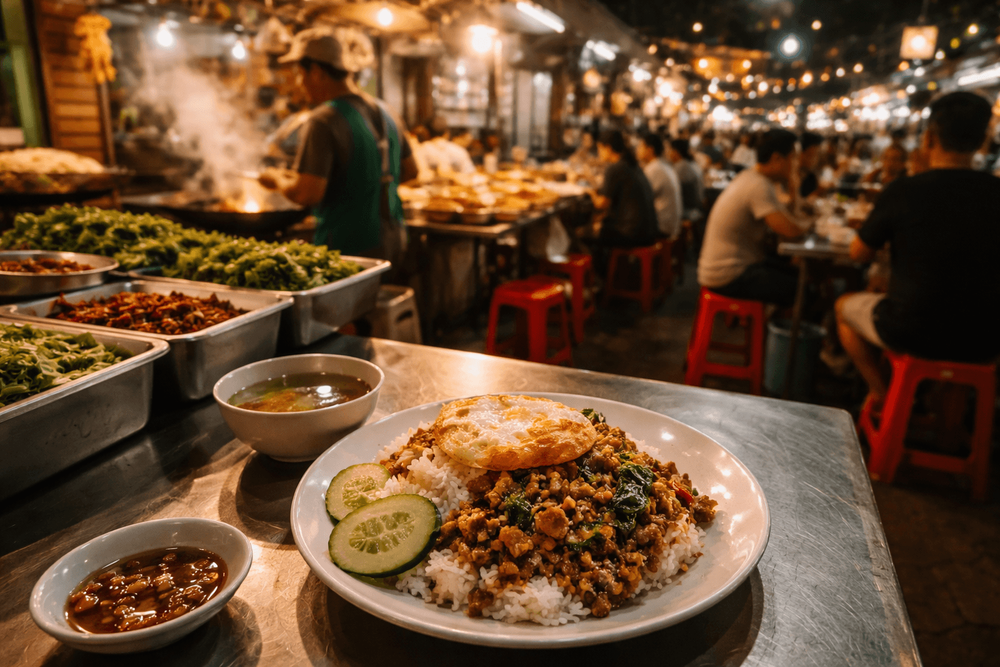
We’re standing under a flickering fluorescent tube on Soi Rambuttri, the wok roar drowning out the tuk-tuks as chilies hit hot oil and punch our sinuses awake. The auntie with forearms of steel doesn’t look up—she’s already smashing garlic and prik kee noo (bird’s eye chilies), tossing in holy basil till the steam smells like pepper and clove. Pad kra pao Bangkok-style is not shy. It’s fast, loud, spicy, and exactly the kind of plate that makes you sweat a little and smile a lot.
Data Freshness + Pricing:
- Prices are approximate and in THB.
- Last checked: June 2026.
- Happy hour and promo details change frequently—confirm locally.
What Is Pad Kra Pao (and Why We Crave It)
Pad kra pao—also spelled pad krapao, pad kaprao, or, if we’re being textbook, phat kaphrao—is Thailand’s holy-basil stir-fry. Think: chopped or minced protein slammed into a smoking wok with garlic, chilies, fish sauce, soy, maybe a lick of oyster sauce, and a fistful of bai kaphrao (holy basil). The result should be glossy, deeply savory, and perfumed with basil that tastes spicier and more peppery than the sweet basil you know.
- The basics: garlic, prik kee noo, fish sauce, light/dark soy, sometimes oyster sauce, and holy basil. Served over steamed rice (khao suay) with a fried egg (kai dao) that’s crispy at the edges and still runny.
- Common proteins: moo sap (minced pork), gai (chicken), nua (beef), moo krob (crispy pork belly), goong (shrimp), pla muek (squid), or tofu/mushrooms for a jay (vegan Buddhist) take. Beef isn’t everywhere; moo and gai rule the day.
- Variations: Some Bangkok cooks throw in long beans or baby corn; others go purist. A few modern cafes upgrade to wagyu or duck. In Old Town shop-houses, you’ll find moo krob kra pao that crackles.
Why it’s Bangkok’s comfort dish? It’s the city’s emergency key: too hungry to think, late for work, out after a few Chang beers—pad kra pao is the default. It’s quick, cheap-ish, and it slaps every time when the basil is fresh and the wok is hot.
Where to Eat Pad Kra Pao in Bangkok (Khao San, Old Town, and Beyond)
not all corners hit the same Here’s where we go when the basil craving hits.
Khao San Road and Soi Rambuttri (for late-night cravings)
- The vibe: neon, backpack beats, the thump-thump from a bar mixing into wok sizzle. We drift between Khao San and its chiller parallel, Soi Rambuttri, where late-night carts fry till 2–3 AM on weekends.
- What to try: pad kra pao moo sap with kai dao. Ask for pet noi (a little spicy) if you’ve just landed.
- Price: approx 70–120 THB for a street-stall plate here; add egg for approx 10–20 THB.
- Tip: The best stalls do one dish fast. If the menu is a telephone book, the kra pao might be an afterthought.
We usually crash near here when we’re in noodle-and-basil mode. When we want an air-con reset and a pool without torpedoing the budget, we’ve holed up at Capital O Khaosan Park Bangkok. It’s steps from the action, so you can go from pillow to pad kra pao in five minutes flat.
Phra Athit Road and Banglamphu’s Old Town sois
- The vibe: river breeze from Phra Arthit Pier (N13), old shophouses, local office crowds at lunch.
- What to try: moo krob (crispy pork) kra pao—Bangkok’s Old Town loves pork belly—and squid with holy basil for something bouncy and chili-bright.
- Price: approx 60–100 THB at daytime cooked-to-order (ahan tham sang) shacks.
- Tip: Come 11:30–13:00 to catch wok masters in full form—portions might run out after lunch rush.
Food courts that deliver
- Pier 21 at Terminal 21 (Asok): Bangkok’s value temple. Kra pao plates hover around approx 40–60 THB. Crowded at lunch, worth the queue.
- MBK Food Island (National Stadium): bigger menu boards, solid consistency. Expect approx 60–90 THB.
- Central Rama IX / Silom complex food courts: a touch pricier (approx 80–120 THB), but clean, fast, and chilies made to order.
Victory Monument, Ari, and office-land
- Victory Monument: before or after boat noodles, we hunt down into the side sois for kra pao moo sap that’s fiery enough to make your ears ring—in the best way.
- Ari (BTS Ari): hip cafés may fancy it up (think duck or wagyu, approx 160–250 THB), but the old-school street wok behind Soi Ari Samphan will remind you why the classic just works.
Chinatown fringe and Sam Yot
- Around MRT Sam Yot, towards Pom Prap Sattru Phai, laneway wok stations belt out kra pao that’s more garlicky and a touch sweeter—Bangkok’s signature. Late-night options run till midnight on weekends.
- Price: approx 60–100 THB; egg still around 10–20 THB.
24/7 emergency kra pao
- Took Lae Dee counters in Foodland supermarkets are legendary for late nights. You’ll get a consistent, un-fussy kra pao at 3 AM for approx 80–120 THB depending on branch.
How to Recognize a Great Pad Kra Pao
Bangkok has standards. Here’s how we judge before the first bite.
- Wok aroma (wok hei): You want smoke—not burnt, but kiss-of-char. If the cook is frying five things at once on a lukewarm pan, move on.
- Holy basil, not sweet basil: Bai kaphrao has jagged leaves and a peppery, clove-ish smell. If you see smooth leaves and an anise kick, that’s horapha (sweet basil). Tasty, but not kra pao.
- Color and gloss: Sauce should cling to the meat and rice, not drown it. A deep brown sheen means the soy blend is balanced; pale usually means under-seasoned.
- Chilies and garlic you can see: Flecks of red/green chili and minced garlic should be visible. If the heat only tastes like sugar, you’ve been robbed.
- The egg test: Kai dao should be lacy-crisp at the edges, with a yolk that runs into the rice like a sauce. Hard-fried is a tragedy—ask for mai suk (not fully cooked) if you care.
- Freshness: Watch turnover. If basil is added early and wilts to grey, the flavor dies. A good cook tosses basil at the last second.
Ordering Pad Kra Pao Like a Local
Don’t overthink it—just say it with a smile. Here’s the playbook.
Build your plate
- Rice style: khao rad kra pao (stir-fry over rice) is the standard single-plate. If you want it share-style, say gap khao (a la carte, no rice) and order rice on the side.
- Protein picks: moo sap (minced pork), gai (chicken), moo krob (crispy pork), goong (shrimp), pla muek (squid), tofu/het (mushrooms) for jay.
- Egg: sai kai dao (add fried egg) or mai sai kai (no egg). If you love runny, add mai suk (not fully cooked) after kai dao.
Control the heat
- Pet noi = a little spicy
- Mai pet = not spicy (they’ll still add some aroma)
- Pet mak = very spicy (brace yourself)
Useful phrases (add khráp/kâ for politeness)
- “Pad kra pao moo sap kai dao khráp/kâ” — holy basil stir-fry with minced pork and fried egg.
- “Mai sai prik khráp/kâ” — no chilies.
- “Mai sai nam man hoi khráp/kâ” — no oyster sauce.
- “Kin jay khráp/kâ” — I eat vegan Buddhist style (no meat, no fish sauce, no egg, no dairy; some places still use soy sauce so confirm).
- “Khao eek khráp/kâ” — extra rice.
Price checkpoints
- Street stalls in Old Town: approx 50–80 THB (egg +10–20 THB)
- Khao San late night: approx 70–120 THB
- Mall food courts: approx 60–120 THB
- Cafés/hip spots: approx 150–250 THB
Got an allergy? The standard sauce combo can include oyster sauce and soy. Read our simple Thai phrases and swap tips in Bangkok’s allergy guide here: Bangkok Street Food for Travelers with Allergies: What to Order, What to Avoid, and How to Ask for Changes.
When Bangkok Eats Pad Kra Pao (and What Makes It Distinct)
Pad kra pao is Bangkok’s Swiss Army knife of meals.
- Breakfast fuel: Markets around Dusit and Nang Loeng hum from 7–9 AM. A lighter kra pao gai over rice gets office workers moving.
- Lunch crush: From Silom to Ari, queues form at 11:45. Bangkok’s take often leans saucier and a touch sweeter than upcountry versions—blame the capital’s soy-and-oyster-sauce habit.
- After-hours sanity: Post-temple run, post-bars, post-everything—kra pao is the reliable landing pad. The city that sweats together eats together.
What makes Bangkok’s versions sing?
- Peppery holy basil used generously and added late.
- A balance of salty (fish/soy sauce) and sweet (just a nudge) with legit heat from prik kee noo.
- Wok discipline: one pan, raging flame, thirty seconds of glory.
Know Before You Go: Getting Around, Etiquette, and Small Wins
We like a little sanuk (fun) with our food hunts, so here’s how we move and what we watch for.
Getting there
- Khao San / Soi Rambuttri / Phra Athit: Ride the Chao Phraya Express Boat to Phra Arthit Pier (N13), then wander inland 5–10 minutes.
- Old Town (Sam Yot, Giant Swing): MRT Blue Line to Sam Yot. Walk east toward Bamrung Muang and the Giant Swing area—laneway woks aplenty.
- Victory Monument / Ari: BTS Victory Monument or Ari; explore the sois on foot.
- Terminal 21 / Asok: BTS Asok or MRT Sukhumvit; follow the signs to the food court.
Street-smarts and comfort
- Heat management: It’s Bangkok—bring a small towel and thank the blast of AC at 7-Eleven between bites.
- Hygiene: Follow lines and turnover. Hot wok + busy stall = safer plate.
- Tuk-tuk fares: Agree on price or stick to metered taxis/Grab. Short hops in Old Town can be done on foot.
- Cash: Stalls prefer cash; food courts use top-up cards. Keep small bills/coins handy.
Portions and pacing
- Single-plate vs shared: For full flavor, order rad khao (over rice). Sharing? Ask for the stir-fry gap khao and a bowl of rice.
- Condiments: The metal caddy is your friend—prik nam pla (chilies in fish sauce), vinegar with chilies (prik nam som), sugar, and chili flakes. Balance to taste.
What we spend in a day of kra pao grazing
- Breakfast market plate: approx 50–70 THB
- Lunch court upgrade: approx 70–110 THB
- Late-night Khao San fix with egg and a drink: approx 120–200 THB total
If you’re deep-planning neighborhoods and transport, our city primer is here: Bangkok. And if you like to map your temple stops before you eat your way home, save this for later: Trip to Bangkok: Complete Travel Guide.
Minor mishaps, major saves
A little spice shock or tummy wobble can happen when you chase chilies across the khlongs. We keep a few essentials on hand—rehydration salts, antihistamines, and blister plasters—see the quick kit rundown here: Thailand Travel First Aid Kit: What Backpackers Should Carry.
Our Favorite Bangkok Moments With Kra Pao
- The Old Town lunch bell: We time it for 11:45 around Phra Athit and watch office workers order like pros—two words, one nod, plate done in 45 seconds.
- Midnight reset on Khao San: We split a kai dao so runny it paints the rice gold, with bass spilling from a bar across the soi.
- Pier 21 precision: Token card topped up, plate that costs less than your iced coffee, and basil that still hits.
When we need a quick nap between basil hunts, we’ve circled back to Capital O Khaosan Park Bangkok. For the price, that pool is a lifesaver after chasing chilies in the afternoon sun.

Final Bite
Bangkok will try to distract you with shiny things—rooftops, malls, infinity pools—but the soul of the city is still a wok, a fist of holy basil, and somebody who knows exactly how much chili you can handle. Meet us on Soi Rambuttri around midnight—we’ll order pet noi to start, then inch up to pet mak if we’re feeling brave. When you find your perfect pad kra pao Bangkok plate, send us the pin; we’ll bring the tissues and the appetite.
Related Hotels & Places
Recommended Products
More Khao San Road Guides
- Where to Find the Best Pad Thai in Bangkok: Khao San Road, Old Town, and Nearby Streets
- Bangkok Street Food After Dark Near Khao San Road: Safe Late-Night Eating, Best Hours, and What Still Sells Late
- How to Find the Best Street Food Stalls Near Khao San Road Without Getting Ripped Off
- Bangkok Street Food Night Guide: Best Evening Stalls, Markets & Late Eats Near Khao San Road