
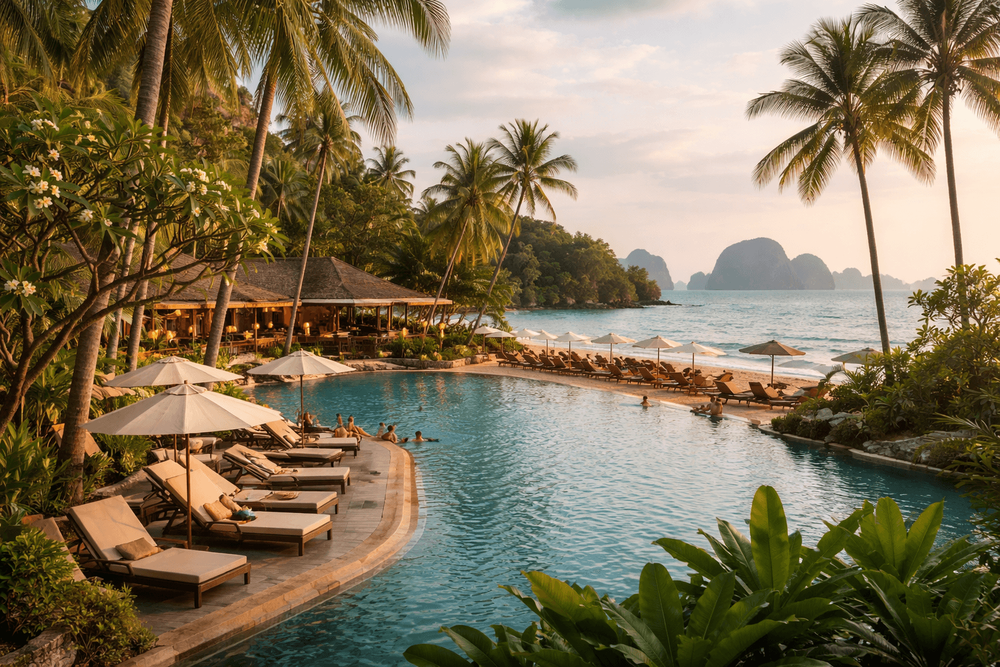
Thailand Resorts: Best Resort Destinations Across the Country
From Phuket to Koh Kood and Chiang Mai, we break down Thailand resorts: where to go, when to book, and how to get the most sun, spa, and sand for your baht.
We’re skimming across a jade-green khlong in a long-tail, the engine chattering like a tuk-tuk that needs coffee. Sea salt hangs in the air, and somewhere back on Khao San the bass is thumping, but out here it’s cicadas and the slap of water on hulls. This is the headspace we chase with Thailand resorts — not just beach loungers and umbrella drinks, but jungle mornings, island sunsets, and the kind of service that remembers how you like your mango sticky rice.
Thailand resorts can mean a lot of things: a family-friendly splash zone in Hua Hin, a hideaway villa on Koh Yao Noi, a cliffside pool in Krabi, or a teak-and-rice-field retreat outside Chiang Mai where the air smells like lemongrass and rain. We’ll skip the brochure fluff and show you where to go, when to book, and how to get the most sanuk for your baht.
What “Thailand resorts” really covers
Let’s decode the menu, because “resort” in Thailand is a generous word.
Beachfront escapes
Think swingy palms, the hush of surf, and a lobby that opens to powder sand. You’ll find everything from laid-back, barefoot spots to big-brand properties with kids’ clubs and five restaurants. Expect sunbeds, beach service, and long-tail boats idling just offshore. Prices range widely: from 2,000–4,000 THB a night for solid midrange on quieter beaches to 10,000 THB and up for prime sand in peak season.
Jungle retreats
Wake to gibbon whoops and the smell of wet leaves. In places like Khao Sok or the foothills around Chiang Mai, you trade waves for waterfalls and infinity pools looking into bamboo. Great for couples and anyone who dreams in green. Downsides: bugs (bring repellent) and the afternoon heat that makes naps non-negotiable.
Island villas
Not all villas are palaces with butlers; plenty are smart one-bed pool villas or hillside suites with plunge pools. On Koh Samui, Koh Phangan, Phuket, and Koh Yao, villa life means privacy without skimping on room service. Check the slope — that “hillside sea view” can mean a lot of stairs.
Family resorts
Hua Hin, Khao Lak, and parts of Phuket and Samui do family-friendly brilliantly: kids’ clubs, shallow pools, shaded lawns, and beach restaurants that don’t clutch pearls when the toddler feeds the mynah birds. If you’re bringing strollers, confirm lift access; some resorts sprawl across levels.
Wellness stays
From beachfront yoga shalas in Koh Phangan to serious detox programs in Phuket and Samui, wellness is big. Expect Thai massage, herbal compresses, steam rooms, and sunrise meditations. Resort spa prices run 1,200–3,000 THB for a 60–90 minute treatment; step outside to a local massage hut for 300–600 THB and a fan that growls like a friendly old dog.
Luxury escapes
The fireworks: cliff-edge pools, private chefs, boat charters to empty sandbars. If you want to splurge, look at Phuket’s northwest coast, Krabi’s Tubkaek, Koh Samui’s Choeng Mon/Bophut hills, and the wilder corners of Koh Kood. Keep an eye out for mandatory gala dinners over Christmas/New Year — they can add a chunky fee.
Best Thailand resorts destinations and what they’re known for
Phuket: Choice overload in the Andaman
Phuket is the buffet: Patong for neon and noise, Kata/Karon for balanced beach life, Kamala and Surin for upmarket calm, Bang Tao for mega-resort convenience, and Nai Harn or Ao Yon for a pocket of peace. The water is clearest November–April; May–October brings waves good for beginner surfers and moody sunsets. Skip Patong if you bruise easily from hawkers; say sawadee with a smile and keep walking.
Krabi: Limestone drama and lazy days
Railay is the headliner: no cars, just sandy paths, rock faces that blush at sunset, and long-tails buzzing like dragonflies. West Railay is for the postcard beach, East Railay for mangrove views and better sunrise. Ao Nang is value-central with a real town feel; Tubkaek is where the luxe hide. Boat out to Hong or Poda Islands early — the beaches glow like powdered sugar before the crowds arrive.
Koh Samui: Villas, breezes, and coconut palms
Chaweng is the thump of nightlife and long sandy arcs; Lamai is its slightly older, wiser cousin; Bophut (Fisherman’s Village) brings boutique charm with supper on the sand; Maenam is quieter, with a family vibe. Weather flips compared to Phuket: Samui’s best months often run January–August, with the heaviest rain in October–December. If you need nightlife and sleep, stay just outside the loudest sois, not on them.
Hua Hin & Cha-Am: Easy escape from Bangkok
Royal resort town energy, golfing greens, and long, walkable beaches. Families love the space, the waterparks, and the seafood shacks by the pier. Cha-Am is the budget cousin up the road with wide sands and low-rise vibe. Weekends get busy with Bangkokians; midweek is blissfully mellow.
Khao Lak: Laid-back Andaman stretch
An hour north of Phuket Airport, Khao Lak strings together beach after beach with reefy patches offshore and a grown-up, unhurried mood. Great value for midrange beachfront and a springboard to the Similan Islands for diving.
Koh Lanta: Long beaches, longer exhale
Wide, tan sands and a mellow west-coast roll. You’ll find family-friendly resorts with sunset bars that slide into live acoustic sets. Rent a scooter if you’re confident; the island is long and taxis add up.
Koh Yao Noi & Koh Yao Yai: Low-key, high-view
Midway between Phuket and Krabi, the Koh Yaos keep it quiet. Wooden piers, paddy fields, and villas angled at Phang Nga Bay’s toothy karsts. It’s honeymoon country without the pretense.
Koh Chang, Koh Mak, and Koh Kood (Trat Islands): Eastern escapes
Koh Chang is mountainy and wild in parts, with everything from backpacker sands to pocket-luxe. Koh Mak is small, coconut-fringed, and calm; Koh Kood is the stunner — teal water, white sand, and a clutch of high-end hideaways plus lovely midrange spots that still feel like a secret.
Koh Phangan & Koh Tao: Party, zen, and reefs
Phangan is not just Full Moon. The north and east coasts hide coves where the loudest thing is a gecko at 3 a.m. Wellness retreats thrive here. Koh Tao is for divers and knees-in-the-sand beach bars.
Chiang Mai: Mountain air and rice-field retreats
Swap surf for rice paddies, mountain silhouettes, and cool-season breezes. Resorts spread across Mae Rim and the valley’s outer ring — think private pavilions, Lanna-style teak, and the distant bong of a temple bell. Heads-up: smoke season from roughly February–April can haze the skies.
Khao Sok & Cheow Lan Lake: Floating dreams
Stay in a jungle resort near the park or go full Tarzan with an over-water raft house on emerald Cheow Lan. Expect limited Wi-Fi, maximum stars, and the chance to spot hornbills over breakfast. Bring dry bags — boats spray because, well, boats.
Lesser-known hideaways we love
- Khanom (Nakhon Si Thammarat): Pink-dolphin folklore and long, uncrowded beaches.
- Trang islands (Koh Ngai, Koh Mook, Koh Kradan): Empty-feeling sand, dreamy shallows, and a time-warp vibe.
- Prachuap Khiri Khan town and Ao Manao: Sleepy bays and mountain-outlined horizons.
How to choose the right Thailand resorts for your trip
Start with your style
- Night owls: Choose Patong, Chaweng, or central Ao Nang so you can walk to bars and skip late-night taxis. Bring earplugs anyway; a soi doesn’t sleep because you do.
- Honeymooners and privacy-seekers: Look at Koh Yao Noi, Tubkaek (Krabi), Kamala/Surin (Phuket), or the hills above Bophut (Samui). Villas with private pools are worth the splurge on milestone trips.
- Families: Hua Hin, Khao Lak, and Koh Lanta for room to roam, gentle surf, and resorts with real kids’ facilities.
- Nature-first travelers: Khao Sok, Chiang Mai countryside, and the Trat islands.
Budget realities
- Under 3,000 THB/night: Hunt second-row resorts (one street back from the beach), Ao Nang in Krabi, Cha-Am near Hua Hin, Maenam on Samui, and Karon in Phuket. You’ll trade a minute’s walk for big savings.
- 3,000–7,000 THB: Sweet spot for 4-star beachfront in value areas and boutique villas on hillsides with shuttles.
- 7,000 THB and up: Prime beachfront, proper pool villas, and the kind of breakfast spread that makes lunch optional.
Season matters
- Andaman coast (Phuket, Krabi, Khao Lak, Lanta): Dry/peak roughly Nov–Apr, with glassy water. May–Oct sees rains, waves, and deals.
- Gulf islands (Samui, Phangan, Tao): Often best Jan–Aug; rain hits hardest Oct–Dec.
- North (Chiang Mai): Cool season Nov–Feb is magic. Expect heat in Mar–May and smoke/haze roughly Feb–Apr.
Access vs serenity
Beachfront is unbeatable, but hillside places often have the view and price advantage. Check for resort shuttles, the number of stairs, and how far it really is to the sand — “5 minutes” can stretch in 35°C heat.
Reality checks
- “Sea view” might be a sliver from the balcony if you lean right. Look for “unobstructed” or specific room location photos.
- Tides matter: some beaches (parts of Lanta, Phangan) get rocky at low tide. If you’re a sand-stroller, pick a long, sandy bay.
- Boat noise: On Railay or Phi Phi, long-tails buzz from dawn. Bring earplugs or choose farther from the boat lanes.
- Mobility: Some resorts are stair-mazes. Email first if you have knee issues or strollers.
Booking Thailand resorts smart
Peak dates and timing
- Christmas/New Year and Chinese New Year sell out early on the coasts. Book 3–6 months ahead for beachfront.
- Songkran is a wild water fight everywhere; fun, but prices and occupancy spike.
- Shoulder seasons are deal heaven if you can risk a shower and want fewer farang on the sand.
Where the value hides
- Phuket: Karon over Kata for price; Bang Tao’s second row for savings with shuttle carts to the beach.
- Krabi: Ao Nang and Klong Muang are kinder to wallets than Railay and Tubkaek.
- Samui: Maenam and Bang Por for quiet value; Bophut for boutique midrange.
- Hua Hin area: Cha-Am for budget beachfront and fewer crowds.
- Trat islands: Koh Chang west coast and Koh Mak for great midrange without Phuket pricing.
Resort types that deliver most for the money
- Second-row boutique resorts with scheduled beach shuttles.
- New or newly renovated places testing prices to build reviews.
- Pool-access rooms (ground-floor with a shared lap pool) — villa vibes without villa rates.
Pitfalls to avoid
- Mandatory gala dinners (24/31 Dec) that add thousands of baht — check the fine print.
- Transfer traps: Some islands have “fixed price” taxis. Ask your resort for shared shuttles or arrange a pick-up.
- Construction noise: Rapid development means surprises. Message the resort directly before booking.
- Monsoon realities: Rough seas can cancel ferries May–Oct on the Andaman. Keep travel flexible.
- Location fibs: “On the beach” can mean “across the road from the beach.” Zoom the map and check recent photos.
Our insider booking rhythm
We like to book cancellable rates early for peak months, then pounce on a promo a few weeks out if it appears. On islands, we ask the resort to arrange pier transfers — fewer WhatsApp scrambles at the dock with luggage and 38°C sun.
The resort experience: What to expect (and savor)
Service and the Thai smile
Expect warm, unhurried welcomes — a chilled towel, maybe a lemongrass iced tea. Staff will learn your breakfast order by day two. “Mai pen rai” (no worries) isn’t a shrug; it’s a promise the solution will appear. Tipping isn’t mandatory, but 20–50 THB for bell staff and housekeeping, and 10% for standout service, goes a long way.
Dining and drinks
Breakfast buffets can be heroic: omelet stations hissing, congee steaming, dragon fruit stacked like sculpture. Resort restaurants punch above their weight on seafood and southern curries; prices are higher than street shophouses but portioned with hotel generosity. Expect 300–600 THB mains, cocktails around 300–500 THB, and local beer 120–200 THB.
Spa culture
Thai massage is a national art. Resorts will have airy salas with the scent of kaffir lime; ninety minutes later you’ll float to the pool. If the spa is booked or pricey, there’s always a no-frills hut by the beach where the fan clacks and the kneads are just as good.
Rooms and pools
Pool villas mean privacy, but watch for shade — a gorgeous wall of palm can keep your pool chilly. Outdoor showers are common; so are geckos, who’ll chirp you to sleep. Wi-Fi is decent but island-storm fickle. Monkeys (Railay, parts of Samui) will go for your minibar nuts if you leave the door ajar.
Activities
- Water: Kayaks, SUPs, snorkeling trips, and island-hopping by long-tail or speedboat. Bring reef-safe sunscreen.
- Land: Temple visits (cover shoulders and knees), markets for mango and kanom krok, scooter rides if you’re confident. Helmet on, always — we’ve seen enough knees meet asphalt.
- Day trips: From Krabi to Hong Islands, Phuket to Phang Nga Bay, Samui to Ang Thong Marine Park. Go early to beat the flotillas.
Getting there and around
From Bangkok to the beach (and beyond)
- Phuket/Krabi/Khao Lak/Koh Lanta: Hour-long flights from BKK or DMK. Khao Lak is ~1–1.5 hours by car from Phuket Airport; Koh Lanta adds a minivan and ferry (3–4 hours total from Krabi Airport).
- Koh Samui/Phangan/Tao: Samui has its own (pricier) airport; otherwise fly to Surat Thani and ferry to Samui (1.5–2.5 hours), then onward boats to Phangan/Tao.
- Hua Hin/Cha-Am: Vans and buses leave from Bangkok; the train is back in style with comfy new rolling stock. It’s 3–4 hours by road.
- Koh Chang/Koh Mak/Koh Kood: Fly to Trat or bus to the pier near Laem Ngop; ferries connect daily in season.
- Chiang Mai/Khao Sok: Chiang Mai is a one-hour flight from Bangkok. For Khao Sok, fly to Surat Thani, Phuket, or Krabi, then shuttle 2–3 hours.
Local moves
- Taxis and Grab work in larger towns; on islands, expect songthaews (shared trucks) and fixed-price stands. Always confirm the fare first.
- Long-tail charters: 1,500–3,000 THB for a half-day depending on island and season. Agree on stops and return time.
- Scooters: 200–350 THB/day. Only rent if you’re confident; police checkpoints are common, licenses should be valid, and road rash is not a souvenir.
Where we crash before (and after) island runs
Sometimes the smartest resort move is a soft landing in Bangkok. For a last-night splurge near Phra Athit and the river, with Khao San’s thump a short stroll away but not under your pillow, we book the tasteful riverside haven and then tiptoe out for street mango — that calm-before-the-airport vibe is why we like Sunday.
If we’re plotting a Sukhumvit launchpad — close to the BTS, easy for airport runs, and a bite on every soi — we pick a polished midrange spot where the AC hits like a 7-Eleven at noon and the beds knock you out before your early flight, which is why we keep returning to Vinary Hotel Sukhumvit.
And for Chinatown nights before an early train or bus south, we crash in a simple, friendly guesthouse tucked near Yaowarat’s neon and noodle smoke — slurping late-night tom yum, slipping past the sweet rot of durian carts, and setting alarms we’ll ignore twice. That’s our ritual at Au Samlor Guesthouse.
Know before you go
- Heat and sun are real. Hydrate, hat up, and respect the midday rays.
- Cash is handy for boats, markets, and some massage huts, though cards are widely accepted at resorts.
- Respect the ocean. If the red flag is up, the surf on the Andaman can be unforgiving.
- Expect a deposit or card hold at check-in. Keep a photo of your passport; hotels take a copy.
- Scams aren’t common at resorts, but do watch for jet-ski shenanigans: document existing dings before renting.
Ready to trade tuk-tuk horns for palm fronds? We’ll meet you on the sand at dawn — first one there picks the long-tail, and we’ll chase that perfect cove together.

