
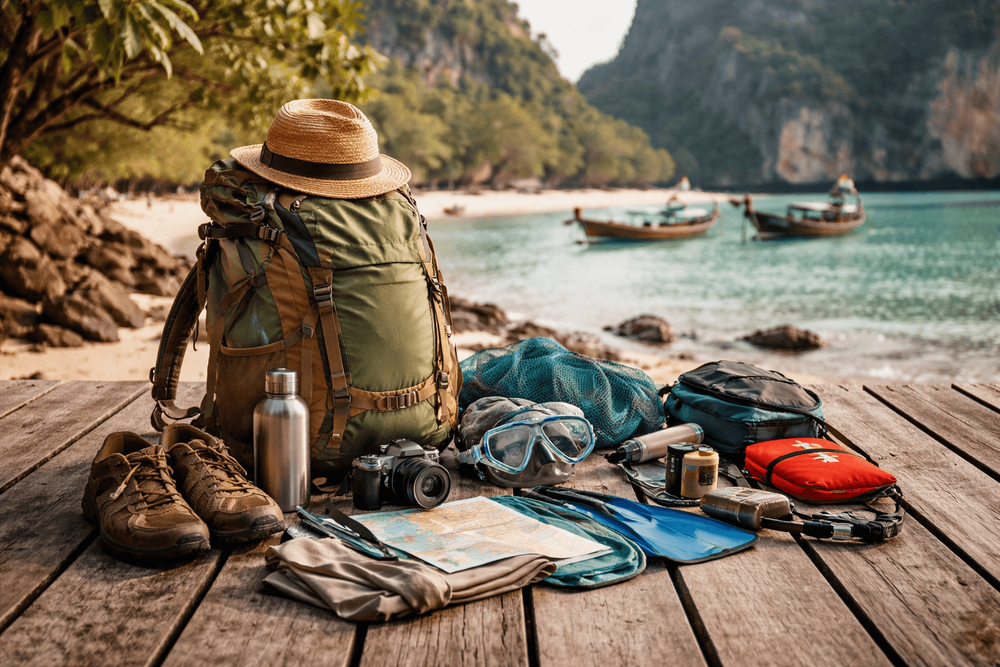
Thailand Backpacker Packing List for Remote Islands and Boat Hops
Dial in your Thailand remote island packing list: waterproof essentials, cash, sun-safe gear, and smart boat-day packing for ferries and longtails.
We’re on the pier before sunrise, the sky cotton-candy pink over the Gulf, longtail boats coughing diesel and porters weaving through with crates of coconuts. The air smells like salt and fish sauce, the boards creak under bare feet, and that first slap of warm sea air makes us grin. This is where the trip begins—and where a smart Thailand remote island packing list pays for itself. When the shop is a shack that closes after lunch and the ATM is “next island, maybe,” the right gear is the difference between sanuk and stress.
Your Thailand Remote Island Packing List
Clothes that earn their keep
- Quick-dry tees or singlets (2–3): Cotton sops up sweat like a sponge. Lightweight synthetics or bamboo blends rinse-and-dry overnight on a bungalow railing.
- Long-sleeve sun shirt or thin button-up (1): For long boat rides and sizzling midday rambles along a white-hot beach road.
- Swimwear (2): One to wear, one to dry. Rash guard tops help avoid the sunscreen shuffle and jellyfish stings.
- Shorts (2–3): One athletic/board short, one casual. Ladies, a breezy skirt or sarong handles temple stops and sunset drinks.
- Light trousers or travel pants (1): For mozzie-heavy dusks, polite dinners, and over-zealous AC on night buses.
- Packable rain jacket or poncho (1): Monsoon squalls blow in fast. A simple poncho (20–60 baht at a 7-Eleven on the mainland) is perfect for longtail spray.
- Thin warmth layer (1): A featherweight hoodie or shawl for AC assaults—ferries, vans, and that one cafe set to Arctic.
- Underwear (4–5) and socks (2–3): Quick-dry if you can; nothing dries slower than a wet cotton sock in a seaside bungalow.
Footwear:
- Flip-flops: The pier uniform. Slip them off at beach bars, temples, and bungalows.
- Amphibious sandals or reef shoes: For rocky entries, low tide reefs, and longtail load-ins where the prop churns up shells.
- Lightweight sneakers: Optional but handy for scooter days, jungle hikes to hidden bays, or climbing the viewpoint ladder on Koh Adang.
Head and eyes:
- Sun hat or cap: Island sun is a bully. Wide brims beat headaches.
- Polarized sunglasses: You’ll actually see past the surface glare—handy when you’re hunting for that coral bommie.
Fabrics that fight the tropics
- Quick-dry, odor-resistant materials keep the pack tiny and the smell factor friendly.
- Neutral colors for mix-and-match; a sarong works as beach blanket, temple cover-up, towel, and privacy curtain on ferries.
Docs, Baht, and Battery: The Boring Heroes
We love a good sanuk day, but paperwork still rules at piers and check-ins.
- Passport + 2 photocopies: Keep one deep in your bag, one in your daypack.
- Digital backups: Photos of passport, visa, and insurance stored offline on your phone and in cloud storage.
- Travel insurance details: Screenshot the hotline; Wi-Fi drops when waves pick up.
- Cash: Remote islands often run on cash. Bring a mainland top-up—think 3,000–8,000 baht depending on stay length and your sundowner habits. ATMs can be nonexistent or charge steep fees.
- Cards: Two separate debit/credit cards in different stash points. Some guesthouses accept card with a 3–4% fee.
- Small bills (20s/50s): For pier snacks, longtail hops (50–200 baht), and island taxis.
- Local SIM: AIS/True/DTAC all work; buy on the mainland (150–300 baht for a week of data). Remote coves still drop to one bar—download offline maps.
- Power bank (10,000–20,000 mAh): Ferries have few outlets; bungalows can have limited sockets. Keep a short cable handy on deck.
- Waterproof phone case or lanyard pouch: Boat spray is not a maybe.
- Universal adapter and short multi-USB cable: One plug, three devices, less fight for the only wall socket.
Pro move: Put your essentials—passport, cash, phone—in a small zip pouch inside a 5–10L dry bag. That’s your grab-and-go for pier chaos and rainy tuk-tuk dashes.
Health, Safety, and First Aid for Salt, Sun, and Seas
- Reef-safe sunscreen (SPF 30–50): The sea doesn’t need oxybenzone. Expect 350–600 baht on-island; cheaper on the mainland.
- Zinc stick for nose/cheeks: Boat noses burn first.
- After-sun or aloe: Or a sliced fresh aloe leaf if you see a market stall.
- Insect repellent: DEET or picaridin works; mosquitoes are keen at dusk near mangroves and khlongs.
- Bite and sting relief: Hydrocortisone cream and antihistamines; jellyfish vinegar is often carried by dive shops but not guaranteed.
- Motion sickness tablets: Swell happens. Take 30 minutes before departure.
- Basic meds: Paracetamol/ibuprofen, loperamide, oral rehydration salts (brilliant after sun and Chang).
- Plasters, blister pads, and a small roll of gauze: Reef and rope are unforgiving.
- Antiseptic wipes/ Betadine: Clean cuts fast in the tropics.
- Compact water filter bottle or purification tablets: Handy if your bungalow sells pricey plastic or you’re hopping to a no-RO-water islet.
- Personal prescriptions + a photo of the script: Keep a couple of doses in your daypack.
We also toss in a tiny headlamp. Night paths on Koh Phayam or Koh Kradan can be proper dark, and phones die right when the geckos start their cackling chorus.
Beach, Snorkeling, and Boat Gear That Punches Above Its Weight
- Dry bags: 10L for daily missions; 20–30L if you’re hugging a longtail with your whole life on board. Good ones run 300–900 baht on the mainland.
- Mesh wet bag: For sandy swimmers and snorkel sets so the rest of your pack stays dry.
- Mask and snorkel: Rentals are 100–200 baht/day, but a personal set fits better and fogs less. Fins optional unless you’re chasing drop-offs.
- Reef-safe lip balm: Sun roasts lips faster than you think when you’re grinning on a bow.
- Quick-dry towel or sarong: Sarongs win for multi-use; microfiber wins for fast packs.
- Collapsible 1L bottle: Refill at stalls; refill stations are sporadic off-grid.
- Compact lock: Some beach shacks have lockers, some don’t. A tiny lock buys peace of mind.
- Lightweight daypack (water-resistant): 15–20L for snacks, camera, towel, and that sweaty hat you keep forgetting.
- Packing cubes and a compression cube for clothes: Organized chaos = fewer “where’s my rashie?” moments.
- Cable ties and a small carabiner: Lash bags to railings, tag zippers, or hang wet gear off the bungalow porch.
- Portable flashlight or headlamp: For late arrivals at unlit piers and sandy walks back from the reggae bar.
If island-hopping is your plan, we’ve got deeper dives here:
- Ferry and dry-bag specifics: What to Pack for Thailand for Island Hopping: Dry Bags, Reef-Safe Gear, and Ferry Essentials
- Beach day setups that actually stay dry: What to Pack for Thailand for Island and Beach Day Bags: Snorkel Gear, Waterproof Storage, and Sun Protection
- Snorkeling-focused kit: Backpacker Packing List for Thailand’s Adventure Islands: Snorkeling, Boat Days, and Waterproof Tech Protection
Practical Packing Tips for Limited Shops and Long Boats
Pack small, move fast
- One carry-on backpack (30–40L) plus one daypack is the sweet spot. You’ll thank yourself when you tightrope a floating pier.
- Soft-sides beat roller bags. Wheels hate sand, and longtails love to toss luggage.
- Put tonight’s essentials on top. Arriving at dusk? You want headlamp, towel, toothbrush, and one clean tee without unpacking your life.
Waterproof like a local
- Double-bag electronics: phone in a sealable pouch, pouch inside a dry bag. Rain squalls hit hard; longtail spray sneaks everywhere.
- Line your main pack with a trash compactor bag or lightweight pack liner. If the big bag gets soaked, your clothes won’t.
Shop wisely on the mainland
- Stock up in Bangkok, Krabi Town, or Trang: sunscreen, meds, and SIMs are cheaper and choice is wider. On-island, sunscreen can jump 30–50%.
- Bring cash from town. Many small islands add card fees or simply smile and point to a “Cash Only” sign.
Respect the elements
- Monsoon rhythm: Gulf side (Koh Tao/Koh Phangan/Koh Samui) is stormier late Oct–Dec; Andaman (Koh Lipe/Koh Lanta/Koh Phi Phi/Koh Phayam) gets rougher May–Oct. Ferries still run, but schedules flex—pack patience and a poncho.
- Electronics sweat too. Keep silica gel packs in your camera pouch; AC to humidity swings fog lenses fast.
Keep it temple-ready
- Even islanders go to wat. Pack a light cover-up for shoulders/knees. A sarong and a plain tee pass any dress code without feeling farang awkward.
Getting There: Ferries, Piers, and Longtails Without the Headache
We’ve danced this dance from the Chao Phraya Express boat all the way to the last longtail bumping into a sandbar at golden hour. Here’s what helps.
- Check pier names twice: Pak Bara for Lipe, Laem Sok for Koh Kood, Bang Bao for Koh Mak/Koh Wai, Ban Phe for Samet. Vans often overshoot if you’re vague.
- Arrive early: Ferries close boarding 15–30 minutes before departure; some piers collect small local fees (10–20 baht). Have change ready.
- Tag your bag: A strip of bright tape stands out in the luggage pile shuffle.
- Ask about sea state: If the clerk sighs and says “lom mak” (very windy), pop that motion pill.
- Sit aft on speedboats: Less slam, more motor noise—bring earplugs. Forward is a quadriceps workout.
- For longtail transfers, keep flip-flops in hand: You’ll wade; props don’t like laces.
- Protect docs: Keep your passport pouch inside your dry bag during boat rides, not around your sweaty neck.
If your plan turns into a full-on island hop, this companion read lines up nicely: Backpacker Packing List for Thailand’s Islands: What to Bring for Ferries, Beaches, and Boat Days
Sample 3-Day Remote Island Loadout (Carry-On Only)
- Wear: quick-dry tee, shorts, flip-flops, hat
- Pack: 2 tees, 1 long-sleeve sun shirt, 1 shorts, 1 light pants, 4 underwear, 2 socks, rash guard + swimmers, packable rain jacket, sarong
- Gear: 10L dry bag, water-resistant daypack, microfiber towel, mask/snorkel, sunglasses, headlamp, power bank, cables, universal adapter, SIM
- Health: reef-safe sunscreen, repellent, motion tablets, ORS, plasters, antiseptic wipes, antihistamines, painkillers, zinc stick, mini first-aid pouch
- Docs/Money: passport + copies, insurance screenshot, 4,000–6,000 baht mixed bills, 2 cards, phone with offline maps
Everything should fit in a 30–35L pack with room for a beach fruit haul and that unexpected bottle of local rum.
Real Talk: Downsides and How We Deal
- Heat: It’s heavy, especially when you step off the boat at noon. We plan transfers early or late, chase shade, and treat the 7-Eleven blast of AC like a temple blessing.
- Noise: Beach bars thump bass, roosters counter at 4 a.m. Earplugs live in the toiletry kit.
- Sand, forever: Ziplocs and mesh bags keep it out of electronics and off your pillow.
- Scams: Not many on tiny islands, but inflated longtail quotes do happen. Ask a shopkeeper for the going rate before you negotiate.
- Patchy Wi-Fi: Download playlists, books, and offline maps in town. Then lean into the digital detox—geckos do better small talk than most group chats anyway.
Sustainability Without the Sermon
- Reef-safe sunscreen and a rash guard cut chemical load.
- Carry a refill bottle; ask cafes for top-ups, or buy bigger jugs to decant at your bungalow.
- Skip standing on coral and chasing turtles. The sea gives sanuk; give some back.
- Pack out what you pack in on little islets where trash runs are rare.
Before You Zip the Pack
Use this quick mental check:
- Do we have cash for two days if the ATM is down?
- Can we keep phones alive for a day if power flickers?
- Will our essentials survive a rain squall or bumpy transfer?
- Are shoulders/knees covered for the island wat?
- Did we stash motion pills where we can reach them without unpacking?
If you’re building a beach-day kit or optimizing for mixed ferries and scooters, these two guides round it out:
- What to Pack for Thailand for Island and Beach Day Bags: Snorkel Gear, Waterproof Storage, and Sun Protection
- What to Pack for Thailand for Island Hopping: Dry Bags, Reef-Safe Gear, and Ferry Essentials
We’ll see you at the pier—hat on, dry bag clipped, mango sticky rice in hand. When the bow swings toward that line of green in a blue so bright it buzzes, you’ll be glad your Thailand remote island packing list is dialed. The rest is just warm wind and water.
Related Hotels & Places
Recommended Products
More Khao San Road Guides
- Backpacker Packing List for Thailand’s Island and Boat Days: Dry Bag Setup, Slip-On Shoes, and Water-Ready Carry
- Backpacker Packing List for Thailand’s Islands and Ferry Hops: What to Carry Between Beaches, Boats, and Hostels
- Backpacker Packing List for Thailand’s Adventure Islands: Snorkeling, Boat Days, and Waterproof Tech Protection
- Backpacker Packing List for Thailand’s Islands: Ferry Bags, Beachwear, and Wet-Season Extras