Golden Mount Bangkok Guide from Khao San Road: Climb, Views & Temple Etiquette
Climb Wat Saket with us—hours, tickets, dress code, how to get there from Khao San, and the best sunset views in old-town Bangkok.
We hear the first bell long before we see the gleam of the chedi. Tuk-tuks growl past Panfa Bridge, incense curls from a roadside shrine, and the canal boat thwacks the green khlong as it docks. If you’re staying around Khao San Road and want one knockout view with a side of calm, this Golden Mount Bangkok guide is our playbook for a perfect Wat visit—how to climb it, when to go, what to wear, and where to eat when we come down hungry.
Why the Golden Mount (Wat Saket) still stops us in our tracks
Wat Saket’s Golden Mount—Phu Khao Thong in Thai—is a man‑made hill crowned with a golden chedi that catches sunrise like a beacon. It’s old‑town Bangkok in a single glance: Loha Prasat’s spires to one side, the Giant Swing to the other, modern towers shimmering in the haze beyond. Built on a 19th‑century brick mound that covers an earlier collapsed chedi, the mount is dramatic without being overwhelming. No marble armies, no crush of tour buses you can’t dodge—just a slow spiral up through bells and banyans to a 360‑degree payoff.
We love it because it’s a mood shifter. Ten minutes earlier we were dodging motorbikes on Maha Chai Road; five minutes from now we’ll be standing in a breeze with the city unspooling at our feet. It’s sanuk—the Thai idea of easy fun—without the stress.
Climbing the Golden Mount: bells, breezes, and that Bangkok skyline
The stairs and the soundscape
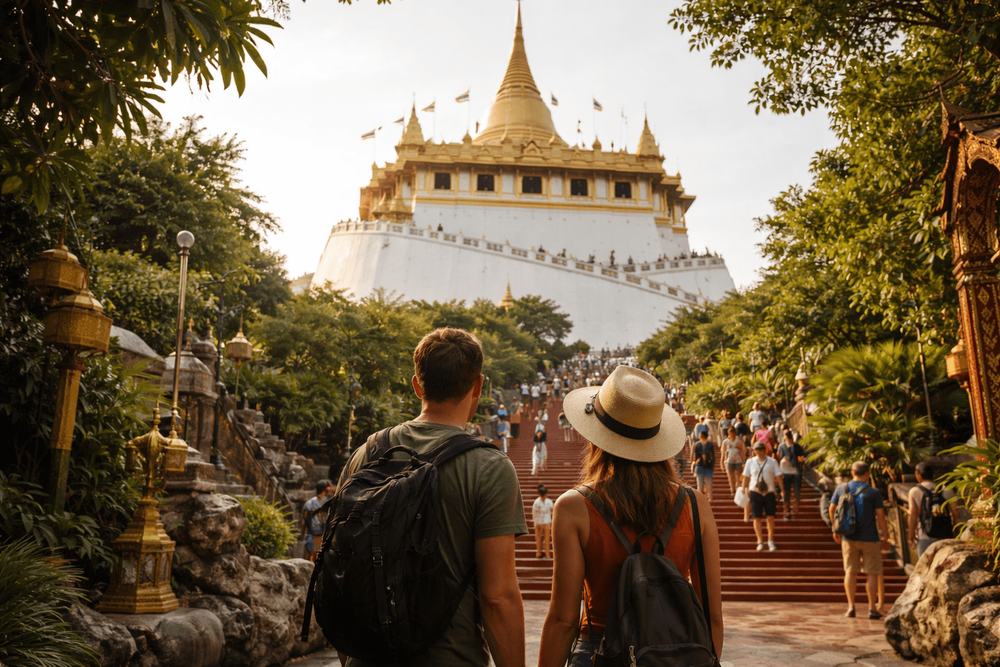
The climb is friendly. About 300‑plus steps (around 344, depending on how you count landings), shallow and forgiving, curling counter‑clockwise under frangipani shade. Bronze bells line the path; locals ring them for luck, so don’t be shy—give a gentle strike and let the sound roll down the soi like a temple heartbeat. You’ll pass small shrines, a waterfall tucked into mossy rock, and a lookout or two that tease what’s coming.
Halfway up, the city noise thins. We trade tuk‑tuk exhaust for damp stone and cool air pushed by a corridor fan. It’s meditative without being hushed; kids giggle, monks pass in saffron, someone’s carrying marigolds and joss sticks. If we started late and the heat’s biting, we duck into the little rest alcoves—the blast of AC you get when you later pop into 7‑Eleven near Panfa Pier will feel like a reward sent by the temple gods.
At the summit
At the top, a small shrine room holds a Buddha image and relics; shoes off if you step inside. Outside, the chedi’s base is wrapped in red cloth for festivals, and the terrace path rings with little prayer wheels. We always pause at the corner facing west to catch the Rama VIII Bridge and the slow fold of the Chao Phraya; then swing around for textbook views of Loha Prasat’s metal castle and the Giant Swing by Wat Suthat. On clear days, you can spot the pixelated profile of King Power Mahanakhon in Silom.
Sunset is the money shot—the city turns peach and the skyline softens—but early mornings have their own hush, all soft light and temple bells waking the neighborhood. During Loy Krathong (usually November), Wat Saket hosts a classic temple fair: red lanterns, old‑school games, and a glowing chedi visible for blocks. It’s crowded and chaotic in the best way.
Down among the temple grounds
Don’t sprint straight out after your sky‑time. Back at ground level, we like to drift through the main ordination hall (ubosot) and the courtyard with its bodhi trees. You’ll find donation boxes for candles and gold leaf if you want to make merit—20–40 baht is normal. The grounds feel very local: office workers on lunch break, aunties chatting in the shade, a cat asleep under a lion statue.
If you’ve got ten extra minutes, wander west to the Baan Bat community—a warren of lanes where artisans still hand‑hammer monks’ alms bowls. It’s one of those crafts Bangkok nearly lost; buy direct if you want a special souvenir, but skip the obvious resellers.
Golden Mount Bangkok guide: hours, tickets, how to get there
Opening hours & tickets
- Hours: Typically daily, 7:30–19:00 (last entry around 18:30). Festival weeks can extend later. Always check the sign at the gate.
- Tickets: Expect 100 baht for foreign visitors to access the mount/upper terrace. The lower temple grounds are free. Bring small cash; QR payments come and go.
- Lines: Minimal early morning; busier 10:00–16:00. Sunset can be popular but still moves fast.
Getting there from Khao San Road
- On foot: About 25–30 minutes, 2 km. Our favorite route: cut from Soi Rambuttri to Tanao Road, drift along Dinso toward Democracy Monument, then amble east past Loha Prasat on Maha Chai Road to Wat Saket. It’s a greatest‑hits walk through Rattanakosin.
- Tuk‑tuk: 80–150 baht depending on mood, traffic, and your haggling. Confirm “Wat Saket, Golden Mount” and refuse any unsolicited “special stops.” If someone tells you it’s closed, smile, keep walking—that’s the classic temple‑closed scam.
- Taxi/Grab: Metered fare from Khao San is usually 60–100 baht off‑peak. Ask for “Wat Saket.”
- Khlong Saen Saep boat: If you’re coming from Pratunam/Asok, ride to Panfa Leelard Pier—the final stop. The pier basically sits at the foot of the Golden Mount. Fares are 10–20 baht, cash only; boats run roughly 06:00–19:30 (later weekdays).
- MRT: Sam Yot (Blue Line) is about 15–20 minutes on foot; it’s handy if you’re hopping from Chinatown or Rattanakosin.
Best time to visit
- Early morning (7:30–9:00): Coolest temps, soft light, minimal crowds. Great if we’re doing a temple run later.
- Late afternoon (16:30–18:00): Golden hour glow and those big sky colors. Bring water; the stairwell can still hold heat.
- Festival week in November: Magical lanterns and a full‑on fair—also elbow‑to‑elbow. Worth it if you like old Bangkok carnivals.
Temple etiquette and comfort hacks
Dress code decoded
Wat Saket isn’t as strict as the Grand Palace, but it’s still a working wat. Cover shoulders and knees; think T‑shirt and long shorts or a light skirt/sarong. If you’re in gym gear, bring a scarf to throw on. Hats off in shrine rooms; shoes off where signs indicate.
Respectful behavior in a working wat
- Keep voices low, especially inside the ubosot and shrine areas.
- Don’t point your feet at Buddha images; sit cross‑legged or with feet tucked back.
- Skip PDA, cigarettes, and drones. Tripods may be restricted on the terrace—ask a guard if you’re unsure.
- Photography is fine outside; inside sacred spaces, avoid flash and keep it discreet.
Photos without being that farang
- Angles: For skyline symmetry, hug the terrace corners. One faces Loha Prasat; another frames the Giant Swing with old rooftops in the foreground.
- Timing: Sunrise gives you haze‑soft layers; sunset gives you drama. Rainy‑season afternoons sometimes crack open with electric skies—bring a microfiber cloth for lens fog when you step out of AC.
- People: If monks or worshippers are in frame, keep respectful distance. Offer a quick nod and wai if you make eye contact.
Heat and comfort
- Hydrate: A chilled water from 7‑Eleven near Panfa Bridge is 10–15 baht and feels like salvation.
- Footwear: Easy on/off shoes help with shrine rooms. The steps can be slick after rain.
- Pace: This is not Everest. Stop, ring a bell, savor the breeze, keep climbing.
Eat, sip, and wander around Wat Saket
Nearby bites we crave
- Pad Thai on Maha Chai Road: The famous “Pratu Phi” pad thai joints near Wat Saket sizzle woks late into the night. Expect queues, charcoal smoke, and prices above your average street cart—but that caramelized tamarind tang is legit.
- Guay jub (peppery rolled rice noodles): A few family spots around Samran Rat serve bowls that’ll clear your sinuses and soothe your soul. Follow the steam and the pepper smell.
- Street sweets: Look for khanom buang (crispy crepes) and coconut pancakes as you wander toward the Giant Swing. Ten baht coins disappear fast here.
- Post‑climb coffee: Indie cafes are multiplying along Bamrung Mueang and in alleys around Loha Prasat—air‑con, Wi‑Fi, and a chance to de‑sweat.
Old Town extras worth your time
- Loha Prasat (Wat Ratchanatdaram): Those black‑tipped spires you saw from the top are a five‑minute walk away. Climb its interior floors for a different angle on the city.
- Giant Swing and Wat Suthat: One of Bangkok’s grandest viharns and a photogenic plaza for golden‑hour people‑watching.
- Canal ride east: From Panfa Leelard, zip over the khlong to Pratunam in under 20 minutes. It’s Bangkok’s secret commuter highway.
- Temple‑hopping day: If you’re chaining sights, we’ve mapped a smooth loop from the Grand Palace to Golden Mount that saves your feet and sanity—see our route here: Grand Palace to Golden Mount: How to Connect Bangkok’s Top Temples in One Smooth Day.
- Deeper neighborhood dive: Rattanakosin isn’t just temples—museums, monk‑supply shops, and amulet markets fill the grid. Our full area primer lives here: Bangkok Old Town (Rattanakosin) Guide: Top Sights, Food & Where to Stay.
If you’re building a whole sightseeing sprint from Khao San, we’ve even laid out a step‑by‑step temple run you can follow without a tour: Bangkok Temple Run: Wat Pho, Grand Palace, and Golden Mount from Khao San Road. And if the Grand Palace is on your list (it should be), bookmark this for logistics from our backyard: Grand Palace Bangkok: Complete Visitor Guide (from Khao San Road).
Where to crash nearby (without blowing the budget)
Base yourself where your nights match your mornings. If we want easy strolls to Wat Saket and sunrise climbs, Old Town stays around Dinso Road and Mahachai put us close to the action and far from late‑night bass. If we crave a pad thai at 2 AM and a short stumble home, Khao San and Soi Rambuttri are our playground—lively, walkable, and dense with cheap eats. Riverside guesthouses along Phra Athit trade noise for breezes and views of the Chao Phraya.
No matter the neighborhood, look for rooms with cross‑ventilation or good AC (Bangkok humidity is no joke), and consider a midday pool break if you’re stacking temples. Prices swing wildly with season; shoulder months often hide the best bargains.
Know before you go: quick tips
- Ticket first, stairs second: The booth is at the base; keep your stub handy for the upper gate.
- Beware the “closed temple” line: Scammers love old town. Wat Saket nearly never closes during the day. Trust the sign at the entrance, not the guy with the cheap tuk‑tuk deal.
- Cash rules: Small bills help with tickets, donations, snacks. ATMs sit by Panfa Bridge and along Bamrung Mueang.
- Weather wiggles: Rain blows in fast. Steps get slick; bring a compact poncho and enjoy the petrichor when it passes.
- Festival week crowds: Gorgeous, but shoulder‑to‑shoulder. If you’re crowd‑averse, come early morning on non‑fair days.

Make it your Bangkok moment
Golden Mount is the reset button we hit whenever the city gets loud. It’s close enough to Khao San for a spontaneous climb, easy enough to enjoy between markets and meals, and rewarding enough that we keep coming back. If this is your first night in town, let’s chase that sunset glow from the terrace and watch Bangkok turn its lights on—then we’ll head down Maha Chai for noodles that taste like victory.
Related Hotels & Places
Recommended Products
More Khao San Road Guides
- Golden Mount from Khao San Road: Climb Guide, Best Time to Go, and What to Expect
- Golden Mount at Sunset from Khao San Road: Climb Tips, Views, and Temple Etiquette
- Golden Mount Temple Guide from Khao San Road: Views, Climb, and Sunset Timing
- Golden Mount (Phu Khao Thong) Bangkok: Visitor’s Guide & Best Tips