Golden Mount (Phu Khao Thong) Bangkok: Visitor’s Guide & Best Tips
Climb Wat Saket’s Golden Mount for skyline views, sunset magic, and a dose of Old City soul. Directions, best times, fees, dress code, and insider tips.
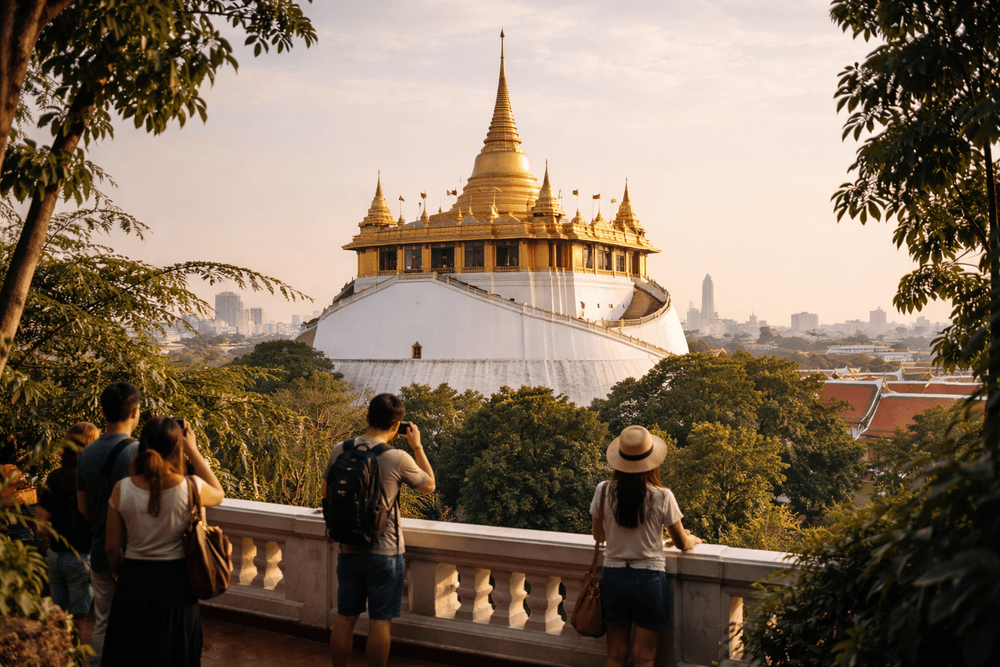
We hit the first step just as the bells start chiming and the scent of incense rides the warm air off Bamrung Muang Road. Golden Mount Bangkok — Wat Saket’s shimmering chedi perched on an artificial hill — is one of those places that still makes us slow down. The city thumps below, tuk-tuks buzz down Boriphat Road, and we spiral up through prayer flags and bodhi shade until the skyline opens and Bangkok looks soft for a moment.
What is the Golden Mount (Phu Khao Thong)?
Phu Khao Thong literally means “Golden Mountain,” a man‑made hill with a gleaming chedi on top inside Wat Saket, just east of the Old City (Rattanakosin). The story is wonderfully Bangkok: during the early Rattanakosin era, King Rama III attempted to build a massive chedi here. The swampy soil couldn’t handle the weight; the structure collapsed and left a mound of rubble that, over time, became a hill. Later kings stabilized it, and under King Rama IV and King Rama V a new chedi rose, enshrining a revered Buddha relic brought from Sri Lanka. The gilded stupa you see today is the city’s quiet compass — a golden spike you can spot from Ratchadamnoen Avenue to the khlongs of Pom Prap.
Why visit Golden Mount Bangkok
- The view: From the rooftop terrace you get a 360-degree sweep — Loha Prasat’s spires to the west, the Giant Swing by Wat Suthat, the Democracy Monument down Ratchadamnoen, and on a clear day the jagged silhouette of MahaNakhon blinking from the modern side of town.
- The vibe: The climb is meditative. Bells to ring for luck, a slow spiral of 318 shallow steps, shady bodhi trees, monks moving quietly between prayer halls — it’s sanuk without shouting.
- The relic and rituals: At the summit, the golden chedi shelters a Buddha relic. Locals circle clockwise with lotus flowers and incense; you’re welcome to follow respectfully.
- Sunset: Golden hour here earns the hype. The chedi glows, the sound of city traffic softens, and Bangkok’s waves of humidity feel like they lift for a few minutes. If you want that postcard skyline, this is the spot.
What to see and do on the Golden Mount
The spiral walkway and bells
We wind up through tiers hung with prayer flags, the sweet-rot perfume of ripe durian occasionally drifting up from a passing street cart below. Along the path are rows of large bronze bells you can ring for merit (and for the sheer joy of the sound). There’s a ceremonial gong too; give it a single, respectful boom. Small shrines dot the way — if you step inside any indoor prayer space, shoes off.
The viewpoints
Two classic photo stops:
- Midway terrace facing west: Loha Prasat lines up nicely and catches the last light across Ratchadamnoen Klang Road.
- Rooftop walkway around the chedi: Step to the north side for Old Town rooftops; the east side looks toward the canal and Chinatown; the south frames the Giant Swing. Early morning clarity is best for long views; at sunset you’ll get warmer tones and silhouettes.
The chedi and the relic
At the top, the golden chedi rises from a whitewashed base. You can circle it on the outer walkway, then duck inside the small chamber below the stupa. Locals leave lotus buds, marigolds, and joss sticks. Keep voices low; this isn’t just a viewpoint, it’s a working temple.
Ceremony and festival moments
- Daily rhythms: You’ll often hear chanting drifting from the main viharn at the base. Mornings are busiest with local worshippers.
- Loy Krathong (usually November): Wat Saket hosts a big temple fair around the Golden Mount. A red cloth is ceremonially wrapped around the chedi, food stalls sprawl along the lanes, and the climb becomes a river of people. It’s crowded, sweaty, and absolutely Bangkok.
Getting to Golden Mount Bangkok
You’ve got options — on foot from Khao San, by canal boat, MRT, river taxi, or a straight shot in a taxi/tuk-tuk.
From Khao San Road / Soi Rambuttri (Old City)
- Walk (25–30 minutes, 2 km): From Khao San Road, cut to Soi Rambuttri and head southeast toward Tanao Road. Continue to Dinso Road, pass City Hall and the Democracy Monument, then angle left onto Bamrung Muang Road. When you see the white fortress-like base of Wat Saket, you’re there. It’s a flat, easy walk with plenty of 7-Elevens for that blessed AC blast.
- Tuk-tuk (10–15 minutes): Negotiate 80–120 baht depending on traffic and your charm. Don’t bite on any “temple is closed” detours.
- Taxi (10–15 minutes): Insist on the meter; expect 60–100 baht. If they refuse the meter, hop out and try the next one.
From the Grand Palace / Wat Pho
- Walk (30–40 minutes): Cross Sanam Luang, follow Ratchadamnoen Klang past Loha Prasat, then continue along Bamrung Muang.
- Tuk-tuk/taxi (15–20 minutes): Similar fares as above; traffic on Ratchadamnoen can crawl on weekends.
By Chao Phraya river taxi
- Take the Chao Phraya Express Boat to Phra Arthit (N13) or Tha Chang (N9). From there, it’s a 15–25 minute tuk-tuk/Grab ride (80–140 baht) to Wat Saket. This is a scenic option if you’re already on the river.
By MRT (Blue Line)
- Nearest station: Sam Yot. From Exit 1, it’s about a 10–12 minute walk (roughly 900 m) east along Mahachai/Bamrung Muang Road. Easy, shaded sidewalks most of the way.
By Khlong Saen Saep canal boat (fast and fun)
- Hop the canal boat to Phanfa Leelard Pier (the eastern terminus). From the pier, it’s a 5–7 minute walk to Wat Saket. Fare is usually 10–14 baht, cash paid to the conductor who nimbly walks the gunwale — welcome to Bangkok’s water-bus ballet.
Best time to visit and crowd tips
- Sunrise (7:30–9:00): Coolest air, clearest views. You’ll share the path with a few joggers and local worshippers. Great for photos with softer light.
- Late afternoon to sunset (4:30–6:30): The golden-hour show. Expect more people, but the vibe is mellow. Arrive 45–60 minutes before sunset to nab a rail spot.
- Midday (11:00–3:00): The heat slaps. Stairs are mostly shaded, but humidity is real; bring water and pace yourself.
- Festivals: During the Loy Krathong temple fair, it’s packed. Go early evening for the atmosphere, not for solitude. Keep an eye on your belongings in the crush.
- Opening hours: Typically daily from around 7:30 to 19:00. Last entry is usually about 30 minutes before closing. Times can shift during festivals; check posted signs at the gate.
Practical tips: dress code, stairs, fees, safety
- Dress code: It’s a temple. Shoulders and knees covered (a light scarf or sarong does the trick). Hats off in prayer halls. Shoes stay on for the outdoor stairs; remove them where signage indicates, especially inside shrines.
- Stairs & accessibility: About 318 shallow steps in a gentle spiral. Plenty of rest spots. Not wheelchair-accessible to the summit. After rain, steps can be slick — hold the rail.
- Entrance fee: Expect around 100 baht for foreigners; Thais usually free. Pay at the booth at the base. Keep small bills handy; cards aren’t always accepted.
- Water & toilets: Grab a cold bottle at the base or from a vending machine (10–20 baht). Toilets are available near the ticket area.
- Etiquette: Ring bells once, not a drum solo. Keep voices low at the top — it’s a sacred space.
- Scams: Classic tuk-tuk lines near the Grand Palace — “Wat Saket closed” — are nonsense. If someone tries to redirect you to a gem shop, smile, say “mai ao khrap/ka” (no thanks), and keep moving.
- Safety: Normal city smarts. The area around Wat Saket is safe by day. At night during festivals, watch your pockets.
Nearby attractions and where to stay
You’re in striking distance of some of Bangkok’s best Old City sights. Loha Prasat (the Metal Castle) is a 10-minute walk west. The Giant Swing and Wat Suthat are a little farther south along Bamrung Muang. Khao San Road and easygoing Soi Rambuttri are 20–25 minutes northwest for street food, cold Chang, and that unmistakable backpacker thump.
- If you want Old Town depth on one page, bookmark our Bangkok Old Town (Rattanakosin) Guide: Top Sights, Food & Where to Stay.
Where we crash nearby:
- We usually tuck into a quiet lane at Lamphu House Bangkok when we want Khao San energy without sleeping on top of a bass speaker. Simple rooms, leafy courtyard, and you can stroll Phra Athit for sunset.
- When we’re feeling upgraded-but-local, The StandardX Bangkok Phra Arthit puts us steps from the river and Rambuttri — perfect for hopping a boat by day and bar-hopping by night.
Sample half-day itinerary with the Golden Mount
Short on time? Here’s how we stack a classic Old City loop without melting.
- 8:00 — Coffee and something flaky on Phra Athit Road. Grab a bottle of water for the climb.
- 8:30 — Tuk-tuk to Golden Mount (80–120 baht) or walk if it’s still cool. Climb, ring a bell, grab your skyline photos while the air is clear.
- 10:00 — Walk west to Loha Prasat for a wander through the metal spires, then continue to the Giant Swing and Wat Suthat. Pad Thai craving? Thip Samai on Maha Chai Road starts early — that wok sizzle and charcoal smoke are the real deal.
- 12:00 — Ride a tuk-tuk or Grab to the Grand Palace. If it’s your first time, go — it’s dazzling. Our detailed route from the backpacker side of town is here: Grand Palace Bangkok: Complete Visitor Guide (from Khao San Road).
- 14:30 — Cross to Wat Pho for reclining Buddha chills and foot massage bliss (air-con, hallelujah).
- Late afternoon — Option A: Boat to Phra Arthit for golden hour on the river and dinner on Phra Sumen Fort lawn. Option B: Circle back to Golden Mount for sunset if you started late.
- Night — Celebrate survival on Soi Rambuttri; the thump from Khao San is just around the corner if you want to lean into it. If you’d rather follow a ready-made temple loop, our Bangkok Temple Run: Wat Pho, Grand Palace, and Golden Mount from Khao San Road lays it out turn-by-turn.
Know before you go
- Cash is king for the ticket and canal boats; keep a 100 and some coins handy.
- Shade is good but Bangkok’s heat is better — at melting you. Hat, sunscreen, and a stop in any 7-Eleven for an AC reset will save you.
- If you’re keen on photos, bring a polarizer in rainy season for crisper skies. In dry season, expect a hazier, warmer palette.
- Weekdays see lighter crowds than weekends. Tour buses tend to land late morning.
If we had just one Old City view to show a friend, it’s the top of Wat Saket at sunset — gold on gold, bells in the breeze, and Bangkok humming below. See you on the stairs.
Related Hotels & Places
More Khao San Road Guides
- Golden Mount Bangkok Guide from Khao San Road: Climb, Views & Temple Etiquette
- Wat Saket (Golden Mount) Visitor Guide: Climb, Views, and Temple Etiquette from Khao San Road
- Wat Saket (Golden Mount) Guide: Climb, Views, Tickets, and Temple Etiquette from Khao San Road
- Golden Mount at Sunset from Khao San Road: Climb Tips, Views, and Temple Etiquette