
Bangkok to Chiang Mai by Shared Van: Is It Worth It for Budget Travelers?
Bangkok to Chiang Mai by van: prices, pickup points, travel times, safety tips, and when this budget ride makes sense (and when it doesn’t).
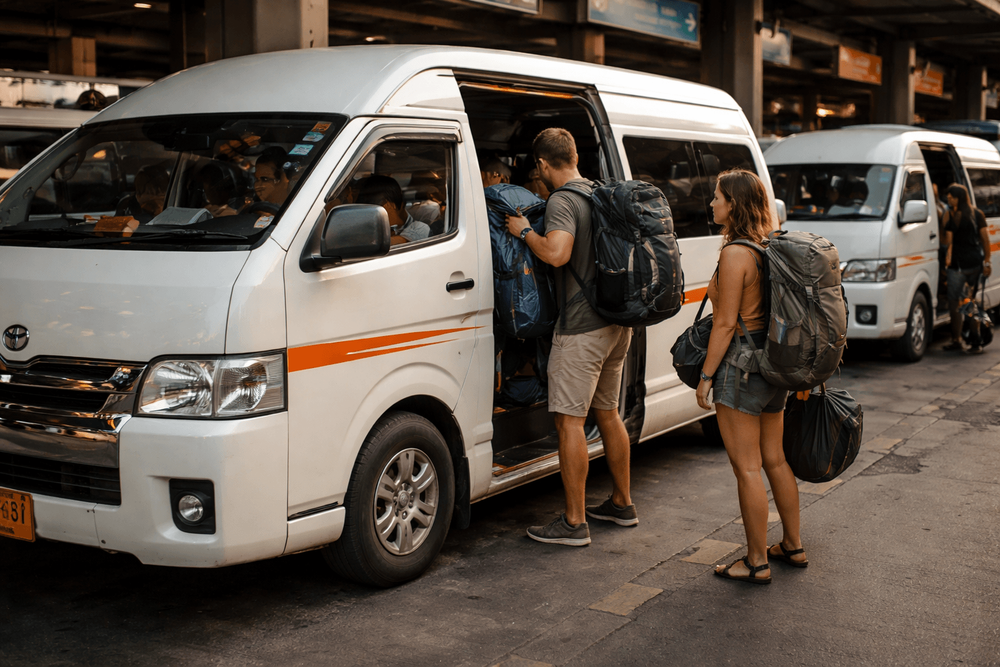
We slide the van’s door shut and the AC punches through Bangkok’s humid dawn. A white Toyota Commuter idles on a side soi off Khao San Road, hazard lights blinking, the driver juggling WhatsApp pings and printed manifests. This is the Bangkok to Chiang Mai van—cheap, no-frills, and fast when the highways behave. If you’re counting baht and traveling light, it can make sense. If you need legroom and beauty sleep, well, we’ve got thoughts.
Data Freshness + Pricing:
- Prices are approximate and in THB.
- Last checked: June 2026.
- Happy hour and promo details change frequently—confirm locally.
Why take the Bangkok to Chiang Mai van?
The bangkok to chiang mai van is the budget traveler’s middle lane: quicker than most big buses on a good day, usually cheaper than a sleeper train, and way cheaper than a last-minute flight. We see backpackers choose it when they want to move same-day without spending much and don’t mind a snug seat. It suits solo travelers and pairs with minimal luggage, people who can sleep anywhere, and anyone who finds sanuk in the blur of roadside 7-Elevens and petrol station noodle stalls.
Who should probably skip it? Tall folks over 185 cm, travelers with big checked suitcases, families who need guaranteed restroom breaks on demand, and anyone anxious about fast drivers. If you want a more comfortable seat and a smoother ride, the Bangkok to Chiang Mai by VIP Bus: Is the Extra Comfort Worth It? guide is a solid next read. For a full comparison across train, bus, and flights, see Bangkok to Chiang Mai by Train, Bus, or Flight: Which Travel Option Is Best?.
Main pickup and drop-off points
Bangkok has a way of scattering your options across the map, and vans are no exception. The main hubs for northern routes—Chiang Mai included—are:
- Bangkok Bus Terminal (Chatuchak), often called Mo Chit 2: Counters and bays for northern services. Many shared vans use the adjacent minibus area on Kamphaeng Phet 2 Road. Easiest access: BTS Mo Chit or MRT Chatuchak Park, then a short taxi or bus hop.
- Khao San / Soi Rambuttri area: Tourist-focused agencies sell van tickets and arrange pickups. Expect a transfer shuffle: a tuk-tuk or small songthaew to a larger van waiting on the main road. Be patient with the choreography.
- Ekkamai and Sai Tai Mai (Eastern and Southern Bus Terminals): Less common for Chiang Mai, but some operators consolidate there. Always confirm the departure point printed on your ticket.
In Chiang Mai, most vans terminate at the Arcade Bus Station complex on the Superhighway (Chiang Mai Bus Terminal 2/3). From there, a red songthaew into the Old City runs approx 30–60 THB per person (approx; haggle politely), depending on time of day and how many farang they can round up. A few tourist vans will offer a drop near Tha Phae Gate early morning for a small surcharge—ask when booking and get it in writing on the ticket if it matters to you.
Typical travel times and distance
Bangkok to Chiang Mai is roughly 680–700 km by road. On paper, vans clock it in 8.5–10.5 hours. In real life, we plan for 9–12 hours depending on:
- Time of departure (leaving after rush hour is gold)
- Number and length of rest stops
- Season (Songkran and long weekends add hours)
- Driver speed and traffic around Nakhon Sawan, Tak, and Lampang
Night runs are often faster but feel bumpier. Day runs let you see the country—flat rice fields giving way to the green shoulders of the north—while also catching more traffic.
Prices, what’s included, and baggage limits
- Ticket price (approx): 600–1,000 THB per person, depending on operator, season, and whether you book via a Khao San agent or at the terminal. Tourist-area markups are normal; at the counter in Mo Chit you can sometimes shave off 50–150 THB.
- What’s included: A seat, AC, and 1–2 short pit stops. Some operators hand you a small water bottle; don’t count on it. No meal coupon (that’s usually a big-bus thing).
- Seat layout: Typically 9–12 seats. The back row is the tightest and jiggles over bumps; front row has legroom but feels every brake.
- Baggage: Vans are picky. Expect 1 medium bag (around 10–15 kg) plus a small daypack. Oversize backpacks and hard suitcases may be refused or charged extra (approx 50–150 THB), and sometimes they simply won’t fit. Roof racks are rare now; most luggage goes behind the last row—so keep valuables on you.
Comfort compared to bus, train, and flight
- Versus VIP bus: Buses win on legroom, recline, onboard bathroom, and consistency. Vans can be quicker point-to-point if the stars align, but you’ll feel more cramped. If you value sleep, we nudge you toward VIP bus; here’s our deeper look: Bangkok to Chiang Mai by VIP Bus.
- Versus train: Overnight sleepers are slower but infinitely more chill. You can stretch, wander to the dining car, and wake to mountain light. Price can be similar to the higher end of van fares for lower berths.
- Versus flight: Flying rules for speed, especially with promos. But once you add luggage fees and airport transfers, the all-in cost creeps up. Vans deliver you into the night without the airport dance.
Booking, schedules, and choosing a reliable operator
You’ve got three booking routes, each with trade-offs:
- Terminal counters (Mo Chit/Chatuchak): Cheapest and most transparent. Show up 1–2 hours before your target departure, point at “Chiang Mai,” and compare timings and prices across counters. We aim for mid-row seats and confirm pickup/drop details on the paper ticket.
- Khao San / Soi Rambuttri travel desks: Convenient if you’re staying nearby. You’ll pay a markup for the pickup, but the convenience can be worth it at 6 AM when the soi smells like yesterday’s pad thai and you’re not haggling with taxis.
- Your guesthouse: Many will book a van for a small commission. Handy if you trust their go-to operator.
Schedule frequency
Daytime vans generally roll from around 06:00 to 12:00, then a late-afternoon wave around 16:00–19:00, plus a night set between 20:00–23:00. Frequency ranges from hourly to every 2–3 hours depending on demand. On Thai holidays, seats disappear early—book ahead.
How we pick a decent van
- Ask about stops: Two to three planned breaks over the journey is ideal. If they brag about “no stops,” think twice.
- Check the vehicle: A clean cabin, working seatbelts, and intact tires matter more than the paint job.
- Sit strategically: Middle seats over the axles bounce less. Avoid the back row if you can.
- Confirm luggage rules on paper: Pushy operators change stories at loading time.
- Time your departure: Leaving after morning rush or late evening saves you an hour of city crawl.
If you’re on the fence and want to weigh every mode side-by-side, our overview of Bangkok to Chiang Mai: The Best Ways to Travel can help you pick.
Safety, rest stops, and the road itself
Safety
We won’t sugarcoat it: some van drivers hustle. That means swift lane changes, tailgating, and speeds that feel saucy. Here’s what we do:
- Buckle up. Every seat has a belt—find it beneath you if it’s tucked away.
- Speak up, politely: A calm “chai yen yen, please” (cool down) can work. Or ask for a short break.
- Travel by day if you’re nervous: Visibility is better, and you’re less likely to nod off into anxiety.
- Keep meds handy: Motion sickness pills help on the curvy stretch before Chiang Mai.
Rest stops
Expect two or three 10–20 minute breaks at petrol stations or food courts around Ayutthaya, Nakhon Sawan, Kamphaeng Phet, or Tak. You’ll find squat and sit toilets (5–10 THB coins sometimes), fried chicken, bao, instant noodles, and the siren glow of 7-Eleven. Stock snacks early; lines build fast.
Road conditions
Most of the run is wide, well-paved highway: Phahonyothin Road (Highway 1) and Asia Highway 32 before bending toward Tak and Lampang. The last hour into Chiang Mai rides mild hills and curves. Heavy rain slows things; otherwise, it’s straightforward.
Know Before You Go: Practical tips
- Pack light: One medium bag plus daypack is the sweet spot.
- Wear layers: AC can be arctic; that blast feels great at Soi Rambuttri but chilly by Nakhon Sawan.
- Bring earplugs and an eye mask: The van’s cabin lights and midnight 7-Eleven neon are not sleep-friendly.
- Keep valuables on you: Luggage in the back shifts; pockets get jostled at stops.
- Screenshot your ticket: If your phone dies, you can still prove your seat.
- Build buffer time: Don’t plan a tight trekking pickup in Chiang Mai the same afternoon.
If you’ve got a pre-dawn van, we crash near the Old City the night before arrival so we can stumble to a bowl of khao soi on Soi Sri Poom when we land. In Bangkok, for early departures, staying up around Ari or Saphan Khwai keeps the taxi meter lower to Mo Chit without sacrificing a decent street food crawl.
Is the Bangkok to Chiang Mai van a good budget choice?
Short answer: Yes—if you’re price-sensitive, flexible, and packing light. You’ll save cash, maybe an hour or two versus some big buses, and land closer to dawn if that’s your plan. You’ll trade legroom, predictability, and a bathroom for that savings.
- Take the van if: You’re two or fewer people, have modest bags, are okay with tight seats, and want to depart today without scouring for train berths.
- Skip the van if: You’re tall, sleep-sensitive, carrying big luggage, or anxious about zippy driving. A VIP bus or sleeper train will treat you better, and if you’re a group splitting fares, a door-to-door car can make sense—see Bangkok to Chiang Mai by Private Car: When a Door-to-Door Transfer Makes Sense.
Our real-world playbook
- Daytime van northbound, stretch your legs at Arcade, and grab a songthaew into the moat before sunset.
- Overnight VIP bus if we need rest. Sleeper train if we want a slow, scenic ride and have time to book.
- Flight only when promos run hot or the calendar’s tight.
Getting There: Departures, arrivals, and transfers
- Bangkok departures: Bangkok Bus Terminal (Chatuchak/Mo Chit 2) is your most reliable point. From BTS Mo Chit/MRT Chatuchak Park, budget approx 60–120 THB for a metered taxi depending on traffic. Khao San pickups add convenience but also add uncertainty; build a buffer.
- Chiang Mai arrivals: Arcade Bus Station is a 10–15 minute songthaew to Tha Phae Gate (approx 30–60 THB per person). If you land after midnight, expect a higher quote or share with fellow passengers and agree a group price first.
- Late-night food: When the van doors hiss open in Chiang Mai, we beeline to Chang Phueak night market or a 7-Eleven for grilled pork buns. If it’s Bangkok the night before, Phra Athit Road’s late bowls of boat noodles hit the spot without wrecking your 200-THB budget.
Common gotchas (and how to dodge them)
- “Express” claims: If it’s suspiciously cheap and claims fewer stops than physics allows, anticipate a shuffle between vehicles.
- Luggage surprises: Confirm in writing if your bag is oversized; arriving with a 70L turtle shell can earn you a frown and a fee.
- Drop-off drift: Some tourist vans promise Old City drop and then punt everyone to Arcade—get it on the ticket.
- Seat swap shenanigans: Board early to lock your seat; the back row always goes last for a reason.
The van won’t be your most glamorous ride in Thailand, but it can be the right one: cheap, direct, and surprisingly human—strangers napping shoulder-to-window, the soft slosh of iced coffee at a PTT stop, a driver humming luk thung as Lampang’s hills appear. If we’re traveling light and the clock’s ticking, we take the van; if we want to arrive fresh, we pay a little more and stretch out. Either way, Chiang Mai’s cool mornings and temple bells make the miles worth it.
Related Hotels & Places
More Khao San Road Guides
- Bangkok to Chiang Mai by Shared Minivan: Is It a Smart Budget Choice?
- Bangkok to Chiang Mai by Minivan: When It Makes Sense, Costs, and Where to Book
- Bangkok to Chiang Mai by Private Van or Shared Transfer: When Door-to-Door Travel Makes Sense
- Bangkok to Chiang Mai by Shared Minivan: What to Expect, Who It Suits, and How to Book