
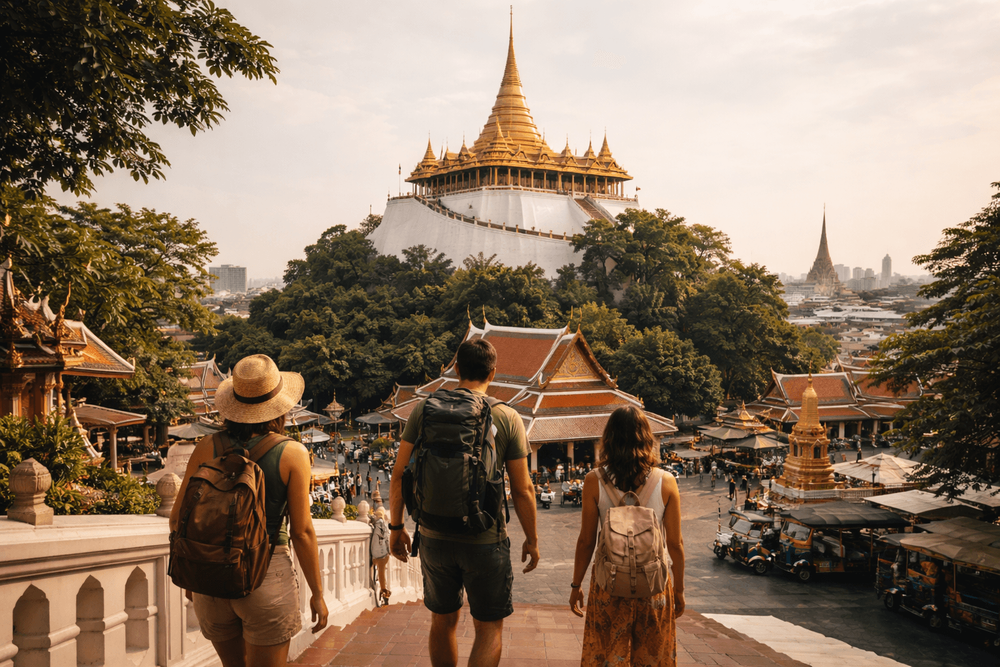
Bangkok Temple Run with Wat Saket: A Khao San Road Guide to the Golden Mount and Nearby Old City Stops
Climb the Golden Mount with us. A streetwise Wat Saket guide from Khao San Road—hours, dress code, how to get there, and the best Old City stops to pair.
We step off Rambuttri and into the heat—street cart smoke curling up from a wok, the sweet rot of durian hanging in the air, a tuk-tuk idling past with a cheerful sawadee from the driver. Over the treetops, the Golden Mount catches a sliver of sun. That’s our north star today. This Wat Saket guide is our shared map to Bangkok’s hilltop stupa, the surrounding temple grounds, and the sanuk of stringing it all together from Khao San Road without getting fleeced or flustered.
Wat Saket Guide: What (and Where) Is the Golden Mount?
Wat Saket, home to the Golden Mount (Phu Khao Thong), sits on the eastern edge of Rattanakosin Island—the Old City—about a 20–25 minute walk from Khao San Road. The “mount” is man‑made: a brick-and-earth hill crowned by a gleaming chedi. We climb a gentle, looping staircase past bells and banyans, and the reward is a 360° sweep of Bangkok—Loha Prasat’s metallic spires to one side, the Democracy Monument down Ratchadamnoen, and, if the haze is kind, even a peek of Rama VIII Bridge.
Why go? Because Wat Saket compresses the city into a single, quiet breath. Up there, above the motorbike buzz, Bangkok softens. You still hear the thump of bass from a Khao San bar if the wind is right, but it’s distant, like a memory you can step back into after sunset.
History and Meaning: Bangkok’s Hill of Faith
Wat Saket reaches back to the early Rattanakosin period. A grand chedi was once planned on this spot and famously collapsed into the swampy ground, leaving the beginnings of a hill. Over decades—and reigns—that failure was reshaped, layer by layer, into the Golden Mount we climb today. The chedi at the top enshrines a Buddha relic, drawing steady flows of worshippers who circle clockwise, press lotus buds to their foreheads, and ring the bells with a soft clink for luck.
The temple is woven into local life, not just religion. In the 19th century, this area served as a burial and cremation ground during epidemics; you’ll still find somber memorial corners within the complex. Come November, the temple fair during Loy Krathong turns the Mount into a glow of lanterns and food stalls—a tradition that feels like a living bridge between old Bangkok and our snack-obsessed present.
What to See at Wat Saket
The Climb and the View
The staircase is broad and forgiving—more a stroll than a slog—and dotted with gongs you can sound, shady niches to catch your breath, and little shrines with flickering candles. We take it slow. Bangkok humidity can wrap you like a wet towel, so we pause to listen for temple bells and the splash of water in guardian fountains.
At the top, the city unfurls. We lean on the balustrade and pick out landmarks: the spiked crown of Loha Prasat at Wat Ratchanatdaram, Wat Suthat and the red sweep of the Giant Swing (Sao Chingcha), the flat plane of Sanam Luang, even the old moat tracing Rattanakosin’s edge. It’s a photographer’s perch—mornings for soft light, late afternoons for that syrupy gold that turns rooftops honey-colored. For deeper background on the climb and what you’re looking at, we like the context in the Golden Mount (Phu Khao Thong) Bangkok: Visitor’s Guide & Best Tips.
The Golden Chedi and Relic Room
Inside the chedi’s drum you’ll find prayer halls scented with incense and coils of candle smoke. The relic room is calm, often with worshippers circling slowly while monks chant nearby. Keep voices to a whisper, hats off, and point your feet away from the Buddha images when you kneel.
Temple Grounds and Quiet Corners
Back at ground level, wander. The ubosot (ordination hall) is typically hushed, with murals worth a look if you have the patience and a respectful distance. There are little courtyards, monk’s quarters you shouldn’t enter but can pass quietly, and pockets of shade where the fans clack lazily in the heat. It’s easy to spend an hour just letting your pulse slow.
Rituals You’ll See (and Can Join)
- Light incense and offer lotus flowers—always with a small wai (palms pressed together) and a mindful moment.
- Ring the bells along the stairs once each for good luck—gently is fine; this isn’t a rock concert.
- Drop a few coins in the donation boxes. It’s not required, but it keeps the place cared for. Keep small bills and coins handy.
Practical Visitor Info: Hours, Fees, Dress, Best Time
- Opening hours: Generally early morning into early evening, with sunset being the sweet spot. Schedules can shift for festivals; confirm locally at the gate.
- Entrance fee: Foreign visitor fees are modest and sometimes vary by area. Expect a small charge (roughly the price of a street pad thai); confirm locally before you climb. Thai citizens may enter for free or by donation.
- Dress code: Shoulders and knees covered. No beachwear, no see-through. Shoes off in sacred interiors. If you forgot a cover-up, you can often buy or borrow one near the entrance.
- Etiquette: Keep voices low, don’t touch monks (women shouldn’t hand items directly to monks—place them within reach), and mind the photo frenzy at the top—everyone wants a skyline shot, but let worshippers have space.
- Best time to go: Early morning for cool air and monk chants drifting from the grounds; late afternoon into golden hour for the skyline glow and a soft breeze. Avoid midday if you can—the sun on those steps can feel like a wok set to high.
If you want a step-by-step on timing your climb, viewpoints, and what to pack in your day bag, we break it down here: How to Visit Wat Saket (Golden Mount) from Khao San Road: Tickets, Climb, Hours, and Best Time to Go.
Getting There from Khao San Road (and Beyond)
- On foot: The most honest route. From Khao San, cut to Phra Athit Road, then Ratchadamnoen Klang, and follow signs toward Wat Saket. About 1.6–2.0 km—20 to 30 minutes depending on how many iced coffees we “need.”
- Tuk-tuk: Fun but haggle. Short hops in the Old City shouldn’t cost the earth. Agree on the fare first and decline any “special gem shop” detours with a smile.
- Taxi: Ask for the meter (mi-ta). For short distances the meter is usually cheaper than a quoted flat rate.
- Khlong boat: If we’re starting from Siam or Pratunam, the Saen Saep canal boat to Phanfa Leelard pier drops us a short walk from Wat Saket. It’s fast, cheap, and a little splashy—embrace it.
- Chao Phraya Express + walk: Scenic but longer. Hop off at Phra Arthit pier, then wander through the Old City. Consider it a pre‑climb stretch.
Nearby Sights to Stitch Into Your Day
We like to make a mini “temple run” out of Wat Saket. It keeps the day tight and the tuk-tuk fares honest.
- Wat Ratchanatdaram & Loha Prasat (10–12 min walk): That tiered metal spire is unlike anything else in Bangkok. Quiet upper floors, killer symmetry.
- Wat Suthat & the Giant Swing (12–15 min walk): Step into the dim, mural-wrapped prayer hall. Outside, the red Giant Swing makes a dramatic photo, especially near sunset.
- Wat Pho (20–30 min walk or short ride): Reclining Buddha, massage pavilions, shady cloisters. When we’re hopping from Wat Pho to Wat Saket (or vice versa), this breakdown helps avoid hot, indirect routes: Wat Pho to Wat Saket by Public Transport: The Best Bus, Ferry, and Walk Connections from Khao San Road.
- Democracy Monument and Ratchadamnoen: Grand avenues, a taste of Bangkok’s civic heart.
- Khao San Road & Soi Rambuttri: Post-temple bowl of boat noodles, mango sticky rice, and a cold Chang. The thump of bass will pull us in eventually—promise.
If you’re tempted to hire a guide for deeper context or to split costs across a small group, have a read of this before you commit: Bangkok Temple Run with a Guidebook Mindset: Self-Guided vs Guided Visits to Wat Pho, the Grand Palace, and Golden Mount from Khao San Road.
Street Smarts: Keep It Sanuk, Not Stress
- Heat management: Freeze a water bottle overnight, duck into 7-Eleven for that glorious AC blast, and pace yourself. Those steps are friendly, the sun is not.
- Scam radar: If a friendly someone says “Wat Saket closed” and ushers you toward a “special shop,” smile, wai, and keep walking. The temple almost never closes in the daytime.
- Footwear: Easy on/easy off. You’ll be slipping shoes off in interiors; sandals with a backstrap are your friend.
- Rain plan: Stairs get slick in downpours. Bring a small umbrella or buy a cheap poncho from a roadside stand.
- Photos: Ask before photographing monks or worshippers. A quick “Ok mai?” with a smile goes a long way.
Where We Crash (So We Can Climb Happy)
In the Old City, we favor guesthouses near Soi Rambuttri or Phra Athit for quiet-ish nights and easy morning walks to Wat Saket. Look for a place with a pool if you can—nothing beats a post‑climb dunk. Budget farang digs fill up in peak season (Nov–Feb), so we book a night or two ahead if sunset on the Mount is our goal. No specific names here—Bangkok’s options churn fast—but aim within walking distance of Khao San to keep tuk‑tuk haggles to a minimum.
A Perfect Half-Day Around the Golden Mount
- 15:30: Iced Thai tea on Phra Athit, then stroll toward Wat Saket.
- 16:00: Start the climb, ring the bells, breathe.
- 16:30–17:45: Linger up top as the city warms to gold. Snap the skyline, then put the phone down and just look.
- 18:00: Wander to Wat Suthat as lights flick on. Early dinner on Dinso Road—pad thai or pad kee mao with a huff of wok hei.
- 19:30: Back to Soi Rambuttri for a nightcap. If the bass thumps, let it—tomorrow we’ll go find peace again by the river.
For more nuts-and-bolts details and extra context on timing, steps, and etiquette, this Wat Saket guide pairs nicely with the quick-hit primer here: Golden Mount (Phu Khao Thong) Bangkok: Visitor’s Guide & Best Tips.
Quick Plan
A→B→C→D: Khao San Rd → Wat Saket → Loha Prasat → Wat Suthat → Wat Pho
- Day 1: Khao San Road → Wat Saket (2 km, 10–20 min drive/20–30 min walk); Key stops: Golden Mount climb, relic hall; Overnight: Old City/Khao San base.
- Day 2: Old City loop → Loha Prasat → Wat Suthat → Wat Pho (total 4–6 km of short hops, 20–40 min drive time cumulatively); Key stops: Loha Prasat rooftops, Giant Swing, Reclining Buddha; Overnight: Same base.
Costs at a Glance (THB)
Last checked: Oct 2026
- Fuel (Gasohol 95) per liter: 34–46 THB
- Segment fuel estimates (city driving; typical compact car 8–12 km/L):
- Khao San → Wat Saket (~2 km): ~8–12 THB
- Wat Saket → Loha Prasat (~1 km): ~4–8 THB
- Loha Prasat → Wat Suthat (~1 km): ~4–8 THB
- Wat Suthat → Wat Pho (~2 km): ~8–12 THB
- Tolls: 0 THB for Old City surface routes (avoid expressways here)
- Attraction fees (per person):
- Wat Saket: small foreign-visitor fee; expect roughly the price of a street meal; confirm locally
- Wat Suthat/Wat Pho: modest fees common; confirm locally
- Parking: 20–60 THB per hour at temple lots where available; 100–300 THB per night at Old City guesthouses; confirm with your stay

We’ll be up there again soon—squinting into the wind, spotting the Giant Swing, plotting the next bowl of noodles. If you time it right, we’ll share that golden hour together and race the twilight back to Soi Rambuttri for a cold one.
Where to stay
Stays we list in Khao San Road. Each place page includes the Agoda booking link.
Related places
Khao San Road
Attractions
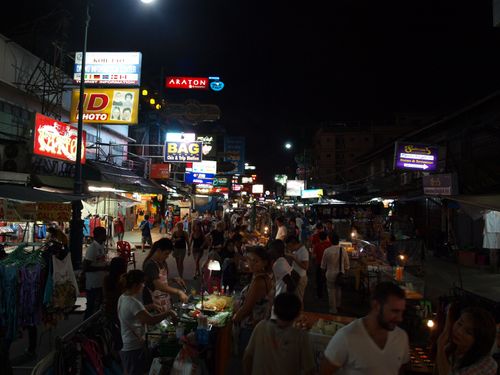
Bangkok’s backpacker carnival: curbside bars, live bands and DJs from 3pm–2am (midnight Sun). Street eats are cheap — pad thai 70–100 THB, mango sticky rice 60–100 THB. Come for wild people-watching; duck into Rambuttri for a calmer beer.
Rambuttri
Markets
Khao San’s calmer cousin: a tree‑shaded lane of VW van cocktail bars, open‑air foot massages, pad thai grills, and easygoing live bands. Best from sunset to 11pm; beers 80–120 THB, cocktails 150–220 THB. One block from the chaos, all the charm.
7-Eleven
Shops
Recommended Products
Staying near Khao San Road? Compare Khao San Road hotels with Expedia booking links.
Flights to Khao San Road
Compare flight options on Expedia.
More Khao San Road Guides
- Bangkok Temple Run with a Guide: When a Tour Makes Wat Pho, the Grand Palace, and Golden Mount Easier from Khao San Road
- Bangkok Temple Run on Foot: A Walkable Old City Route to Wat Pho, the Grand Palace, and Golden Mount from Khao San Road
- Bangkok Temple Run with Wat Saket, Loha Prasat, and the Giant Swing from Khao San Road
- Bangkok Temple Run With a Guide or Self-Guided: When a Tour Helps and When It Doesn’t for Wat Pho, the Grand Palace, and Golden Mount from Khao San Road