
Bangkok Street Food Guide to Dry Markets and Fresh Markets: Where to Eat Beyond the Night Market Scene
Skip the neon. This guide to Bangkok’s fresh markets covers what to eat, where to go, when to go, and how to do it like a local—prices, tips, and routes.
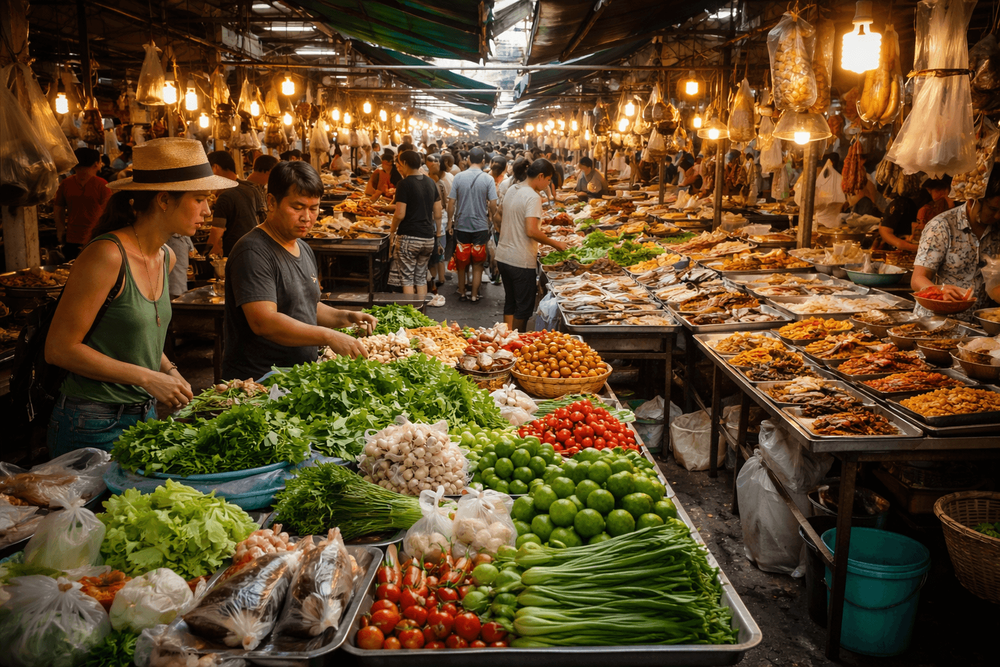
We slip into Khlong Toei just after sunrise, when the air is equal parts lemongrass and diesel. Fish scales gleam under bare bulbs, cleavers thwack through pork ribs, and a wok somewhere hisses like a snake. This is where Bangkok eats before the Instagram crowds wake up. If you want real-deal bangkok fresh market food—breakfast curries ladled from battered pots, grilled pork skewers fanned by aunties with cardboard, fruit so ripe it perfumes the soi—daytime fresh markets are where we go.
Data Freshness + Pricing:
- Prices are approximate and in THB.
- Last checked: July 2026
- Happy hour and promo details change frequently—confirm locally.
Bangkok fresh market food: the markets we actually eat at
Khlong Toei Market (คลองเตย)
- Why we go: Bangkok’s biggest wet market—messy, marvelous, and mercilessly honest. You’ll see everything from live river prawns to offal and herbs still beaded with field mud.
- What to eat: Morning jok (rice porridge) with a soft egg (approx. 40–60 THB), moo ping (grilled pork skewers; approx. 10–15 THB each), curries over rice (khao rad gaeng; 40–70 THB). Fruit stands sell seasonal mangosteen and rambutan by the kilo (approx. 60–120 THB/kg), durian when in season (approx. 150–300 THB/kg depending on variety).
- When: Best 6:00–10:00. After noon, heat and traffic kick up, and some sections wind down.
- Getting there: MRT Queen Sirikit or Khlong Toei, then a 10–15 minute motorcycle taxi or walk. Wear closed shoes—the floors are wet.
Or Tor Kor (องค์การตลาดเพื่อเกษตรกร)
- Why we go: The “spa day” of markets—pristine, photogenic, and curated. Prices are higher but quality is top. Great for gifts and a gentle intro to market chaos.
- What to eat: Southern grilled pork belly (approx. 60–80 THB per stick), sai grok Isan (sour sausage; 20–30 THB), roasted duck over rice (60–100 THB), coconutty kanom krok (25–40 THB). Dried fruit, curry pastes, and premium fruit (think perfect nam dok mai mangoes) cost more but taste like they should.
- When: 8:00–18:00 daily.
- Getting there: MRT Kamphaeng Phet, Exit 3. It’s directly opposite Chatuchak.
Wang Lang Market (ตลาดวังหลัง)
- Why we go: A thrum of street-style eating wrapped around Siriraj Hospital, right by the river. More “ready-to-eat” than butcher-stall wet.
- What to eat: Crispy pork belly (krob) with rice (approx. 60–90 THB), grilled chicken wings lacquered with palm sugar (20–30 THB), banana fritters, boat noodles (40–70 THB), Thai desserts like khanom tuay (small pandan-coconut cups; 15–25 THB for a set).
- When: Late morning to late afternoon, roughly 10:00–17:00; slower Sundays.
- Getting there: Chao Phraya Express Boat to Wang Lang (Siriraj) Pier. From Khao San/Phra Athit, hop the local ferry across.
Nang Loeng Market (นางเลิ้ง)
- Why we go: Old Bangkok feels—wooden shop-houses, aunties who’ve been stewing duck noodles for decades, and a dessert lineage that’ll wreck your willpower.
- What to eat: Duck noodles (60–80 THB), kanom piak poon (black coconut jelly), and legendary sweets like foi thong and thong yip (25–50 THB per pack). Many vendors sell until they sell out.
- When: Roughly 9:00–15:00, Mon–Sat. Many stalls closed Sundays.
- Getting there: From Democracy Monument or MRT Sam Yot, it’s a quick taxi or a 15–20 minute walk.
Talat Phlu (ตลาดพลู)
- Why we go: Thonburi comfort food—Chinese-Thai roast meats by day, dessert alley by dusk. The fresh market section hums in the morning.
- What to eat: Crispy pork on rice (60–90 THB), duck noodles, coconut pancakes, and street-style sweets at night. In the AM, look for stalls selling fresh herbs, betel leaves, and curry pastes.
- When: Fresh market best 6:00–11:00; food vendors reappear late afternoon.
- Getting there: BTS Talat Phlu or Wutthakat, then a short ride or 10–15 minute walk.
Bang Rak Market (บางรัก)
- Why we go: The “Village of Love” between Silom and the river—office lunch chaos meets old-school produce lanes.
- What to eat: Khao man gai (Hainanese chicken rice; 50–80 THB), duck rice, fish-ball noodles, and piles of fresh greens used by Silom shophouse kitchens.
- When: Early morning for produce; 11:00–14:00 for cooked lunches.
- Getting there: BTS Saphan Taksin or Surasak, then walk.
Thewet Market (เทเวศร์)
- Why we go: Old riverside produce, aquarium fish stalls, and herb bundles that smell like the jungle after rain.
- What to eat: Snack on grilled pork, sticky rice (20–30 THB), and grab fruit for the ferry ride. Not many sit-downs—this is a buy-and-go scene.
- When: Mornings 6:00–11:00 hum best.
- Getting there: Chao Phraya Express Boat to Thewet Pier.
Chinatown’s Talat Kao (ตลาดเก่า)
- Why we go: Pre-Yaowarat bustle, heavy on Chinese-Thai ingredients—dried mushrooms, lap cheong (Chinese sausage), roasted chestnuts, and congee shops steaming at dawn.
- What to eat: Jok with minced pork (40–60 THB), soy milk and youtiao (pa thong ko; 20–30 THB), roast duck buns (25–40 THB).
- When: Early mornings to late morning; dims toward noon.
- Getting there: MRT Wat Mangkon, walk via Yaowarat Soi 6/7 into the old lanes.
On Nut & Phra Khanong Markets
- Why we go: Everyday neighborhood wet markets along Sukhumvit. Good for cheap breakfasts and takeaway curries.
- What to eat: Curry-over-rice plates (40–60 THB), fried chicken with sticky rice (30–50 THB), cut fruit (20–40 THB a bag).
- When: Peak 6:00–10:00.
- Getting there: BTS On Nut or Phra Khanong; markets sit just off Sukhumvit on Soi 77 (On Nut) and Soi 71 (Phra Khanong).
Pro tip if you’re staying near Khao San/Phra Athit: Wang Lang and Nang Loeng are your “roll out of bed and eat” markets. If you’re based around Sathorn/Silom, Bang Rak is your local. On a Sukhumvit stay, On Nut and Phra Khanong will be your breakfast canteens.
What to eat at fresh markets (beyond the usual pad thai)
Breakfast like a Bangkokian
- Jok (rice porridge): Order with an egg (kai) and ginger. Comfort in a bowl (approx. 40–60 THB).
- Khao tom (rice soup) with fish or pork: Lighter than jok; great when it’s already 30°C at 8 a.m. (40–70 THB).
- Pa thong ko with sangkhaya: Fried dough sticks with pandan custard dip (20–30 THB). Dip, dunk, repeat.
- Khao man gai: Don’t overthink it—juicy chicken, rice perfumed with chicken fat, and a gingery chili sauce (50–80 THB).
- Boat noodles & pork soups: Short, punchy bowls, heavy on spice and herb (40–70 THB).
If you’re the type who plans dawn eats like a mission, our early-bird playbook pairs well with markets—see the Bangkok Morning Street Food Guide for more AM gems (/articles/bangkok-morning-street-food-guide-best-breakfast-stalls-markets-early-eats).
Regional flavors under one roof
- Isan (Northeast): Som tam (papaya salad; 40–70 THB), gai yang (grilled chicken; 60–90 THB per quarter), and sticky rice (10–15 THB). Look for mortar-and-pestle action and charcoal smoke.
- Southern: Fiery yellow curries (gaeng luang), turmeric fried chicken, and grilled seafood. If you see fresh sator (stink beans), lean in.
- Northern: Nam prik ong (tomato-pork chili dip), sai ua (herb sausage; 40–60 THB per chunk), and sticky rice. Vendors often sell dips by tub for takeaway.
Street-style meals to fill you up
- Khao rad gaeng (rice + two curries): The worker’s lunch. Pick what looks lively—bubbling, hot, lots of turnover (40–70 THB).
- Khao kha moo (stewed pork leg): Braised, glossy, and soothing (50–80 THB).
- Hoy tod (crispy oyster omelet): Sizzles on a well-seasoned pan; ask for “krob” if you like it extra crisp (60–120 THB).
- Pla pao (salt-crusted grilled fish): Shared plate, perfect with som tam (120–220 THB depending on size).
- Kanom jeen nam ya: Fresh rice noodles with curry—watch for tubs of sauces in orange, green, and brown (40–70 THB).
Sweets and fruit that taste like Bangkok
- Kanom krok: Coconut custard cups, wobbly-centers with crisp rims (25–40 THB for 6–8 pieces).
- Lod chong & tub tim grob: Iced desserts built to fight the heat (30–50 THB).
- Mango sticky rice: Best in late hot season; don’t be shy about asking for “nam khao niew nit noy” if you want extra coconut cream (80–150 THB).
- Seasonal fruit: Longan, lychee, mangosteen—buy what smells like it’s singing. Vendors will often peel on the spot.
If floating kitchens and boats loaded with pomelos get you excited, pair a weekend with the Bangkok Floating Market Food Guide (/articles/bangkok-floating-market-food-guide-what-to-eat-when-to-go-which-markets-are-worth-it). Different vibe, same appetite.
Practical tips for fresh markets (timing, hygiene, cash, bargaining)
- Go early: 6:00–9:00 is gold. Cooler temps, fresher picks, and aunties are chattier. After 10:30, stalls sell out and the sun bites.
- Cash first, QR second: Most vendors love cash. Many accept PromptPay/QR now, but carry small bills (20s/50s/100s). ATMs sit near main roads and 7-Eleven.
- Hygiene like a local:
- Choose stalls with lines and high turnover.
- Cooked-to-order is king; soups should be boiling, fried things sizzling.
- Plates rinsed in clean water, vendors using tongs or gloves, and covered food are good signs.
- If you’re cautious or have a sensitive stomach, our Bangkok Street Food Hygiene Guide lays out what to look for without killing the fun (/articles/bangkok-street-food-hygiene-guide).
- Bargaining: Don’t haggle cooked food. For produce, polite bargaining is okay if you’re buying kilos. Smile and say “lot noi dai mai?” (Can you discount a little?).
- BYO kit: Reusable tote, napkins, hand gel, and a collapsible spoon-fork (chamchaa–soa) make life easier. Vendors happily pack curries in plastic bags; ask for “mai ao chan” if you don’t need cutlery.
- Heat, noise, and crowds: It’s part of the sanuk. Wear breathable clothes and closed shoes. The floor can be slick; watch the khlong-side puddles.
- Phrases that help:
- “Mai phet” = not spicy; “phet nit noy” = a little spicy.
- “Sai kai” = add egg; “mai sai...” = don’t add (e.g., “mai sai prik” = no chili).
- “Kin tee nai?” = Where to eat? Many stalls have tiny stool corners.
- Allergies and restrictions: Bring a card with your restrictions in Thai or learn key lines. For specifics on navigating nuts, shellfish, and gluten, see Bangkok Street Food for Travelers with Allergies (/articles/bangkok-street-food-allergies).
Typical costs you’ll see (approx.):
- Breakfast bowls (jok, noodles): 40–70 THB
- Rice plates (two curries): 40–70 THB
- Grilled meats per stick: 10–30 THB
- Fresh fruit/kg: 60–150 THB depending on season
- Iced drinks: 25–50 THB
How fresh markets differ from night markets and street-food strips
Fresh markets are for feeding Bangkok’s day—home cooks, restaurant aunties, and office workers grabbing lunch. Expect wet floors, butcher tables, the sweet rot of durian next to shelves of holy basil. Ready-to-eat food exists, but it shares space with raw ingredients and condiments: galangal roots, live prawns flicking, factory-fresh tofu, tubs of nam prik.
Night markets and street-food strips (think Soi Rambuttri after dark) prioritize snackable, stroll-friendly bites, neon drinks, and browsing. Prices skew tourist-friendly and hours stretch late. Fresh markets trade the fairy lights for fluorescent tubes and close after lunch. If you want more of the evening scene, our Best Bangkok Street Food Markets Beyond Khao San Road has after-dark ideas that still eat local (/articles/best-bangkok-street-food-markets-beyond-khao-san-road).
Find a fresh market near where you’re staying
- Old Town/Khao San–Phra Athit: Walk or quick tuk-tuk to Nang Loeng for midday sweets and duck noodles; hop the ferry to Wang Lang for riverfront snacking. Staying around here means you can roll out early, eat, and be at the Grand Palace before the tour buses.
- Chinatown/Yaowarat: Talat Kao lights up early; pair jok with a wander through spice and dried goods lanes. MRT Wat Mangkon gets you close.
- Silom–Sathorn: Bang Rak is your go-to for produce and lunch plates. If you’re based near Saphan Taksin, you’re one pier from Thewet and Wang Lang via the river.
- Sukhumvit (Asok–Ekkamai): Morning prowls at Phra Khanong and On Nut markets. Great if you’re working out of a co-working and want a quick khao rad gaeng lunch that won’t nuke your budget.
- Chatuchak–Ari: Or Tor Kor is an easy win via MRT. If you want grittier, ride to Khlong Toei before the sun bakes the concrete.
- Thonburi: Talat Phlu is your comfort-food compass, with riverside lanes perfect for a late-afternoon graze.
We usually crash somewhere near Phra Athit when we’re in research mode—mornings are calm, and we can ferry-hop to Wang Lang in ten minutes. When we base ourselves in Sathorn, Bang Rak becomes our daily canteen. If you’re up on Sukhumvit for a few days, pick a place near On Nut BTS and you’ll eat like a local before 9 a.m.
Know before you go (logistics that save sweat and baht)
- Opening days: Many markets thin out or partially close on Sundays and Buddhist holidays. Wang Lang slows on Sundays; Nang Loeng is mostly Mon–Sat.
- Carry small change: Vendors appreciate exact or close to exact payment. Change for 1,000 THB at a tiny stall is a headache.
- Waste: Bins exist but move fast. Better yet, bring a tote and say “mai ao tung plastic” (no plastic bag) if you can carry it.
- Seating: Most fresh markets aren’t sit-down palaces. If you see a few plastic stools, stake one. Otherwise, eat curbside like a pro.
- Transport timing: Morning peak can snarl roads. MRT/BTS + a short motorcycle taxi is often faster (and more fun) than a full taxi ride.
- Safety: Pickpocketing is rare but not unheard of. Keep your phone zipped. For solo eaters, markets are safe—plenty of eyes, plenty of light.
Sample half-day routes (so you actually go)
- Khao San base: 8:00 jok at Nang Loeng, 9:30 stroll to Golden Mount for city views, 11:00 ferry from Phra Arthit to Wang Lang for crispy pork and sweets, siesta by the river.
- Sukhumvit base: 7:30 curry-over-rice at On Nut Market, BTS to Kamphaeng Phet for Or Tor Kor grazing at 10:00, optional Chatuchak browse if it’s the weekend.
- Silom/Sathorn base: 8:00 Bang Rak breakfast run, hop the boat up to Thewet for fruit and herbs, lunch back on Silom Soi Convent.
If you only have time for one bangkok fresh market food hit
- Want raw, roaring, sensory overload? Go Khlong Toei, dawn to 9:00. Eat jok, buy fruit, and watch Bangkok feed itself.
- Want clean, camera-friendly, everything-in-one-place? Or Tor Kor, late morning. Splurge a little; it’s worth it.
- Want snackable riverside vibes after temple-hopping? Wang Lang, late morning to mid-afternoon.
Bangkok’s markets teach you how the city eats when no one’s watching. Set an alarm, lace up shoes you don’t mind baptizing in fish water, and come hungry. Tomorrow, we’ll meet you by the wok at Wang Lang—the auntie with the crispest pork skin usually sells out by noon.
More Khao San Road Guides
- Bangkok Morning Street Food Guide: Best Breakfast Stalls, Markets & Early Eats
- Best Bangkok Street Food Markets Beyond Khao San Road: Where to Eat Like a Local
- Bangkok Floating Market Food Guide: What to Eat, When to Go, and Which Markets Are Worth It
- Bangkok Night Street Food Guide: Best Late-Evening Stalls, Markets, and Snacks After Dark